
A kitchen fire in a South Bend apartment emptied the building, because the smoke went through the entryway

By Albina Bieci, Staff Writer
Firefighters confined the fire to one unit in the 600 block of West Washington Street. The resident hospitalized for smoke inhalation is displaced, and what the building's alarm and protection records show next is the decision that matters.
SOUTH BEND, Ind.
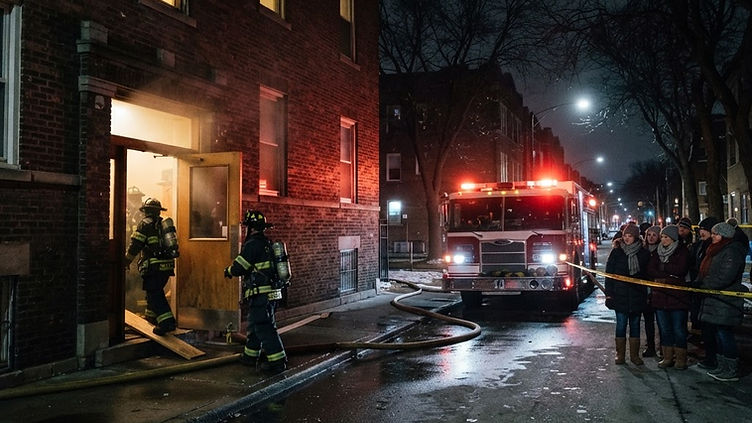
Firefighters were called overnight to an apartment building in the 600 block of West Washington Street after smoke filled the ground-floor entryway and residents began leaving their units on their own, and the fire they found was confined to a single kitchen.
One resident was taken to a hospital for smoke inhalation, WSBT 22 reported, and that resident is displaced along with the occupants of the affected unit while investigators assess the building. No damage estimate has been published, and nothing released so far states a cause.
The distance between those two facts, a kitchen fire that stayed inside one unit and a building that emptied anyway, is the useful part of the story for anyone responsible for a multifamily property. Smoke that collects in an entryway is smoke in the path people use to get out. It reaches a stair tower before it reaches a closed apartment door, and it leaves a residue that outlasts the fire by weeks.
What has been confirmed, and what has not
WSBT 22, the CBS affiliate in South Bend, reported that crews responded to the 600 block of West Washington Street after smoke filled the entryway of the apartment building, that firefighters extinguished a kitchen fire in one unit, that one resident was hospitalized for smoke inhalation and is displaced, and that investigators were assessing the building.
Not established in the public reporting: the cause, the number of units affected, whether the building's alarm system performed as designed, whether a sprinkler system activated if the building has one, and how long any portion of the building will be out of service. Those are open questions, and the difference between a question and a conclusion is what separates reporting from speculation. A fire under investigation is described as under investigation until an authority closes it, and a finding that a required system failed or a code was violated belongs to the fire department, the state fire marshal or a court.
The incident also demonstrates a pattern that readers of this newsroom will recognize: the fire is often the shortest part of the event. The building's recovery, its protection status and its occupancy are the parts that run for weeks.
The entryway does the most work in a small apartment building
In a three- or four-story apartment building, the lobby and the single stair rising out of it carry two jobs at once. They are the way in, and they are the only way out. When smoke fills that space, egress capacity falls toward zero without fire ever entering a corridor.
Smoke behaves predictably in that geometry. A kitchen fire produces a large volume of hot gas in a short time. Once that gas leaves the unit and enters a common space it cools, expands and stratifies, filling the upper part of the lobby and then the stairwell and descending. A heated building in November adds a stack effect that draws smoke upward from the entry, so a third-floor resident can have heavy smoke at the door before anyone on the ground floor sees flame.
That is why a fire confined to one kitchen forces an evacuation, and it is why the sequence after the fire matters more than the damage report. The units that did not burn were still exposed to smoke, and their occupants left at night, in cold weather, with what they were wearing.
Door control is the variable that usually decides how bad this gets. A self-closing unit door that latches holds smoke back long enough for a stair to stay usable. A door propped for a delivery, or a lobby door chocked open for a smoker, removes that protection in the one opening that serves every floor.
One kitchen fire, several displaced households
The unit that burned is one insurance claim. The building is a set of them. Smoke residue reaches inside cabinets, into wall cavities by way of outlet boxes and into HVAC returns, and the odor returns on the first warm day if the cleaning was not done properly. In multifamily restoration, the file usually covers the burned unit, the units above and beside it, the common lobby and corridor, and any shared mechanical equipment the smoke passed through.
Where a resident has been hospitalized, the unit stays sealed or supervised until the fire department releases it and the property's insurer or restoration contractor takes possession of the contents. That is where a building's security exposure appears: an apartment standing open with a resident's belongings inside, a lobby door propped for drying equipment, contractors moving in and out all day, and crews working after hours. None of that is a fire problem. It is an access-control problem that the fire created.
Residents who are displaced need a way to retrieve medication, documents and keys without the property losing track of who entered which unit. That is a log and a staffed post, not a policy.
Three tasks that begin after the trucks leave
The first is alarm verification. A building that evacuated has a history, and the fire alarm panel holds it. NFPA 72, the National Fire Alarm and Signaling Code, requires inspection, testing and maintenance on a documented schedule, and an activation is the moment a property learns what actually operated: which initiating devices reported, which notification appliances sounded, whether the signal reached the supervising station and whether the panel's event log confirms the sequence. Detectors exposed to smoke require cleaning or replacement under manufacturer instructions after a fire event, and a device soaked with soot can pass a functional test and still fail the next real event.
Second is protection-system status. If the responding companies shut a control valve or drained part of a sprinkler system, or if detection was taken offline to keep equipment out of water, the building is operating without part of its designed protection until the work is finished and the system is tested. Section 901.7 of the International Fire Code addresses precisely this condition: the fire code official is to be notified when a required fire protection system is out of service, and where the system cannot be restored, a fire watch is required. Indiana adopts the International Fire Code through its Fire Prevention and Building Safety Commission, and the South Bend Fire Department enforces it locally, which means the determination for this building belongs to that department rather than to the property's contractor.
Third is occupancy management. A building with displaced households and open units needs someone accountable for who is inside it at any hour. That is a staffing question before it is a policy question.
What Indiana's code path means for this property
Indiana's fire code is adopted at state level and applied locally. For a property facing repair work, the sequence is the one written into the adopted code and into the property's own protection program: notify the authority having jurisdiction, tag and record any impairment, provide interim protection, then test to restore.
Water-based systems follow NFPA 25 Chapter 15 when impaired, which calls for an impairment coordinator, notification of the fire department, interim protection and a restoration test with documentation. In a building of this type that paperwork is what the insurer, the lender and any future buyer will ask for, and it is also what the fire department asks for if it returns to check.
An investigation changes the timetable. While a fire is under investigation, areas may be held, evidence preserved and access restricted until the department releases the scene. The property should plan its repair schedule to move around that hold.
Related coverage
The pattern repeats across this beat. In Providence, an apartment fire took the breaker panels and the smoke detectors with it, leaving a multifamily building without the systems a nighttime evacuation depends on (read that report). In Fort Lauderdale, a storage-area fire on East Las Olas Boulevard damaged monitoring circuits, and the businesses could not reopen without a person on patrol (that story is here). In Orlando, a condemned building on Rio Grande Avenue turned a fire into a perimeter problem (previously reported).
Coverage for South Bend properties
A South Bend property in this position, with an impaired alarm or sprinkler system, a fire marshal's order, or a building that cannot be fully occupied while repairs proceed, can review what documented coverage involves on the South Bend fire watch page and on the national emergency fire watch page. The technical basis for the requirement, including the difference between a watch ordered by an authority and one an owner adopts voluntarily, is set out in the fire watch white paper.
Nothing in that material implies USPA responded to or was retained for this incident. It was not.
What to watch in the next 72 hours
Three things will decide how this story develops. The first is the department's cause determination. The second is the documented condition of the building's alarm and suppression systems, as recorded rather than as assumed. The third is whether the property restores protection before it reopens units.
The first will appear in the public record. The second is a document the property controls. The third determines whether anyone is at risk in the building while the paperwork catches up.
WSBT 22's reporting is the primary account of this incident at this stage. This article will be updated if the department or the property releases information that changes the sequence above, and any update note will say what changed and when.
Services in South Bend, IN
Sources
- WSBT 22 (CBS South Bend) — initial report on the West Washington Street apartment fire
- City of South Bend, Indiana — municipal government and fire department information
- National Fire Protection Association — NFPA 72, National Fire Alarm and Signaling Code, and NFPA 25, water-based protection ITM
- U.S. Fire Administration — residential fire loss and smoke alarm research
About the reporter
Staff Writer
Staff writer for the USPA Nationwide Security newsroom. Receives newsroom tips, corrections and editorial inquiries.
Author biography and credentialsMore from The Watchline

Fire Protection
After three alarms on West Broad Street, the fight is over who enters a five-story building nobody may occupy
The three-alarm fire is out, but the five-story building on West Broad Street is still held: residents and businesses are out, and the terms of securing the property and letting people back in are the unresolved part.
· Albina Bieci

Fire Protection
Private hydrants at a Huntsville complex could not hold pressure, so crews ran hose to the street instead
Crews ran more than 100 feet of hose to street hydrants after the property's own hydrants could not hold pressure. Fifteen families are out, and the flow test that was never produced is the document that now matters most.
· Albina Bieci

Fire Protection
A roof fire at The Elements at Cedar Bluff displaced 17 residents and closed all fourteen units
The fire went through the roof of a 14-unit building at the Cedar Bluff complex, heavily damaging five units. Two assessments now decide whether nine other households can return, and the fire-protection one starts a clock.
· Albina Bieci
