
A Providence apartment fire took the breaker panels and the smoke detectors with it

By Albina Bieci, Staff Writer
Interior framing failed and utility service was cut to the block, which puts an emptied building back to the condition fire codes were written to prevent: no power, no detection, no occupants to notice.
PROVIDENCE
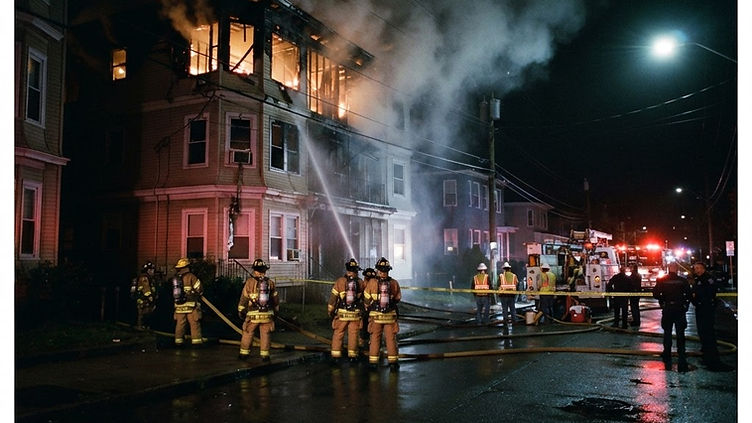
PROVIDENCE — Emergency crews rushed to a heavily involved fire in a multi-story Providence residential apartment block, where the incident caused immediate structural failure to portions of the interior framing and led to widespread utility cutoffs.
With the building's main breaker panels shut down and the hardwired smoke detection systems rendered useless, a dedicated foot-patrol fire watch must remain on site to handle fire monitoring and property security while utility contractors work through restoration.
That description sounds administrative. The condition it describes is not.
What was reported
The account published by WPRI 12 News describes a heavily involved fire in a multi-story residential block, partial structural failure of the interior framing and utility cutoffs across the area. Both of those facts matter more than they appear at first reading, and together they explain the assignment that follows.
Two systems failed at once
Ordinary fire protection in an occupied building is a chain. Detection senses the fire, the alarm tells the occupants, the occupants evacuate through protected exits, and the fire department is called. Remove the occupants as well as the detection, and the chain has no links left.
A building with its main breakers shut down and its hardwired detection dead is in exactly that position. It has no automatic notification, no power for anything that would provide it, and nobody inside to smell smoke. It also remains a building with contents in it, because tenants who left during a fire leave their possessions behind.
That is why the watch is a foot patrol rather than a camera or a call-out arrangement. Somebody has to be physically present in a dark building, at intervals, looking for the thing no system will report.
The framing failure is the part that limits everything else
The more serious finding in the account is the structural one. Interior framing that failed in a fire means load paths have changed, floors may not be carrying what they were designed to carry, and openings in the structure now lead into voids that are not visible from the room. Access to a portion of the building may be unsafe for anyone, including the fire department, until an engineer says otherwise.
For the watch, that changes the route rather than the duty. The patrol is scoped to the areas that can be safely walked, with the unsafe areas observed from the perimeter rather than entered. The log records the route as it was actually walked, because a route that no longer exists is not a route.
Utility restoration takes weeks, and the risk does not pause
Bringing electrical service back to a fire-damaged building is not a matter of throwing a breaker. The service has to be inspected, damaged wiring and panels replaced, and the work happens in a structure that is still being dried out and assessed. Detection has to be restored and tested before it can be relied on. That sequence is measured in weeks, and it runs alongside insurance adjustment, engineering reports and tenant relocation.
During that period the property is carrying a fire risk it cannot detect and a security exposure it cannot see. Contractors working in the building during the day introduce ignition sources and propped doors. Empty units invite entry. And a building with no alarms has nothing to tell anyone if either goes wrong.
What a foot patrol actually covers
A competent post on a building in this condition covers three things on every round. Fire: checking the areas where a rekindle or new ignition would present, watching for smoke, heat and the smells that precede them, and calling the fire department on the first credible sign. Security: confirming openings are secured, that nobody unauthorized is inside, and that contractor access during the day is accounted for. Condition: noting water, debris, damaged barriers and anything that has changed since the last shift, and getting it to the person responsible.
The documentation is not a formality. On a property where the detection system is out, the log is the evidence of the compensating measure, and it is the first thing an insurer, a fire inspector or a lawyer will ask for.
Who orders it and how long it lasts
The requirement generally comes from the local authority having jurisdiction, from a fire code that requires protection where a system is impaired, or from an insurer as a condition of coverage. It ends when service and detection are restored and accepted, not when the building looks dry.
USPA staffs emergency fire watch posts across Rhode Island and southern New England, with officers assigned to long-duration impaired-building assignments and coordinated with the contractors doing the restoration. Dispatch answers at any hour, and the company's regulatory knowledge base documents the reasoning behind how a post is scoped.
Why a camera cannot replace the round
Video is a useful record of what happened. It is a poor substitute for somebody being present, and the difference matters on a building whose detection is dead. A camera sees the corridor it is pointed at, in the spectrum it was specified for, at the resolution it was installed at, and only while its power and network hold. On a building with the mains shut down, that is not a safe assumption.
The round also does things a camera does not. It smells smoke before it sees it. It notices that a door is warm, that water is running where it should not be, that a contractor left a panel open, that the stairwell smells different from the last check. Those observations are not in a sensor's specification, and they are exactly what the assignment exists to catch.
The honest framing is that a fire watch is a compensating measure for a human risk, staffed by a human being. Replacing it with hardware is a substitution the authority having jurisdiction has not agreed to, and properties that attempt it usually find that out at the inspection.
Coordinating with the contractors doing the restoration
Restoration is the period when a damaged building is most likely to have a second incident. Contractors are working with temporary power, hot work equipment, solvents and adhesives, in a structure that has lost its detection and may have lost its water supply. Doors are propped for access. Extensions run across corridors. A panel is opened and left open.
The watch is the one party on site every day, and it should be used as such. That means a daily check of the contractor's own fire precautions, a log entry for hot work that is supposed to be permitted, and a named contact who can stop an unsafe practice without a negotiation. It also means the property's post orders describe construction access explicitly, because an officer improvising access rules in a building full of trades is being set up to fail.
What belongs in writing
Four documents carry this assignment. The order or directive that requires the watch, with its date and its source. The post orders, describing the route, the frequencies, the denied areas and the escalation contacts. The staffing schedule, showing who is on post at every hour of every day. And the log, kept in real time. Everything else is convenience. Those four are the record.
What residents need while the building is unavailable
A displaced household needs four things on the first day: somewhere to sleep, medication, identification, and a phone number that reaches a person. The building cannot supply the first three. It can supply the fourth, and the failure to do so is what turns a displaced tenant into an adversarial one.
The practical minimum is a published contact, staffed during stated hours, able to answer questions about access to units and about the timeline. Residents who can reach somebody do not call the city. Residents who cannot, do, and a property with an unmanaged tenant population finds itself in an enforcement conversation it did not need to have.
The question the property should be ready for
If the fire marshal, the insurer or a tenant's attorney asked this week who was in the building and when it was last walked, the answer has to be a name and a time. A building that has lost its power and its detection has lost the systems that used to answer that question. What replaces them is a person with a flashlight and a log, and the record has to be good enough to prove it.
Sources
About the reporter
Staff Writer
Staff writer for the USPA Nationwide Security newsroom. Receives newsroom tips, corrections and editorial inquiries.
Author biography and credentialsMore from The Watchline

Fire Protection
A storage-area fire on East Las Olas Boulevard damaged the monitoring circuits, and the businesses cannot reopen without a person on patrol
Contained fire damage and a dead alarm circuit are not the same problem. The second one keeps storefronts shut until a human being is walking the building.
· Albina Bieci

Fire Protection
A four-alarm fire on West 107th Street took the roof of a Manhattan walk-up, and the building is now a long operation
A partial roof collapse and gutted units end the residential use of the building and begin a forensic and clearing phase that has to be secured while the structure is still failing.
· Albina Bieci

Fire Protection
Orlando condemned the building on Rio Grande Avenue. What follows is a perimeter problem, not a fire problem
A fast fire took the roof and the second-floor platforms, inspectors condemned the complex, and the ordinance that follows requires round-the-clock security of an emptied building.
· Albina Bieci