
Five fires in five states, and five buildings that can no longer detect the next one

By Albina Bieci, Staff Writer
Apartment and commercial fires in Union Township, Pennsylvania; Union, New Jersey; Los Angeles; Cherokee County, Georgia and Hopkinsville, Kentucky left collapsed truss roofs, breached firewalls and damaged detection, the condition fire codes answer with a staffed fire watch.
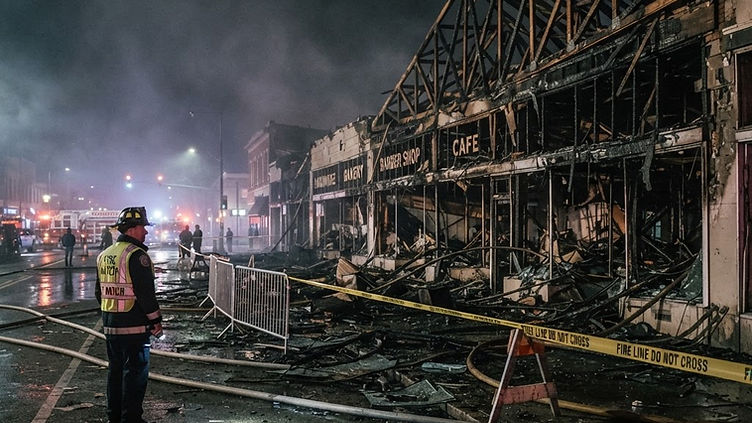
UNION, N.J.
Five structure fires were reported in five states between Monday night and Tuesday morning, and in every case the fire was the shortest part of the incident. Crews put each one out. What is left behind is a building that is still standing, still holding apartments, inventory or equipment, and no longer able to detect a fire or put one out on its own.
That condition has a name in the fire codes and a response in the fire service: a fire watch, staffed by people whose only job is to find the next fire before it becomes the second incident of the week.
The five, as reported:
- Union Township, Pennsylvania. An early morning fire destroyed the eight-unit Parkstown apartment complex and its on-site office. Seven tenants were displaced and one was taken to a hospital.
- Union, New Jersey. A multi-alarm fire tore through a block-long commercial strip on Stuyvesant Avenue, causing a partial bowstring truss roof collapse and heavy damage to seven businesses, including the 91-year-old Conca D'Oro Italian Pastry Shop and Barangay Grill.
- Los Angeles, California. Roughly 150 firefighters responded to a major emergency fire that burned through the roof of a 150-by-100-foot commercial building row on South San Julian Street.
- Cherokee County, Georgia. An overheated bathroom exhaust fan ignited a fire inside an unoccupied unit of a multi-unit apartment complex.
- Hopkinsville, Kentucky. An exterior mulch fire at an Arby's on Fort Campbell Boulevard worked into the building's wall and reached concealed spaces, sending smoke through interior electrical outlets.
Union, New Jersey: a truss roof that fails without warning
A bowstring truss roof is the reason fire departments treat a commercial strip fire as an operational problem that continues after the fire is out. The truss is a set of curved top chords and straight bottom chords joined by metal gusset plates, and it carries the roof over a wide span with no interior columns. It also fails suddenly, often within minutes of a fire reaching the attic, and often without the sag or crack that would warn a crew working inside.
The fire on Stuyvesant Avenue took multiple alarms and collapsed part of that roof over seven businesses. Firewalls between the units were breached, which means the separations that are supposed to stop a fire from travelling the length of a block no longer do. Utilities were severed.
For the owners of those seven businesses, the practical sequence is now: the fire department releases the scene, an investigator finishes cause and origin work, the insurance adjuster arrives, and a contractor begins debris removal. Every one of those steps happens inside a building with an open roof, no power, no detection and no suppression. That is the window a fire watch occupies, and it is why a fire watch is usually the first vendor on site and the last to leave.
The 91-year-old pastry shop at the center of the strip adds a second problem that does not appear on a fire report. A business that old holds records, equipment and inventory that the owner will want to recover, and every recovery visit is an entry into a structure the fire department has already declared unsafe. Escorted access is part of the job, not an exception to it.
Los Angeles: textiles, overhaul and the flare-ups that follow
The South San Julian Street fire drew about 150 firefighters to a 150-by-100-foot row of commercial buildings. Fire burned through the roof.
The detail that matters for the days after is the contents. Large volumes of textile material smolder rather than burn cleanly, and smoldering material inside a collapsed or opened structure can reignite hours later, sometimes after crews have cleared the scene. Los Angeles fire officials noted the volume of smoldering textiles and the overhaul work it requires, which is the technical description of a long monitoring job rather than a short one.
A commercial building full of textiles after a roof fire is also a building with a compromised floor, charred structural members and no lighting. Anyone walking it, whether an adjuster, an owner or a salvage crew, is doing so under conditions the fire department will not certify as safe. A watch keeps the building under observation and keeps unauthorized people out of it.
Union Township, Pennsylvania: connected units, shared voids
The Parkstown complex fire destroyed eight connected units and the complex office in the early morning hours. Seven residents lost their homes and one tenant was hospitalized.
Connected multi-family construction is the hardest residential case to clear. Units share attics, cocklofts, plumbing chases and wall cavities, so fire that appears out in one unit can still be moving inside a void above the next. A destroyed unit is also an open unit: with a roof or a wall gone, the building has a permanent opening to the weather and to anyone who wants to walk in.
Displacement adds a second problem. Seven households are now moving through a property that has no lighting, no alarm system and debris in the walkways, while the owner and the insurer work out what happens next. A staffed post handles both halves of that: patrols of the standing structure, and control of who enters the site.
Cherokee County, Georgia: a contained fire in a building nobody was watching
The Cherokee County fire started when an overheated bathroom exhaust fan ignited material in an unoccupied unit. Crews contained it quickly after responding to smoke reports.
Quick containment is the good outcome. The condition it leaves is the one that gets missed: an unoccupied multi-family building where a small electrical fire has produced smoke throughout a unit and possibly into the building's shared systems. Alarm devices and ventilation equipment exposed to heat and smoke are supposed to be inspected and cleared before the building returns to service, and until that happens the building's ability to announce a fire is an open question.
An unoccupied building is also the building where a fire gets the longest head start, because there is nobody inside to smell smoke. Where a property is between tenants, under renovation, or sitting vacant pending a sale, the fire watch is often the only thing on site that can report anything at all.
Hopkinsville, Kentucky: fire inside the wall
Three fire stations responded to the Arby's on Fort Campbell Boulevard after an exterior mulch fire spread into the building's wall. Smoke came out of interior electrical outlets, which is the clearest possible sign that fire was travelling inside a concealed space.
Concealed-space fires are notorious for re-ignition. A wall cavity is a chimney with no windows, and a fire inside it can be wet down, opened, wet down again and still come back hours later when a hot member finds fuel. The electrical system in that wall is now suspect as well, which means the building's detection and lighting may be out along with the branch circuits that feed them.
Overnight coverage is the standard answer at a restaurant: the building is closed, the staff are gone, and the fire service is not going to leave a smoldering wall unobserved.
What the codes actually require
The requirement is not a suggestion written by an insurer. Where the International Fire Code is adopted, section 901.7 requires that where a required fire protection system is out of service, the fire department be notified and, where the authority having jurisdiction directs, a fire watch be provided. NFPA 1 carries the same requirement in its own numbering. The watch is conducted by trained personnel, and the code language describes what they do: patrol the area, maintain a record, and be equipped to notify the fire department and to control a small fire without placing themselves at risk.
NFPA 601, the standard for security services in fire loss prevention, is the practice document for what a watch looks like on a shift: the patrol route, the frequency, the log entries, the escalation path and the interface with the fire department.
Three things follow from those documents. A watch is staffed by people, not by a camera or an alarm, because a system that has already failed once cannot be the system that reports the next fire. It is documented, because the log is the evidence the owner, the insurer and the authority having jurisdiction will read. And it is scoped by the building, not by the hour, which is why the cost of a watch is set by the size of the structure, the number of access points and the number of shifts required, not by a single flat rate.
What the next thirty days look like at these five sites
At the New Jersey strip, the sequence runs from a controlled demolition of the remaining truss roof to debris removal to a rebuild, with the site under watch and access control throughout.
In Los Angeles, the building row is an overhaul and salvage problem: the owner, the tenants and the adjusters all need access to a structure that is not safe to enter unescorted.
In Union Township, the property is a demolition and rebuild with seven displaced households and an insurer to satisfy, and the standing portion of the building is open.
In Cherokee County, the question is a certification question: until the alarm and ventilation systems are inspected and cleared, the building needs eyes.
In Hopkinsville, the restaurant needs overnight coverage until the wall assembly and the electrical system are opened, repaired and returned to service.
None of those five situations is unusual, and that is the point. Fire watch is not a rare service that appears after a disaster. It is the ordinary consequence of a fire in a building that people still need to use, and it begins as soon as the fire department leaves.
Owners and property managers who need coverage on a site tonight can reach the dispatch desk around the clock at 1-800-214-1448. The operating standard behind those deployments, including the patrol and documentation requirements, is published in the fire watch white paper, and the national deployment capability is described on the emergency fire watch page.
Reference and services
Knowledge base
NFPA 25 Impairment Protocols (2026): Fire Watch, the Ten-Hour Framework and System Restoration
National reference · 23 pages, citation registry attached
Read the volumeService
Fire watch services
How USPA staffs this work, with the coverage, licensing and dispatch terms for the assignment.
See the serviceSources
About the reporter
Staff Writer
Staff writer for the USPA Nationwide Security newsroom. Receives newsroom tips, corrections and editorial inquiries.
Author biography and credentialsMore from The Watchline

Fire Protection
Seven structure fires in one news cycle, and seven buildings that can no longer detect one
Apartment and rowhouse fires in Houston, Waikiki, Walnut Creek, Everett, Lawrence County, Kansas City and Allentown left occupied buildings with damaged suppression, severed utilities and open structures, the exact condition fire codes answer with a staffed fire watch.
· Albina Bieci

Fire Protection
Largo apartment fire displaces 75 and leaves a four-story building on watch
A two-alarm fire ran through the roof of a four-story building on Steeplechase Way and forced more than 30 families out. The roof is the repair; the systems left offline underneath it are the reason a fire watch is now the property manager's problem.
· Albina Bieci


Fire Protection
Chicago fire watch, documented: the 2026 interim code and the Title 15 fireguard rules
USPA Nationwide Security published a 40-chapter volume on Chicago fire watch and special fireguard practice, built on Title 14F's 2026 interim adoption of the 2024 IFC and the Title 15 exhibition articles, with 34 primary sources and a Nov. 22 cutoff.
· Albina Bieci