
Largo apartment fire displaces 75 and leaves a four-story building on watch

By Albina Bieci, Staff Writer
A two-alarm fire ran through the roof of a four-story building on Steeplechase Way and forced more than 30 families out. The roof is the repair; the systems left offline underneath it are the reason a fire watch is now the property manager's problem.
LARGO, Md.
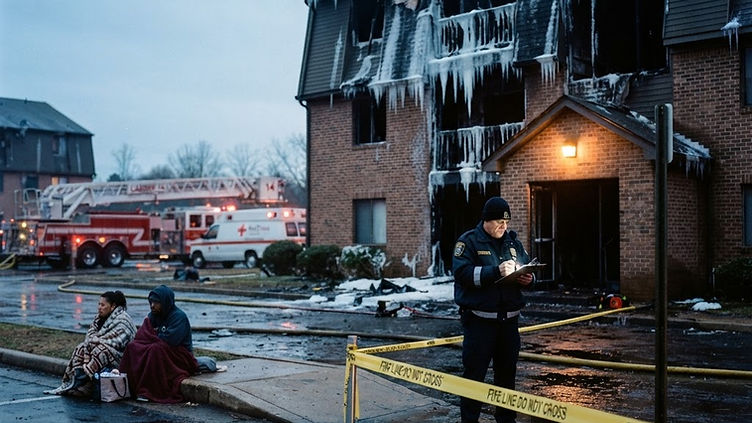
More than 75 people from at least 30 families were displaced after a two-alarm fire tore through the roof of a four-story apartment building on Steeplechase Way in Largo early Sunday, WUSA9 reported. One person was taken to a hospital for evaluation.
Prince George's County Fire/EMS Department crews were dispatched to the 100 block of Steeplechase Way at about 3:52 a.m. for a reported structure fire, and a second alarm was sounded, according to the department. The fire reached the roof assembly of a multi-family building, and that detail decides how long the address stays out of service.
The department has not released a cause, a damage estimate, or a count of the units unfit for occupancy. WUSA9 reported that more than 30 families, and more than 75 people in total, were forced out of their homes.
What is known
- Fire in a four-story multi-family apartment building on Steeplechase Way, Largo, Prince George's County, Maryland.
- Prince George's County Fire/EMS dispatched at about 3:52 a.m. Sunday; second alarm sounded.
- Fire ran through the roof of the building.
- More than 30 families, more than 75 people, displaced.
- One person transported for evaluation.
- Cause, damage estimate and unit count not released.
The roof is the part that outlasts the fire
A fire that reaches the roof of a four-story building has usually been burning long enough to open the attic and the top-floor units. Putting it out leaves an address with charred roof framing, water in the ceilings below, and openings that were windows a few hours earlier. None of that clears quickly.
The building systems that fail alongside the roof are the ones residents who stay depend on. Suppression lines in a burned wing are shut for overhaul. Alarm circuits in damaged areas are interrupted. Electrical service to the affected units is disconnected for safety, and in many multi-unit buildings the smoke alarms in those units draw their primary power from that same service. Each of those is a required fire protection system that is now out of service in a building that is still partly occupied.
Maryland adopts the International Fire Code statewide through COMAR 29.06.01, with local amendments, and Prince George's County Fire/EMS is the authority having jurisdiction at this address. Under the model fire code the state adopts, IFC Section 901.7, the owner must notify the fire code official when a required fire protection system is out of service and provide an approved fire watch until it is restored. Whether the watch is required, for which hours, and over which portions of the building is the fire code official's call, not the property manager's.
Two jobs now sit at one address
A fire watch is a documented patrol, not a guard at a door. The person on post walks a defined route at a defined interval through the occupied portions of the building, checks that means of egress are clear and that nothing new is burning, and records the round in a log that the fire department can read. If smoke or fire is found, the response is notification and evacuation, not investigation.
Site security is the second job, and it is separate. Dozens of units are now unoccupied and full of residents' belongings. Burned and water-damaged units are open to the weather and to anyone walking the property. Board-up on the damaged openings, one controlled point of entry, and a post that can say who belongs in the building are what keep a fire loss from becoming a theft loss and a second fire.
The two functions can be performed by the same contract, but they are not the same task, and the log for one does not substitute for the other. Emergency fire watch is staffed for the first; site security is scoped to the property.
What property management should confirm today
- Written notice of the impairment to the Prince George's County Fire/EMS fire marshal, with the systems affected and the expected restoration date.
- The fire code official's determination on the watch: hours, coverage area, and whether the occupied wings require continuous staffing.
- A fire watch log that records each round, by time and location, and is available to the department on request.
- Board-up or secure closure of every opening created by the fire, with a single controlled entrance for the building.
- A contact chain that reaches the property manager and the fire department without going through a call center.
- Photographs and records of the security measures taken, for the insurance file and for the authority having jurisdiction.
The displaced families are the immediate concern, and the county and relief organizations are handling that response. The building itself is the longer problem. A fire watch in Prince George's County runs until the suppression and alarm systems are back in service, and that date is set by the fire marshal and the repair contractor, not by the property.
USPA Nationwide Security provides fire watch and site security in Maryland and the Washington metropolitan area, including Washington, D.C. and Baltimore. The company publishes The Watchline and maintains a Fire Watch Regulatory Knowledge Base of jurisdiction-specific code references.
Reference and services
Knowledge base
NFPA 25 Impairment Protocols (2026): Fire Watch, the Ten-Hour Framework and System Restoration
National reference · 23 pages, citation registry attached
Read the volumeService
Fire watch services
How USPA staffs this work, with the coverage, licensing and dispatch terms for the assignment.
See the serviceSources
About the reporter
Staff Writer
Staff writer for the USPA Nationwide Security newsroom. Receives newsroom tips, corrections and editorial inquiries.
Author biography and credentialsMore from The Watchline


Fire Protection
Chicago fire watch, documented: the 2026 interim code and the Title 15 fireguard rules
USPA Nationwide Security published a 40-chapter volume on Chicago fire watch and special fireguard practice, built on Title 14F's 2026 interim adoption of the 2024 IFC and the Title 15 exhibition articles, with 34 primary sources and a Nov. 22 cutoff.
· Albina Bieci


Fire Protection
Murfreesboro cut power to three units after a Manor Drive fire, and hardwired detection went with it
Flames broke through an apartment window and damaged four units on Manor Drive. Utility crews disconnected power to three of them, which is the detail that matters for the tenants still living in the building.
· Albina Bieci


Fire Protection
A zero-visibility fire in a seven-unit Johnston building displaced residents, and the alarm panel is the next question
Johnston-Grimes firefighters searched a seven-unit apartment building on NW 62nd Avenue with smoke down to the floor. Everyone got out, several residents are displaced, and what happens to the building's detection is what decides whether a fire watch follows.
· Albina Bieci