
Seven structure fires in one news cycle, and seven buildings that can no longer detect one

By Albina Bieci, Staff Writer
Apartment and rowhouse fires in Houston, Waikiki, Walnut Creek, Everett, Lawrence County, Kansas City and Allentown left occupied buildings with damaged suppression, severed utilities and open structures, the exact condition fire codes answer with a staffed fire watch.
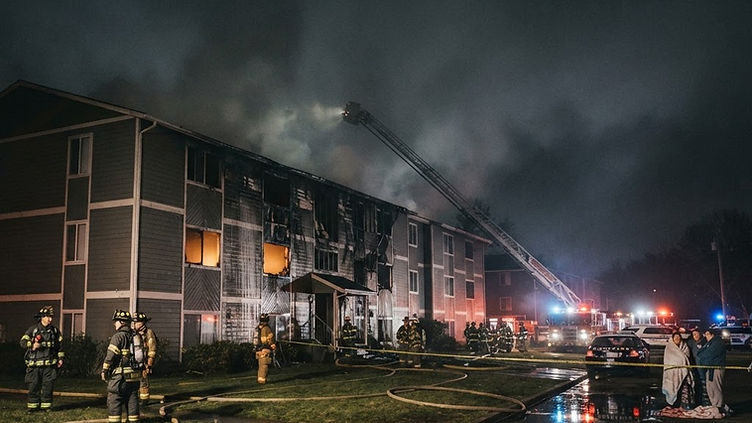
HOUSTON, Texas
Seven structure fires were reported in seven jurisdictions between Sunday night and Tuesday morning, and the fires are the shortest part of the story. Each of the buildings that burned is now a structure with damaged detection, damaged suppression, or no utility service at all. That is the condition the fire codes treat as an emergency of its own, and it is the reason fire watch exists as a separate, staffed function rather than a line item in a restoration schedule.
The seven, as reported:
- West Houston, Texas. A two-alarm fire late Monday night into early Tuesday damaged multiple units at the Verano Apartments on S. Dairy Ashford Road. Residents evacuated with few belongings. Arson investigators opened a probe.
- Waikiki, Hawaii. Honolulu Fire Department crews extinguished a 16th-floor fire in a residential high-rise on Seaside Avenue. Sprinklers controlled the flames and then discharged water through multiple floors, displacing residents.
- Walnut Creek, California. A suspected explosion triggered a three-alarm fire in a multi-unit building inside the Rossmoor 55-plus retirement community, injuring at least one resident and causing severe structural and roof damage across four top-floor units.
- Everett, Pennsylvania. Eight regional fire companies fought a two-alarm fire through a row of apartments on North Hopewell Street. Charred structural remains are all that is left of several units, and the American Red Cross is assisting displaced tenants.
- Union Township, Lawrence County, Pennsylvania. A multi-unit apartment fire forced residents out and left multiple units uninhabitable.
- Kansas City, Missouri. Crews contained a fire burning inside the exterior wall of a two-story apartment building on Troost Avenue after full building searches and evacuations.
- Allentown, Pennsylvania. A five-alarm fire on Tilghman Street severely damaged seven attached rowhomes, collapsed roofs and displaced 26 residents. City officials and federal ATF investigators are still working the scene, and gas and electric service remains disconnected.
Seven different causes, at least four different construction types, one shared consequence: multifamily buildings that cannot currently detect or suppress a fire on their own.
Houston: a two-alarm fire that is also an active investigation
The Verano Apartments fire on S. Dairy Ashford Road burned from late Monday into early Tuesday and took two alarms to bring under control. That the cause is under investigation by arson investigators changes the building's status in a way residents may not anticipate. A structure with an undetermined cause is a scene. Access has to be controlled for evidentiary reasons before it is controlled for safety reasons, and the two priorities do not always point the same direction.
For the owner, the practical sequence is fixed. The fire department releases the building once its work is done. The insurance carrier and the investigators may not be done with it. Occupants want their belongings. Contractors want to start mitigation. In a building whose alarm panel is dark and whose corridors may be open to the weather, none of that traffic can be left unsupervised without turning a fire loss into a second incident.
West Houston is a dense, low-rise multifamily market where wood-frame and light-steel apartment buildings sit close together. The buildings that survive a fire next to one that burned are the ones that now need watching, because the exposure that threatened them once has not gone away. It has only stopped being visible.
Waikiki: the sprinkler worked, and the tower is still impaired
The Seaside Avenue fire is the case that most often gets misread. The sprinkler system did its job. It controlled a 16th-floor fire before it spread, and the building's occupants are alive because of it. Then the same water that saved the building ran down through multiple floors, and now the tower has a partial impairment: heads that fused and must be replaced, piping that may have shifted, alarm circuits that took water, and residents in units that are not habitable.
A high-rise with an impaired sprinkler zone is not a high-rise with a smaller problem. It is a building whose fire protection strategy has changed without anyone announcing it. In a tower of that height, the strategy depends on automatic suppression, compartmentation and a functioning alarm, in that order. Take the first one offline on several floors and the only remaining detection is a person walking a corridor.
Replacing sprinkler heads and returning a zone to service is not a one-day job. The heads have to match the original specification, the piping has to be inspected, and the system has to be tested and returned to service under a documented impairment program. Until that happens, the floors involved are on watch, and the occupants of a building that just proved its system works are the ones most likely to assume it still does.
Walnut Creek: an explosion, four top-floor units, and a population that cannot self-evacuate quickly
The Rossmoor fire began with what authorities describe as a suspected explosion, which is a different failure mode from a fire that starts and grows. An explosion removes structure before it removes anything else. Four top-floor units and the roof took severe damage, and at least one resident was injured.
Two facts make this building a fire watch case rather than a restoration case. The first is structural: a roof and top-floor assembly damaged by overpressure has to be evaluated before anyone works under it, and until it is, the building's ability to contain a fire on the floors below is unknown. The second is demographic. Rossmoor is a 55-plus community, and a significant share of its residents need assistance to evacuate, use mobility devices, or sleep through an alarm that a younger occupant would wake to. When a building's occupants cannot self-evacuate on the timeline the code assumes, the human detection layer has to be staffed rather than assumed.
That means continuous coverage, not periodic checks. It means someone physically present overnight, on the floors that remain occupied, with the authority to wake people and the means to call the fire department directly.
Everett: a row of apartments, eight companies, and party walls that carry fire
Eight regional fire companies and two alarms is a lot of resources for a row of apartments, and the number tells you what the building was. Attached rowhouse construction shares walls, and in older stock those walls are often not the fire-rated assemblies a modern code requires. Fire enters a cockloft or an attic and travels horizontally through the row without ever crossing a floor the crews can see.
The result in Everett is the predictable one: several units destroyed, structural remains unsafe to enter, tenants displaced and dependent on the Red Cross for housing. The building's remaining units are now adjacent to an open, charred structure with exposed framing, no working detection, and a debris field that will hold heat for days.
Two risks govern the site. Rekindle is the first. A fire that burned in a cockloft can sit in concealed insulation or charred framing and return hours or days later, and the only reliable detection is a person with a thermal imager walking the structure on a documented schedule. Security is the second. A vacant, open, partially burned multifamily building in a residential neighborhood is a target for entry, theft of remaining tenant property, and, in a building with an undetermined cause, for a second fire.
Lawrence County: the smaller fire with the same obligations
The Union Township fire will not generate a fraction of the coverage the others did. It displaced fewer people, and it was controlled faster. The obligation it creates is identical. Multiple units are uninhabitable, utilities are severed in parts of the building, and the fire walls that separated units have been breached by the fire or by the work of extinguishing it.
A multifamily building with severed utilities and compromised separations is a building where a fire starting in one unit has a shorter path to the next one. Guard coverage in that condition is not about guarding property. It is about the fact that no one is inside the building at night whose job is to notice smoke.
Kansas City: the fire inside the wall
The Troost Avenue fire is the most instructive of the seven from an engineering standpoint, because it burned inside an exterior wall of a two-story apartment building and was only found by crews conducting full searches and evacuations. A concealed cavity fire is difficult to reach, difficult to confirm as extinguished, and difficult to monitor afterward. It travels vertically in a wall cavity and can enter an attic or a floor assembly.
Extinguishing it usually requires opening the wall, and opening the wall means breaching a fire-rated assembly that was doing work. Once the assembly is breached, the building has a new horizontal or vertical path for fire and smoke that did not exist before the incident, and it stays open until repairs are complete.
Concealed fires are the strongest argument for thermal imaging in post-incident monitoring. A guard walking a hallway with a flashlight cannot see heat in a wall. A guard with an imager, working a documented route and logging readings, can.
Allentown: five alarms, seven rowhomes, 26 displaced
The Tilghman Street fire is the largest of the seven and the one with the longest tail. Five alarms, seven attached rowhomes severely damaged, roofs collapsed, 26 residents displaced, and a scene now shared by city officials and federal ATF investigators while gas and electric service remains disconnected.
Attached rowhomes present the worst combination for post-fire security: a large open structure with multiple points of entry, shared walls that are now the only separation between a burned unit and an occupied one, no utilities, and a perimeter that has to be maintained for an investigation. The residents who remain in the adjacent homes are living next to a building that can no longer contain a fire, and their own detection systems may have been affected by the same utility disconnection.
That is a fire watch assignment measured in weeks, not shifts. It ends when suppression and detection are restored and the AHJ is satisfied, not when the news trucks leave.
What a fire watch actually is
The International Fire Code, in section 901.7, requires a fire watch when a fire protection system is out of service, and it requires the owner to notify the fire code official. The code language is short and the operational meaning is not. The requirement exists because a building's life safety design assumes detection and suppression work. When they do not, the code substitutes people for systems.
NFPA 1 and NFPA 601 describe what those people do. A fire watch patrols the affected areas on a defined interval, maintains a record of each round, keeps extinguishing equipment available, knows how to transmit an alarm without relying on the building's alarm system, and is trained in what to do when they find fire. The distinction between a fire watch and a security guard posted in a lobby is exactly that set of duties. A guard who watches a door is not a fire watch. A fire watch walks the impaired zones, on a schedule, and writes it down.
For buildings with hot work underway during restoration, the requirement stacks. Cutting, grinding and soldering in a fire-damaged structure is a separate permit and a separate watch, and the person holding the extinguisher at the work site cannot be the same person patrolling the impaired floors.
Why the owner carries this, not the fire department
The fire department leaves. That is the whole point. Once command releases a building, the obligation to maintain life safety transfers back to the owner, and the AHJ retains the authority to order a fire watch and to enforce it. Insurance carriers write the same requirement into property policies, often with specific patrol documentation expectations.
For the seven buildings above, the practical calendar runs like this: structural evaluation, scene release, utility restoration, alarm and sprinkler repair, testing, and finally the return of the building to the protection it had before. Fire watch covers the gap between the fire and that final test. It is not a precaution taken while waiting. It is the code-mandated substitute for the systems that are down.
The security layer after the fire
Fire losses in occupied buildings have a second phase that rarely makes the news. A building that is half vacant, half occupied, open to the weather and lit by temporary power attracts people who are not residents. Copper, tools, appliances and personal property move out. In an undetermined-cause fire, the same access makes a second fire easier.
That is why the two functions are usually delivered together on a building of this size: a fire watch that owns detection and a security posture that owns access. One guard cannot do both well, and the code does not ask them to.
Owners in any of these markets who need coverage now can reach the emergency fire watch desk, and the national fire watch service page describes patrol documentation, response windows and the assignment process. Market pages for the cities in this report are listed below.
What to expect in the next thirty days
Residents of the Waikiki tower will return to floors whose sprinkler zones were restored, and will not be told which ones were not. Tenants in Everett and Allentown will wait on structural evaluations before they are allowed to retrieve anything. The Houston investigation will either name a cause or remain open, and the building will sit behind a fence in either case. Kansas City will close a wall.
In each case, the building is protected by people until it can protect itself again. That is the only part of these seven stories that is still under someone's control.
Services in Houston, TX
Reference and services
Sources
About the reporter
Staff Writer
Staff writer for the USPA Nationwide Security newsroom. Receives newsroom tips, corrections and editorial inquiries.
Author biography and credentialsMore from The Watchline

Fire Protection
Largo apartment fire displaces 75 and leaves a four-story building on watch
A two-alarm fire ran through the roof of a four-story building on Steeplechase Way and forced more than 30 families out. The roof is the repair; the systems left offline underneath it are the reason a fire watch is now the property manager's problem.
· Albina Bieci


Fire Protection
Chicago fire watch, documented: the 2026 interim code and the Title 15 fireguard rules
USPA Nationwide Security published a 40-chapter volume on Chicago fire watch and special fireguard practice, built on Title 14F's 2026 interim adoption of the 2024 IFC and the Title 15 exhibition articles, with 34 primary sources and a Nov. 22 cutoff.
· Albina Bieci


Fire Protection
Murfreesboro cut power to three units after a Manor Drive fire, and hardwired detection went with it
Flames broke through an apartment window and damaged four units on Manor Drive. Utility crews disconnected power to three of them, which is the detail that matters for the tenants still living in the building.
· Albina Bieci