
Four more multi-family fires, and four addresses that will not be habitable by Christmas

By Albina Bieci, Staff Writer
Townhome and apartment fires in Woodbridge, New Jersey; Montpelier, Vermont; Kenmore, Washington and Scranton, Pennsylvania put 39 people out of their homes and left shared attics open, detection disconnected and one building condemned.
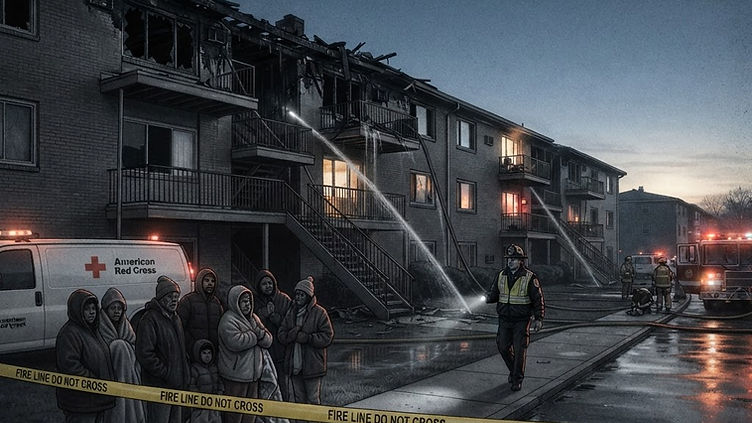
WOODBRIDGE, N.J.
Four multi-family fires were reported in four states between Sunday and Tuesday, and each one ended the same way: a building still partly standing, partly open to the weather, with the systems that detect and suppress fire no longer working in the part residents still need to use.
The four, as reported:
- Woodbridge, New Jersey. A multi-unit fire tore through three connected apartments at Maple Hill Townhomes just after 8:00 a.m. Tuesday, displacing 31 people from eight families.
- Montpelier, Vermont. Mutual aid crews from five surrounding towns fought an afternoon blaze at an apartment complex on Cummings Street, where limited municipal hydrant capacity complicated suppression. One resident was reported unaccounted for.
- Kenmore, Washington. A top-floor apartment fire on 61st Avenue NE extended behind cabinets into the building's shared wall and attic spaces. Eight residents were displaced and overhaul required extensive opening of concealed framing.
- Scranton, Pennsylvania. An attic fire on East Elm Street spread down into the second floor and left severe water damage on the first. City fire officials condemned the building.
Two of the four are attached residential construction, one is a converted multi-family building with a common attic, and one is a townhome row. The construction type changes the tactics. It does not change the condition that follows: shared voids that can hold fire, water in assemblies that were never designed to be wet, and detection that is either disconnected or no longer trustworthy.
Woodbridge: three units burned, five more are wet
Maple Hill Townhomes is attached construction, which means the fire that took three apartments also took the attics and utility infrastructure those apartments shared with their neighbors.
That is the part property managers underestimate. Units that did not burn are frequently uninhabitable anyway. Suppression water runs down through ceiling assemblies and into the units below. Attic spaces that were opened for overhaul are now open to the weather. Fire detection that was tied to a shared system is either interrupted or has been exposed to heat and smoke and cannot be certified until it is inspected.
Thirty-one people from eight families are out of their homes. The building's remaining units are the ones that need watching: a shared attic is a path, and a disconnected alarm in a neighboring unit is the reason a small fire in an empty apartment becomes a second incident.
Montpelier: when the water supply is the constraint
The Cummings Street fire required mutual aid from five surrounding towns, and the reason is the one that matters for every older Vermont village center: municipal hydrant capacity. A water system sized for a small city core cannot feed the fire flow that a fully involved apartment building demands, so the response becomes a tanker operation, and a tanker operation takes time.
Time is what a fire uses. Crews contained the blaze, and the complex still took heavy structural damage. One resident was reported unaccounted for, which changes the building's status again: the scene is now a Vermont state fire marshal investigation, and a scene under investigation is a scene with a controlled entry list.
That produces two requirements that run in parallel. The first is scene preservation: nobody walks the structure except the investigator and the people the investigator admits, and every entry is logged. The second is hotspot monitoring: a building that burned for an extended period, with water applied from tankers rather than a pressurized main, can hold heat in concealed spaces long after visible fire is out.
Kenmore: a stove fire that went behind the cabinets
The 61st Avenue NE fire started at a stove and got behind the cabinetry, which is the route a kitchen fire takes when it leaves the room. Cabinets sit against a wall, the wall is a cavity, and the cavity runs up into the attic and sideways into the neighboring unit's framing.
Shoreline Fire stopped it before it took the building. What is left is a top-floor unit opened up to chase the fire, water in the ceilings below, and eight residents displaced from a building whose concealed framing is now exposed and still capable of holding an ember.
This is the most common version of the post-fire problem in residential construction: the fire is out, the overhaul is thorough, and the building still needs a person walking it at intervals because a concealed member can re-ignite hours later, usually at night, usually after the crews have gone.
Scranton: condemned is a different job
An attic fire on East Elm Street spread down into the second floor of a three-unit building, and suppression hoses left severe water damage on the first. City fire officials condemned the structure because of the damage to the building and its utilities.
A condemnation changes the assignment. There is no occupied portion to patrol for the sake of residents, so the work shifts to two other things: keeping people out of a building that has been declared unsafe, and keeping the structure under observation while the cause is determined.
Board-up is part of that, and board-up done badly is worse than none. A sheet of plywood over a window is an invitation unless it is anchored, and a rear or side opening that is missed is the entry point that gets used. The post that matters at a condemned three-unit building is the one that controls the front, walks the perimeter on a schedule, and records both.
What all four have in common
None of these fires was unusual, and that is the point. Attached residential construction shares attics, cocklofts, plumbing chases and utility runs by design. Water from suppression travels down and sideways. Detection that worked before the fire is now either off or unverified.
Under the model fire code that most states adopt in some form, IFC Section 901.7 requires the owner to notify the fire code official when a required fire protection system is out of service and to provide an approved fire watch until service is restored. NFPA 1 carries the same requirement in its own numbering, and NFPA 601 is the practice standard for what a watch actually does on a shift: a defined route, a defined interval, a written log, and a notification path to the fire department.
The authority having jurisdiction decides whether the watch is required, over which portions of the building, and for what hours. In practice, the properties that get into trouble are the ones where the property manager assumes the answer is no.
What to confirm in the first 24 hours
- Written notice to the local fire official naming every system out of service, with an expected restoration date.
- The fire official's determination in writing: hours, coverage area, and whether the occupied portion needs continuous staffing.
- A watch log that records each round by time and location, produced on request rather than reconstructed later.
- Board-up or secure closure of every opening, with one controlled entrance and a person who can say who belongs inside.
- A documented check on the detection systems in the units that did not burn, before anyone moves back in.
- Photographs of every measure taken, for the insurance file and for the authority having jurisdiction.
The Largo, Maryland apartment fire reported here on 23 November has since been updated with the county's count of more than 44 affected units and a timeline that keeps residents out until after Christmas, which is the same pattern these four now follow: the fire is a night, the displacement is a season.
USPA Nationwide Security staffs fire watch and site security for multi-family properties in all four states. Dispatch answers around the clock at 1-800-214-1448. The operating standard behind those deployments is published in the fire watch white paper, the national capability is described on the emergency fire watch page, and the code references for each jurisdiction are collected in the Fire Watch Regulatory Knowledge Base.
Services in Woodbridge, NJ
Reference and services
Knowledge base
NFPA 25 Impairment Protocols (2026): Fire Watch, the Ten-Hour Framework and System Restoration
National reference · 23 pages, citation registry attached
Read the volumeService
Fire watch services
How USPA staffs this work, with the coverage, licensing and dispatch terms for the assignment.
See the serviceSources
About the reporter
Staff Writer
Staff writer for the USPA Nationwide Security newsroom. Receives newsroom tips, corrections and editorial inquiries.
Author biography and credentialsMore from The Watchline

Fire Protection
Five fires in five states, and five buildings that can no longer detect the next one
Apartment and commercial fires in Union Township, Pennsylvania; Union, New Jersey; Los Angeles; Cherokee County, Georgia and Hopkinsville, Kentucky left collapsed truss roofs, breached firewalls and damaged detection, the condition fire codes answer with a staffed fire watch.
· Albina Bieci

Fire Protection
Seven structure fires in one news cycle, and seven buildings that can no longer detect one
Apartment and rowhouse fires in Houston, Waikiki, Walnut Creek, Everett, Lawrence County, Kansas City and Allentown left occupied buildings with damaged suppression, severed utilities and open structures, the exact condition fire codes answer with a staffed fire watch.
· Albina Bieci

Fire Protection
Largo apartment fire displaces 75 and leaves a four-story building on watch
A two-alarm fire ran through the roof of a four-story building on Steeplechase Way and forced more than 30 families out. The roof is the repair; the systems left offline underneath it are the reason a fire watch is now the property manager's problem.
· Albina Bieci
