
A Thanksgiving fire displaced 36 people from a St. Paul building where one apartment burned

By Albina Bieci, Staff Writer
Firefighters held the flames to a single unit. Inspectors still emptied all sixteen, because smoke, water and severed utilities make a building uninhabitable long before the charred apartment does.
ST. PAUL, Minn.
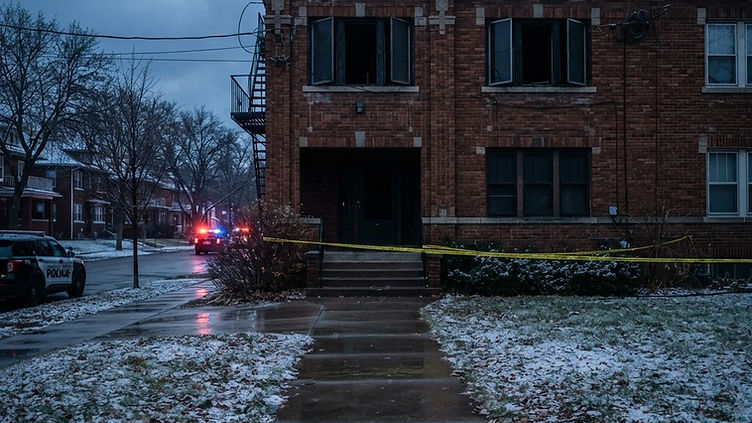
Thirty-six people were displaced from a sixteen-unit apartment building in St. Paul on Thanksgiving morning, after a fire that firefighters confined to a single apartment left the rest of the building without the utilities that make it habitable, according to MinneapoliMedia.
Emergency fire watch
Alarm or sprinkler system out of service? USPA can post a fire watch on site within 60 minutes.
Trained officers, documented patrol rounds and direct 911 notification, scoped to the order your fire marshal actually issued.
Live dispatch, 24 hours. In an emergency, call 911 first.
The fire broke out early on Nov. 26 in a two-story building on the 200 block of Western Avenue South. Crews contained the flames to one unit. Smoke moved through the building, suppression water reached apartments that never burned, and utility service was severed during the firefight. City safety inspectors then declared all sixteen apartments uninhabitable, and the thirty-six residents who lived in them were left to find somewhere else to stay on a holiday.
That outcome is worth reading carefully, because it is the ordinary arithmetic of a multi-family fire. The fire damage was one apartment. The habitability loss was sixteen.
What the record establishes
As of Nov. 27, the published reporting establishes the following, and nothing more:
- The fire occurred in a two-story, sixteen-unit apartment building on the 200 block of Western Avenue South in St. Paul.
- Firefighters contained the flames to one unit.
- Smoke, water damage and severed utilities affected the wider building.
- City safety inspectors declared all sixteen apartments uninhabitable.
- Thirty-six residents were displaced.
- The report was published by MinneapoliMedia on Nov. 27, 2026.
The cause has not been established in the reporting. Nothing here should be read as a finding about it, and any investigation will take time.
Containment is a success, and it is also the beginning of the problem
A fire held to one apartment in a shared building is a good outcome by every measure that matters at 4 a.m. Nobody died. The building is still standing. The units on either side still have their walls.
But containment changes the shape of the loss rather than eliminating it. Three things travel through a building that fire did not have to reach.
Smoke travels first. Combustion products move through door undercuts, corridor ceilings, shaft openings and the penetrations that every older building has. Smoke deposits are acidic and they settle on surfaces the fire never touched. An apartment two floors away can be uninhabitable on smoke alone, especially where the occupants include children, older adults or anyone with respiratory illness.
Water travels second, and further. Suppression water follows gravity and the path of least resistance: down through floor assemblies, sideways along joists, into ceiling cavities, wall insulation and electrical boxes. A unit below the fire can lose its ceiling without a flame ever entering the room.
Utility isolation travels last and lasts longest. This is the part that is easiest to underestimate. When a building loses gas, electric or water service, the building does not become uncomfortable; it becomes legally uninhabitable, because occupancy depends on heat, potable water, sanitation and working smoke alarms. Inspectors are not making a judgment call when they empty a building like this. They are applying a standard.
Why sixteen units go dark when one burns
A reader could reasonably ask why the other fifteen apartments could not simply stay occupied. The answer is that the systems serving them are not divided the way the apartments are.
Most two-story apartment buildings of this size have a single electrical service with a meter bank, one or two gas services feeding a common boiler or separate furnaces from a shared header, and one water service. When firefighting operations require a service to be shut off, or when a utility shuts it off because the equipment was exposed to heat or water, the shutdown is building-wide. Restoration is not a matter of turning a valve back on. It requires an electrician, a plumber or a utility crew, an inspection, and in many cases a permit, and each of those steps takes days that displaced families spend in hotels or with relatives.
The same logic applies to the fire alarm system. Detection devices in the burned unit and its corridor are gone or damaged. If the panel is in trouble and the initiating loop is open, the building no longer has the system it was approved with, and the code official has a defined response to that: under Section 901.7 of the International Fire Code, a fire watch is required where a fire protection system is out of service, and occupancy is prohibited until the system is restored or the watch is established.
A vacant building is a different building
Once all sixteen units are empty, the property changes character. It is no longer an occupied residential building with tenants who notice a stranger in the hallway. It is a vacant structure, and vacant structures attract the three problems that follow every displacement: trespass, theft of fixtures and metals, and re-ignition during restoration work.
The International Fire Code addresses vacant premises directly, requiring that they be maintained and secured against unauthorized entry. Cities add registration requirements of their own, and insurers add conditions. In practice the obligation lands on the owner in the first seventy-two hours, when the owner is also dealing with the adjuster, the restoration contractor and thirty-six households who need their belongings.
Two functions have to be separated at this point, because they are routinely confused:
Fire watch is a life-safety function. It exists because a building without working detection or suppression needs a trained person physically present to detect fire, sound the alarm, notify the fire department and begin evacuation. NFPA 601 describes how it runs: patrols of the affected area at defined intervals, a written record of each round, and immediate notification of the fire department on any indication of smoke or heat. The record is not paperwork for its own sake. It is the evidence that the building was covered while its systems were not.
Security patrol protects the property: locked and documented access points, control of the units themselves, deterrence of theft, and reporting. It does not substitute for a fire watch, and a fire watch does not substitute for it.
A displaced sixteen-unit building needs both, on the same schedule, until the systems are back and the building is re-occupied.
Restoration is the second fire risk
The dangerous period in a fire-damaged building is not over when the trucks leave. It moves into the restoration phase, where the work itself introduces ignition sources into a structure whose detection is impaired.
Welding, cutting, brazing, soldering and grinding are hot work, and hot work in a building with an impaired alarm system is precisely the condition NFPA 51B and the fire code's hot work provisions exist to control: a written permit, a fire watch during the work and for a period afterward, cleared combustibles, and a person whose only job is to watch for ignition. Restoration contractors are usually diligent about this. The failure mode is the unpermitted work: the plumber who cuts a pipe, the roofer who torches a membrane, the electrician who needs a single weld at the service.
When the building is vacant, there is nobody to smell smoke. That is the entire argument for continuous coverage.
What the owner should be doing this week
The sequence is predictable even without knowing the cause:
Document the condition before anything is moved. Photographs of every unit, the panel, the service equipment and the water damage support the claim and the eventual re-occupancy inspection.
Secure the building, unit by unit. Sixteen doors need sixteen documented locks, and the burned unit needs a board-up that will survive a week of weather and curiosity.
Establish the watch in writing. The fire marshal's order, the patrol intervals, the log format and the notification list should be one document, shared with the responding fire company, so that a crew arriving at 2 a.m. knows who is inside the building and what they are watching.
Plan the restoration schedule against the watch schedule. The watch should shrink as systems come back online, zone by zone, not all at once at the end.
Tell the tenants what is working. A displaced household that returns to a unit with a dead smoke alarm and no heat will call the city, and they will be right.
The holiday variable
Thanksgiving week is a staffing problem in the fire protection trades, and it always has been. Restoration contractors run holiday crews. Inspectors are on rotation. Utilities schedule non-emergency reconnections into the following week. A building that lost its systems on a Thursday morning is therefore likely to be without them for longer than a similar fire in April would leave it, which means the watch is longer and has to be planned as a continuous schedule rather than improvised night by night.
That is the practical lesson of this fire for any owner, manager or responder reading it: the fire is one night's work, and the coverage is the week after. A working alarm system does not take the holiday off, and neither can the arrangement that replaces it.
For buildings facing that gap, USPA operates emergency fire watch coverage staffed by personnel trained to NFPA 601 patrol and record standards, and its fire watch white paper sets out how the coverage is documented for a fire marshal and an insurer.
Services in St. Paul, MN
Reference and services
Knowledge base
NFPA 25 Impairment Protocols (2026): Fire Watch, the Ten-Hour Framework and System Restoration
National reference · 23 pages, citation registry attached
Read the volumeService
Fire watch services
How USPA staffs this work, with the coverage, licensing and dispatch terms for the assignment.
See the serviceSources
About the reporter
Staff Writer
Staff writer for the USPA Nationwide Security newsroom. Receives newsroom tips, corrections and editorial inquiries.
Author biography and credentialsMore from The Watchline

Fire Protection
In Titusville, the sprinkler did its job. Now the system is the reason the building needs a watch
A single head held a third-floor bedroom fire in check before crews arrived. The discharge also left lower units under water and the system out of service, which is the condition that puts a fire watch on the building.
· Albina Bieci

Fire Protection
Eighty firefighters, one downtown Los Angeles commercial building, and the roof they had to cut
Crews knocked the fire down in twenty minutes at 717 E. Ninth Street. The ventilation openings and a compromised alarm panel are what keep the building a fire watch assignment after the trucks leave.
· Albina Bieci

Fire Protection
Pooler crews stayed for the water. The alarm system is what keeps the building on a watch
Pooler Fire-Rescue put out a commercial fire on Highway 80 and then spent hours on smoke and water removal. Electrical shutdowns and wet detection are why the building is not cleared when the fire is.
· Albina Bieci
