
Eighty firefighters, one downtown Los Angeles commercial building, and the roof they had to cut

By Albina Bieci, Staff Writer
Crews knocked the fire down in twenty minutes at 717 E. Ninth Street. The ventilation openings and a compromised alarm panel are what keep the building a fire watch assignment after the trucks leave.
LOS ANGELES
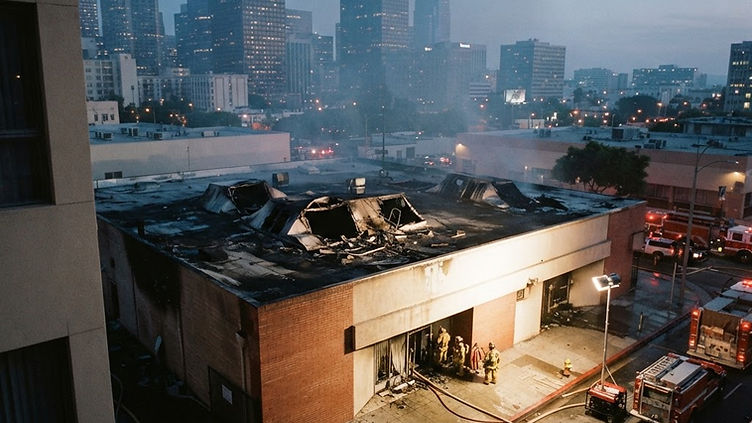
A commercial building at 717 E. Ninth Street in downtown Los Angeles took roughly eighty Los Angeles Fire Department personnel to bring under control on Nov. 26, according to MyNewsLA. Crews made an aggressive interior attack and opened the roof to vent the structure, achieving a knockdown in about twenty minutes with no reported injuries.
Emergency fire watch
Alarm or sprinkler system out of service? USPA can post a fire watch on site within 60 minutes.
Trained officers, documented patrol rounds and direct 911 notification, scoped to the order your fire marshal actually issued.
Live dispatch, 24 hours. In an emergency, call 911 first.
By any measure that is a successful firefight. A working commercial building in a dense downtown block, eighty personnel, twenty minutes, nobody hurt. The fire did not spread to the neighboring structures, and the department's investment of people and apparatus is the reason.
The building's problems begin where the fire ended.
What the record establishes
- The fire occurred in a commercial structure at 717 E. Ninth Street in downtown Los Angeles.
- Approximately eighty Los Angeles Fire Department personnel responded.
- Crews conducted an interior attack and roof ventilation operations.
- Knockdown was achieved in about twenty minutes.
- No injuries were reported.
- The report was published by MyNewsLA on Nov. 27, 2026.
The cause of the fire and the extent of interior damage have not been established in the published reporting.
What vertical ventilation does to a building
Opening a roof is one of the oldest tactics in structural firefighting, and it is used because it works: it lets heat and smoke leave the building above the fire so that crews can advance inside at a temperature and visibility that allows them to find the seat of the fire and finish it.
It also converts the roof into an opening. A commercial roof that has been cut has holes in it, in the same way that a window taken out by a crew is a hole in the wall. That has consequences that outlast the fire:
The building is open to weather. Rain on a fire-damaged commercial interior reaches stock, equipment, ceilings and electrical systems that survived the fire. In a downtown Los Angeles building, the square footage at risk from a single night of rain can exceed the fire loss.
The structure has been altered. Roof framing that was cut, and the decking around the cuts, may have lost capacity. Before anyone walks that roof again, or hangs a load from it, an engineer has to look at it.
The openings are access points. A cut roof and forced doors are how a vacant commercial building gets entered after dark.
The alarm system is the second casualty
Commercial occupancies are approved with a fire alarm system designed for the specific building: detection in the occupied areas, notification appliances, often sprinkler monitoring and a communicator that reaches a supervising station. In a fire of this size, that system takes damage in predictable places.
Smoke and heat damage devices in the fire area. Suppression water finds panels, junction boxes and conduit. Firefighting operations shut power at the service, which silences the panel and can leave it in a fault condition when power returns. A panel that has been through a fire is not a panel that can be assumed to be working; it is a panel that has to be inspected, tested and in many cases replaced.
The replacement is the slow part. Commercial fire alarm panels are not stocked on a shelf in every configuration, and a panel replacement requires programming, device verification and a witness test before the system is accepted again.
That is the interval that matters here. Under Section 901.7 of the International Fire Code, as adopted in California, where a fire protection system is out of service the code official may require a fire watch and prohibit occupancy until protection is restored. In a building with a damaged alarm system, that is not an unusual order. It is the ordinary consequence.
Why commercial fire watch is an access-control job as well as a patrol job
Fire watch in an occupied apartment building is mostly about people: knowing who is inside, keeping exits clear, being able to move them out. Fire watch in a damaged commercial building is mostly about the building.
The duties that matter in a case like this one:
Patrol the fire area and the voids. Smoldering material in a commercial building hides in stock, in mezzanines, in wall cavities and under a collapsed ceiling. A patrol that walks only the main floor is not watching the building.
Control the openings. Every cut roof, forced door and broken window is a way in. Access has to be documented, and the building has to be closed to anyone who is not on the access list.
Watch the utilities. A service that has been shut off and is later re-energized is a new risk, and the period around re-energization is when a damaged conductor announces itself.
Keep the record. NFPA 601 requires a written log of each patrol round and immediate notification of the fire department on any sign of smoke or heat. In a commercial loss, that log also becomes evidence in the insurance claim and in any cause-and-origin investigation.
The rekindle problem in commercial occupancies
Rekindle is not a rare event; it is a normal hazard of deep-seated fire in ordinary combustibles. Commercial occupancies concentrate those combustibles: paper records, packaging, textiles, foam, stored goods on racks that a hose stream cannot reach.
The standard response is overhaul: opening ceilings, pulling stock apart, wetting down hot spots, and using thermal imaging to find heat that is not visible. Overhaul takes hours and it is done under time pressure, because crews are needed elsewhere and the building has to be released.
The fire watch is what covers the gap between a crew's best effort at overhaul and the certainty that the fire is out. It is also why the watch is scheduled for the first night, when the building is still hot, rather than a week later when the contractor arrives.
The downtown variable
A fire in a dense commercial district carries risks that a suburban building does not.
Exposure is the first. Buildings that share walls, or that sit within a few feet of each other, can be heated through a party wall for hours after the fire is out. A patrol that checks only the fire building is missing half the assignment.
Occupancy is the second. Downtown Los Angeles blocks mix ground-floor commercial space with residential or office uses above and around them. When one building is closed, the people who used it move to the buildings beside it, and those buildings now carry a load they were not designed for.
Traffic and access are the third. Apparatus blocking a downtown street for hours is a normal part of the job, but it also means a fire watch crew arriving after the fire has to coordinate access with the department rather than assume it.
What the owner faces in the first seventy-two hours
The sequence for a commercial owner after a fire of this kind:
Get the fire department's release in writing before anyone enters for assessment. The scene is the department's until it is not.
Board, lock and document. Every opening gets closed, every door gets a lock, and the access list gets written down. A downtown commercial building that is open for a night will be entered.
Have the alarm and sprinkler contractors inspect before the claim conversation gets detailed. The adjuster needs to know whether the systems can be restored or must be replaced, because that answer determines how long the fire watch lasts.
Tell the insurer what the coverage is. Many commercial policies contain protective safeguards endorsements that require the insured to maintain fire protection and to notify the carrier when it is impaired. A fire watch that is ordered by the fire marshal and documented properly is usually the difference between a covered loss and a dispute.
Plan for the roof. A tarped roof is a temporary repair, not a solution, and it needs to be inspected after every storm until the permanent repair is complete.
The bottom line
Twenty minutes of firefighting and eighty people kept this fire from becoming a block fire. What the building has now is a hole in the roof, a fire alarm system of unknown condition and a stock of commercial contents that will be sorted, discarded or claimed over the next several weeks.
None of that is visible from the street, and all of it is what a fire watch is for. USPA provides emergency fire watch for commercial buildings with impaired detection and suppression, with NFPA 601 patrol records and access control, and publishes its fire watch white paper on how coverage is scoped and closed out.
Services in Los Angeles, CA
Reference and services
Sources
About the reporter
Staff Writer
Staff writer for the USPA Nationwide Security newsroom. Receives newsroom tips, corrections and editorial inquiries.
Author biography and credentialsMore from The Watchline

Fire Protection
A Thanksgiving fire displaced 36 people from a St. Paul building where one apartment burned
Firefighters held the flames to a single unit. Inspectors still emptied all sixteen, because smoke, water and severed utilities make a building uninhabitable long before the charred apartment does.
· Albina Bieci

Fire Protection
In Titusville, the sprinkler did its job. Now the system is the reason the building needs a watch
A single head held a third-floor bedroom fire in check before crews arrived. The discharge also left lower units under water and the system out of service, which is the condition that puts a fire watch on the building.
· Albina Bieci

Fire Protection
Pooler crews stayed for the water. The alarm system is what keeps the building on a watch
Pooler Fire-Rescue put out a commercial fire on Highway 80 and then spent hours on smoke and water removal. Electrical shutdowns and wet detection are why the building is not cleared when the fire is.
· Albina Bieci
