
Pooler crews stayed for the water. The alarm system is what keeps the building on a watch

By Albina Bieci, Staff Writer
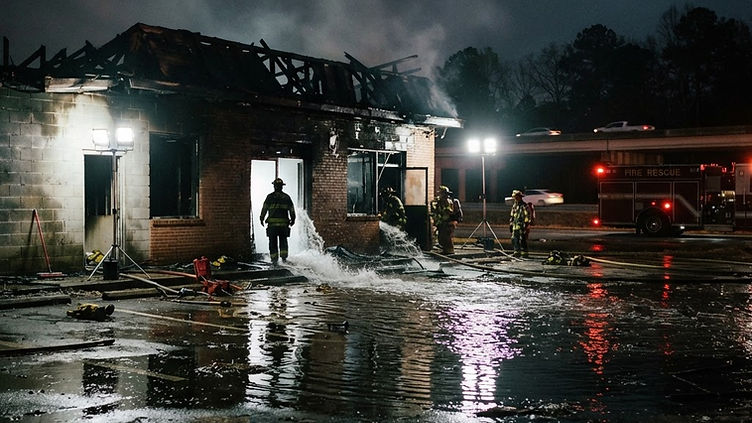
Pooler Fire-Rescue put out a commercial fire on Highway 80 and then spent hours on smoke and water removal. Electrical shutdowns and wet detection are why the building is not cleared when the fire is.
POOLER, Ga.
Pooler Fire-Rescue brought a working commercial fire under control in the 1000 block of East U.S. Highway 80 on Nov. 26 and then stayed on scene for extensive smoke and water removal, according to WTOC 11. That second phase is the one that decides how long the building stays closed, and it is the phase most owners have never planned for.
Emergency fire watch
Alarm or sprinkler system out of service? USPA can post a fire watch on site within 60 minutes.
Trained officers, documented patrol rounds and direct 911 notification, scoped to the order your fire marshal actually issued.
Live dispatch, 24 hours. In an emergency, call 911 first.
Pooler sits on the Interstate 95 corridor outside Savannah, and its commercial stock is built for logistics: warehouses, service buildings, retail pads and light industrial space along the highway. A fire in any of them produces the same three-part problem: what burned, what got wet, and what stopped working.
What the record establishes
- Pooler Fire-Rescue responded to a working fire at a commercial facility in the 1000 block of East U.S. Highway 80 in Pooler, Georgia.
- Crews brought the fire under control.
- Crews remained on scene conducting extensive smoke and water removal.
- The report was published by WTOC 11 (CBS Savannah) on Nov. 27, 2026.
The cause, the extent of damage and the occupancy type have not been established in the published reporting.
Smoke and water removal is a fire protection activity
It is easy to file smoke and water removal under cleanup, and to assume the fire protection question is settled once the fire is out. It is not, for a simple reason: both jobs require the building's systems to be off.
Water extraction means moving standing water out of a commercial floor, and that means the electrical service is de-energized in the affected areas so that nobody is working around live equipment in a wet building. Smoke removal means running high-volume fans and negative air machines, which requires power that is often supplied temporarily, and which distributes soot into every surface it passes.
While that work is underway, three things are typically true:
The fire alarm system is off or impaired. A wet panel, a soaked device or a de-energized circuit leaves the system unable to detect or notify.
The sprinkler system may be drained. Where heads flowed or piping was damaged, the system is isolated for repair.
The building is occupied by workers, not by tenants. Contractors, adjusters and cleanup crews move through a space whose exits and alarm notification are not what they were designed to be.
That combination is exactly what a fire watch exists to cover.
The code path from fire to fire watch
Section 901.7 of the International Fire Code, as adopted in Georgia, gives the code official authority to require a fire watch where a fire protection system is out of service and to prohibit occupancy until the system is restored or the watch is established.
For a commercial building, the practical path runs through the fire marshal's inspection. The department releases the scene; the marshal or a fire inspector looks at the building; the alarm contractor reports on the panel; the sprinkler contractor reports on the system. If either is impaired, an order follows, and the order names the owner.
The order is usually specific about what it wants: continuous coverage, patrols of the affected area, a log, and a phone number that reaches the fire department. NFPA 601 fills in the operating detail: defined patrol intervals, a written record of each round, immediate notification on any sign of smoke or heat, and a trained person on site.
What "extensive" water removal implies
The reporting describes extensive smoke and water removal, which is a signal about scale. In a commercial building, water travels along the paths the building gives it: roof drains, floor drains, the gaps around columns, the joints in a concrete slab, the cable trays above a ceiling.
Three practical consequences follow.
The service equipment needs an electrician, not a shop vac. Water in a panel, a disconnect or a motor control center is a fire risk when power returns. The building should not be re-energized until the equipment has been inspected and dried, and that inspection is the gate for everything else.
The detection devices in the wet area are suspect. Smoke detectors that have been exposed to water and soot are replaced rather than cleaned in most cases, and the devices' wiring has to be verified before the panel is returned to normal.
The inventory is the loss. In a Pooler commercial building, the contents may be the majority of the claim: palletized goods, packaging, equipment. Contents that stay wet become mold, and mold becomes a second claim.
Why the watch often starts before the marshal's order
A well-run response does not wait for the written order to begin coverage. The gap between the fire being declared out and the arrival of a fire watch is the gap in which a rekindle becomes a second fire, and it is a gap the owner controls.
The sequence that works:
Call for coverage when the department announces overhaul, not when the marshal's letter arrives.
Bring the building's own information to the watch: the alarm zone map, the sprinkler riser locations, the utility shutoffs, and the contact for the alarm company.
Set the access list on day one. In a commercial loss, the number of people who want to walk the building in the first week is large, and every one of them is an entry that has to be logged.
Coordinate the restoration schedule with the watch footprint. As areas are dried, cleaned and re-energized, the watch should contract. A watch that stays building-wide for a month is a watch that was never scoped.
The Savannah-corridor context
The Interstate 95 corridor around Pooler is one of the busiest logistics stretches in the Southeast, and its buildings share a characteristic that matters after a fire: they are large, they are compartmented for storage rather than for people, and they are often unoccupied at night.
An unoccupied commercial building with a damaged alarm system is the case fire watch was designed for. There is nobody inside to smell smoke, the building is large enough that a fire can develop for a long time before it is visible from outside, and the contents are frequently the most valuable thing on the site.
That is also why the fire department stays. A crew that leaves a commercial building too early comes back to a second alarm.
What the owner should do now
Get the impairment documented by the contractors who will fix it. A one-page report from the alarm and sprinkler contractors, with the affected zones named, is what the fire marshal and the insurer both need.
Keep the utilities off until the electrician signs off, and put that decision in writing so nobody re-energizes the building to run a fan.
Establish the watch as a schedule with a named supervisor, not as a phone number that answers when it can.
Photograph everything before cleanup. Water damage disappears as it dries, and the claim depends on the record.
Plan the re-occupancy inspection. The building is not cleared when it is dry. It is cleared when the fire marshal accepts the restored systems, and that appointment should be booked as soon as the contractors give a date.
What "under control" does and does not mean
Fire department terminology is precise, and the public reads it loosely. Three phrases carry most of the weight, and they describe three different conditions.
Under control means the fire is no longer spreading and the department has the resources it needs on scene. It does not mean the fire is out, and it does not mean the building is safe.
Knockdown means the main body of fire has been knocked down, usually by an aggressive attack. Hot spots, concealed fire and rekindle potential remain.
Under investigation means the cause has not been determined and the scene is being treated as evidence.
For an owner, the operative fact is that none of those conditions releases the building. The release comes from the fire department and the fire marshal, in that order, and it comes with conditions attached: the scene is secured, the utilities are managed, and the fire protection systems are either restored or replaced by a fire watch.
The commercial loss in Pooler is a normal example of that sequence. The department did its job and then stayed for the part the public never sees, which is the hours of smoke and water removal that make the building safe enough to hand back. The owner's job begins at the handoff, and it begins with a phone call that should have been made an hour earlier.
USPA provides emergency fire watch for commercial buildings in the Savannah and Pooler corridor with impaired detection and suppression, staffed to NFPA 601 patrol and documentation standards, and its fire watch white paper sets out how coverage is scoped, logged and closed out with the authority having jurisdiction.
Reference and services
Knowledge base
NFPA 25 Impairment Protocols (2026): Fire Watch, the Ten-Hour Framework and System Restoration
National reference · 23 pages, citation registry attached
Read the volumeService
Fire watch services
How USPA staffs this work, with the coverage, licensing and dispatch terms for the assignment.
See the serviceSources
About the reporter
Staff Writer
Staff writer for the USPA Nationwide Security newsroom. Receives newsroom tips, corrections and editorial inquiries.
Author biography and credentialsMore from The Watchline

Fire Protection
A Thanksgiving fire displaced 36 people from a St. Paul building where one apartment burned
Firefighters held the flames to a single unit. Inspectors still emptied all sixteen, because smoke, water and severed utilities make a building uninhabitable long before the charred apartment does.
· Albina Bieci

Fire Protection
In Titusville, the sprinkler did its job. Now the system is the reason the building needs a watch
A single head held a third-floor bedroom fire in check before crews arrived. The discharge also left lower units under water and the system out of service, which is the condition that puts a fire watch on the building.
· Albina Bieci

Fire Protection
Eighty firefighters, one downtown Los Angeles commercial building, and the roof they had to cut
Crews knocked the fire down in twenty minutes at 717 E. Ninth Street. The ventilation openings and a compromised alarm panel are what keep the building a fire watch assignment after the trucks leave.
· Albina Bieci
