
Orlando condemned the building on Rio Grande Avenue. What follows is a perimeter problem, not a fire problem

By Albina Bieci, Staff Writer
A fast fire took the roof and the second-floor platforms, inspectors condemned the complex, and the ordinance that follows requires round-the-clock security of an emptied building.
ORLANDO
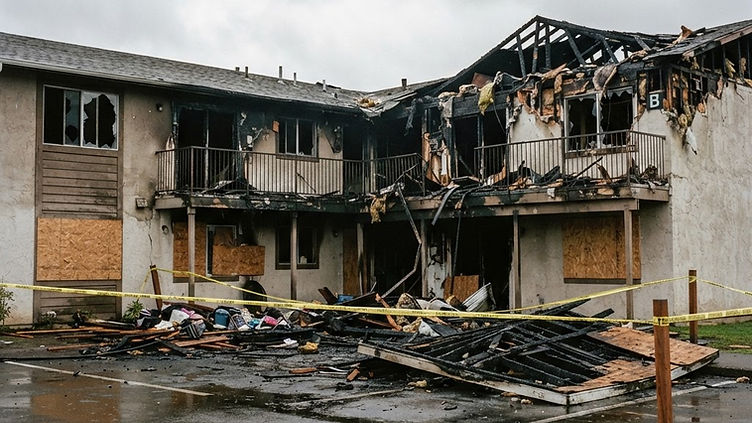
ORLANDO — A fast-moving fire tore through a multi-story apartment complex on Rio Grande Avenue, causing severe structural degradation to the roof and the second-story platforms, and building inspectors condemned the entire structure, forcing the emergency displacement of every resident.
The condemnation changes the assignment. A condemned, emptied apartment building is not a fire scene with a guard on it. It is a secured perimeter with a fire watch inside it, and the two jobs run at the same time, around the clock, until the building is either restored or demolished.
What was reported
The account published by WESH 2 News describes a fast-spreading fire, severe damage to the roof and the second-story platforms, an immediate condemnation by inspectors and the displacement of all residents. The firefighting phase is over. The occupancy phase has begun.
Condemnation is a legal event with physical consequences
A condemnation notice means the building is uninhabitable and may not be entered except by authorized people. In practice, that means the property is now responsible for an empty structure in which the following are all true: the roofs and walkway platforms that failed under fire are still failing, water and debris are inside, the electrical service may be shut off, the alarm system is dead, and every normal access control point is either broken or held by hardware nobody is monitoring.
A building like that collects problems within hours. People enter looking for belongings. People enter to take belongings. Kids enter because it looks interesting. Contractors enter for assessment and start work without signing anything. None of that is hypothetical, and none of it is addressed by a chain across the driveway.
The belongings problem
Displaced tenants of a condemned building usually leave with what they could carry in a morning. Their remaining property, including documents, medication, furniture and the contents of a life, sits in units that are now inside an unsafe structure with no access control.
This is the reason a watch on a condemned property is staffed continuously rather than during working hours. The assignment includes controlled access for residents recovering property, with identification, a scheduled window, an escort and a record. Without that structure, either nobody gets their property back or everybody wanders through a building that may not be structurally sound.
Fire watch does not end at condemnation
Condemnation is not a release from fire protection. With the electrical and alarm systems out of service, the property still has ignition sources, still has potentially smouldering material in voids, and still has the legal obligation that produced the watch in the first place. The requirement runs until the main electrical service and the fire alarm system are rebuilt, inspected and accepted, which on a structure with a collapsed roof and failed platforms is a construction project, not a repair.
Whether the building is ultimately restored or demolished matters to the schedule. A demolition requires its own safety plan, its own notifications and its own perimeter, and the watch usually remains through that work because an unstable structure being taken down is at least as hazardous as one standing empty.
What 24/7 actually requires
Round-the-clock coverage is staffing arithmetic that property managers routinely underestimate. One post covered continuously is not one officer. It is four to five full-time equivalents once relief, breaks, sick cover and supervision are counted, and a two-person post doubles it. Add a documented route, a log reviewed at shift change, and a supervisor who visits rather than calls, and the cost is real.
The cost of not staffing it is larger. A property that cannot demonstrate control of a condemned building is exposed on three fronts at once: a fire that starts in an unwatched structure, a claim from a tenant whose property disappeared, and an enforcement action for failing the order.
USPA staffs emergency fire watch and condemned-property security in Orlando and across Florida, and the company's regulatory knowledge base sets out how a post is scoped against an impairment. Dispatch answers continuously for properties that need coverage the same night.
How a condemned property is secured in practice
Securing a condemned building is not one measure. It is a short list applied in the right order on the first day, because every hour that passes after the residents leave teaches the neighbourhood what the property's posture is. Doors and windows secured or boarded, where boarding is permitted and matches the code. Gate hardware repaired or replaced rather than chained. Exterior lighting restored on temporary power. A single controlled point of entry for residents, contractors and officials, with a log at that point. A post at that entry whenever anyone is inside the building.
The perimeter then has to be walked, not assumed. A property with three sides visible from the street and one side facing an alley has one side that will be tested first. Officers who know that, and who vary the timing of the round, are doing the job. Officers who sit in a vehicle at the front gate are providing an appearance.
The demolition decision changes the risk profile
If the building is condemned and the repair scope exceeds its value, the next event is demolition, and demolition has its own risks. Notification requirements, utility disconnections, asbestos and lead surveys in older structures, and a work zone that has to be kept clear while heavy equipment operates next to occupied property.
For the watch, demolition usually means more people on site rather than fewer, because the property now has contractors, equipment, debris removal and a public that treats a demolition as entertainment. The post is coordinating access, keeping the public out of the work zone, and maintaining the fire watch on the part of the structure still standing. Properties that withdraw the watch at the start of demolition typically reinstate it within a week.
Records that survive scrutiny
A condemned building is a property where the paperwork will be read by someone hostile: a tenant's attorney, a code enforcement officer, an insurer deciding whether to pay. Three habits make that reading straightforward. Write the log in ink or its digital equivalent, in real time, with a name against each entry. Photograph the condition of each unit at the point of securing it, so a later claim about missing property can be answered with a date and an image. Keep the access list current, because an access list that names a contractor who finished last month is evidence of a system nobody maintains.
None of that is expensive. All of it is what a property is judged on after the building is gone.
Why a condemned building attracts people
An empty building with a story attached is a destination. Former tenants come back for belongings, relatives come back on their behalf, and people who have never lived there come to see it. Each of those groups has a different motive and the same problem: the building is not safe and nobody is stopping them.
The control that works is a visible, staffed, consistent perimeter with one way in. Not a chain and a sign. A person who can identify themselves, state their business, be recorded and be escorted. That posture is also the cheapest security available, because most of what happens to an empty building happens because a person tested it once and found nothing there.
The thirty-day review
A property that has been running a watch for a month should be able to look at the log and answer three questions: what was found, what was done about it, and what changed as a result. A log with no findings is not evidence of a quiet building. It is usually evidence of a route that does not pass anywhere interesting.
The review also decides the next phase. If restoration has begun, the watch is scoped to the areas still impaired and the construction access. If demolition has been scheduled, the post is rewritten for a work zone. If the building is going to sit, the property should expect the requirement to sit with it, and budget accordingly rather than renewing a short-term arrangement on emergency terms every two weeks.
The questions a property should be able to answer
Who is inside the building, and how do you know? Where is the access log, and who reviewed it? What is the route, and what is on it? What happens in the first ten minutes after an officer smells smoke? A property with a written answer to those four questions is running a controlled site. A property without them is hoping, and a condemned building is a poor place to hope.
Services in Orlando, FL
Sources
About the reporter
Staff Writer
Staff writer for the USPA Nationwide Security newsroom. Receives newsroom tips, corrections and editorial inquiries.
Author biography and credentialsMore from The Watchline

Fire Protection
A storage-area fire on East Las Olas Boulevard damaged the monitoring circuits, and the businesses cannot reopen without a person on patrol
Contained fire damage and a dead alarm circuit are not the same problem. The second one keeps storefronts shut until a human being is walking the building.
· Albina Bieci

Fire Protection
A four-alarm fire on West 107th Street took the roof of a Manhattan walk-up, and the building is now a long operation
A partial roof collapse and gutted units end the residential use of the building and begin a forensic and clearing phase that has to be secured while the structure is still failing.
· Albina Bieci

Fire Protection
A Providence apartment fire took the breaker panels and the smoke detectors with it
Interior framing failed and utility service was cut to the block, which puts an emptied building back to the condition fire codes were written to prevent: no power, no detection, no occupants to notice.
· Albina Bieci
