
A storage-area fire on East Las Olas Boulevard damaged the monitoring circuits, and the businesses cannot reopen without a person on patrol

By Albina Bieci, Staff Writer
Contained fire damage and a dead alarm circuit are not the same problem. The second one keeps storefronts shut until a human being is walking the building.
FORT LAUDERDALE
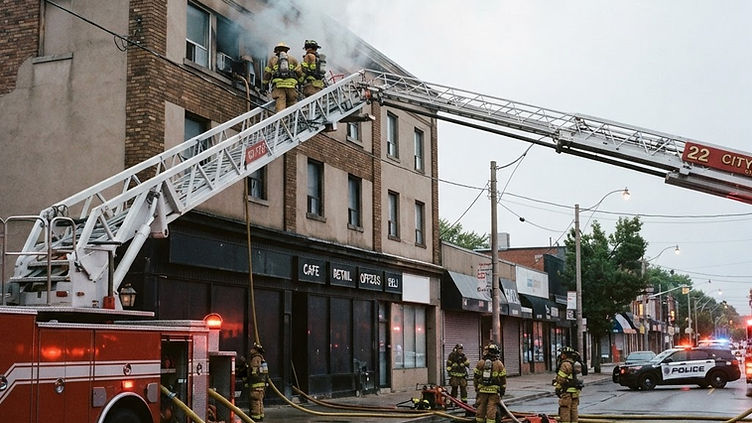
FORT LAUDERDALE — Fort Lauderdale Fire Rescue responded to an early morning fire inside a two-story commercial building on East Las Olas Boulevard, using ladder trucks and interior lines to contain a heavy fire that originated in a storage area between floors.
The fire damage was contained. The building's internal commercial fire monitoring systems suffered severe circuit damage, which is why a human fire watch patrol is required during operational hours before the businesses inside can reopen to the public.
What was reported
The account published by Fort Lauderdale Fire Rescue describes an early-morning fire in a two-story commercial building, a storage area between floors as the origin, and containment by crews using ladder trucks and interior handlines. It reports severe circuit damage to the building's fire monitoring systems.
Contained is not the same as restored
A contained fire in a storage area between floors is a good outcome for a fire department and a difficult outcome for a property. The fire itself was limited. What it did on the way through was damage the wiring and devices that make the building's protection work, and those are the systems a certificate of occupancy and an operating permit quietly depend on.
A commercial fire alarm system is not one device. It is detection, notification, a control panel, the circuits that connect them, and the monitoring path that raises an alarm off site. Damage to the circuits can leave a building that looks intact, with a panel that reports trouble and no reliable way to know whether a smoke detector on the second floor would actually do anything.
Why the fire marshal withholds reopening
An assembly, mercantile or business occupancy that cannot detect a fire and cannot notify occupants is not a premises the public should be inside. The authority having jurisdiction does not usually close a business over a repair schedule. It requires a compensating measure, and the compensating measure available to a commercial building is a person: a fire watch patrol that walks the space during operating hours, checks the areas a detector would have covered, keeps exits and extinguishers clear, and calls the fire department without waiting.
The order is specific in a way that matters commercially. It usually attaches to occupancy rather than to hours of the day, which means it applies when staff are in the building and, in a retail or restaurant setting, when customers are. It ends when the system is repaired, tested and accepted, not when the contractor says the parts arrived.
What a commercial fire watch looks like on Las Olas
A post in an operating commercial building is a different assignment from a post on a burned structure. The building is open, people are working, deliveries are arriving, and the officer's value is in the ordinary: a smell of smoke in a stockroom that nobody else has time to chase, an exit blocked by a delivery pallet, an extinguisher missing from its bracket, a panel in trouble that the staff have stopped noticing.
It also has to be unobtrusive. A patrol walking through a retail floor every twenty minutes needs to be dressed and briefed for that environment, with post orders that describe what the officer checks and where the officer stands, and a single named contact on site who owns the interaction with staff.
The record is what satisfies the inspector. Times walked, areas covered, findings and their disposition. A log with three entries for an eight-hour trading day is not a watch, and an inspector can tell.
The restoration clock
Repair of fire alarm circuits in a commercial building involves a licensed contractor, replacement devices, recalibration of the panel, testing of every initiating and notification device, and a monitoring connection that has to be verified end to end. That is days at best and weeks in a building where the damage is inside wall cavities between floors.
Meanwhile the tenants are paying rent on space they cannot fully use, and the landlord is carrying a building whose tenants have a claim if the delay is the landlord's own. That is the argument for starting the watch the same day the order is issued rather than after the insurance adjuster visits.
USPA staffs emergency fire watch posts for commercial occupancies across South Florida, including operating-hours patrols written to satisfy a fire marshal's order without disrupting trade. Dispatch answers at any hour, and the company's regulatory knowledge base documents the basis for how a post is scoped.
What the order usually says
A fire watch directive on a commercial occupancy is a short document with unusually specific requirements. Continuous presence during hours the space is occupied. A defined route covering the areas the impaired system would have covered. Immediate notification of the fire department by telephone, not by a message to the landlord. A written record available for inspection. And a named responsible party who can be reached at any hour.
Two details catch properties out. The first is the notification requirement, because an officer instructed to report to a manager first has been set up to delay the one action that matters. The second is the record requirement, because the inspector does not ask whether the building was patrolled, they ask to see the log.
Trade disruption is the landlord's exposure
A tenant whose premises cannot be fully used because the landlord's alarm system is down is a tenant with a rent abatement argument, and possibly an interruption claim if the restriction reduces trade. That exposure compounds the moment the landlord stops being able to demonstrate progress.
Starting the watch immediately does two things at once. It restores lawful occupancy, which the tenant needs, and it starts the record that shows the landlord acted on the day the requirement landed rather than after a demand letter. Both are cheap compared with the alternative, and neither requires the alarm repair to be finished.
A post that satisfies an inspector
The test is simple and unfashionable. Can the officer describe the route without reading it? Does the log show the route being walked at the intervals the order names, including the quiet hours? Are findings written down, and is the disposition of each finding recorded? If a detector would have covered a stockroom, does the route go into the stockroom?
A post that passes those questions is doing the job. A post that signs a sheet at the reception desk is not, and a fire marshal who visits twice will know which one the building bought.
What a delayed reopening actually costs a tenant
A restaurant or retail tenant with an operating alarm impairment faces a decision that is not about the fire at all. Keep the doors closed and lose trade, or trade without lawful occupancy and risk the enforcement action, the insurance consequences and the personal exposure of operating a space that cannot warn its occupants.
Neither option is acceptable, which is why the watch is the resolution rather than an expense. For a tenant trading six days a week, the cost of a documented patrol in an operating space is a fraction of a closure, and the landlord who arranges it on day one keeps a tenant who is still a tenant at renewal.
The part the landlord owns
The fire alarm in a multi-tenant commercial building is the landlord's system, even where the tenants have their own panels and their own monitoring. When it fails, the obligation to provide a compensating measure is the landlord's, and a lease that assigns fire protection responsibility to the tenant does not move that obligation to the authority having jurisdiction.
That is worth stating plainly to a property manager who is waiting for the tenants to sort it out. The order will be issued to the building. The inspection will be conducted at the building. The watch will be posted at the building. Delegation is a commercial arrangement, not a regulatory one.
What the tenant should ask before signing a lease renewal
One question is worth adding to the usual list. If the alarm system went down tomorrow, what is the plan, who executes it and how long does the building stay closed? An owner with an answer is running a building. An owner without one is running a schedule.
Sources
About the reporter
Staff Writer
Staff writer for the USPA Nationwide Security newsroom. Receives newsroom tips, corrections and editorial inquiries.
Author biography and credentialsMore from The Watchline

Fire Protection
A four-alarm fire on West 107th Street took the roof of a Manhattan walk-up, and the building is now a long operation
A partial roof collapse and gutted units end the residential use of the building and begin a forensic and clearing phase that has to be secured while the structure is still failing.
· Albina Bieci

Fire Protection
A Providence apartment fire took the breaker panels and the smoke detectors with it
Interior framing failed and utility service was cut to the block, which puts an emptied building back to the condition fire codes were written to prevent: no power, no detection, no occupants to notice.
· Albina Bieci

Fire Protection
Orlando condemned the building on Rio Grande Avenue. What follows is a perimeter problem, not a fire problem
A fast fire took the roof and the second-floor platforms, inspectors condemned the complex, and the ordinance that follows requires round-the-clock security of an emptied building.
· Albina Bieci