
A fire confined to one bathroom at Audubon Park Apartments still took a building's plumbing and alarm loop out of the argument

By Albina Bieci, Staff Writer
Daphne police and fire crews contained the late-night fire to a bathroom with no injuries reported. Investigators are still working the ignition source, and that is the period when the unit has to be held.
DAPHNE, Ala.
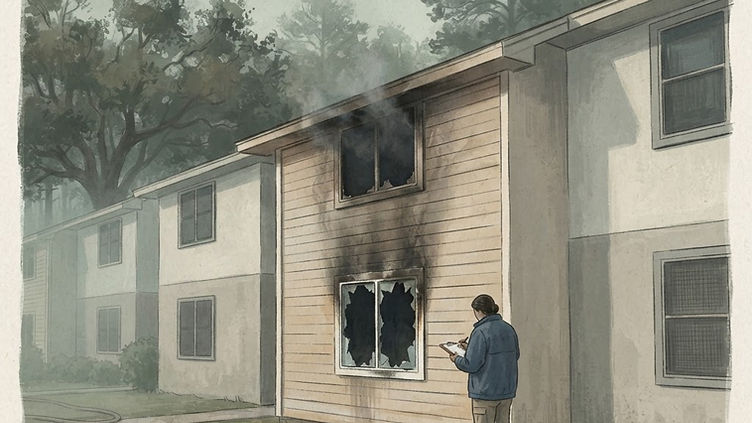
Daphne police and fire crews responded late Thursday night to a structure fire inside a multi-family unit at Audubon Park Apartments on County Road 64, containing the blaze to a bathroom area with no injuries reported, according to reporting by WKRG News 5.
The call went out after 10:30 p.m. Central. Fire investigators are working to determine the ignition source.
What has been confirmed
The fire occurred inside a multi-family unit at Audubon Park Apartments on County Road 64 in Daphne. Crews contained it to a bathroom area. No injuries were reported. The ignition source has not been determined and remains under investigation. The dispatch occurred after 10:30 p.m. Central.
The reporting available at publication does not state how many units the building contains, whether the unit was occupied at the time, what the damage estimate is, or whether the unit's residents were displaced. Those details will be added here if the department or the property releases them.
A bathroom is a plumbing room with a fuel load
Bathrooms are one of the more common rooms of origin in residential fires and one of the least discussed. The reason is that a bathroom is not a simple space. It is a small room containing a water supply under pressure, a drain system, a fan that penetrates the wall or roof, a light fixture and often a receptacle within reach of the sink, and a door that is normally closed.
The ignition sources that show up in post-fire analysis are consistent. A fan motor that seizes and overheats, igniting lint and dust that accumulated on the housing. A wiring failure in a circuit that has been wet or overloaded. A hair dryer, curling iron or space heater left against a combustible surface. A light fixture that was covered or insulated with material the fixture was not rated for.
A bathroom fire also has a distinctive burn pattern, because the room is small and closed. The fire is oxygen-limited until the door is opened, at which point it gets a supply of air from the corridor and can flash across the ceiling in seconds. That is the moment firefighters describe when they say the fire "came at them" out of a bathroom doorway, and it is why the door is opened from the side, from a protected position, with a charged line.
Why containment here is a genuine success
A fire confined to a bathroom in a multi-family building is a fire that the compartmentation and the response both worked on. The room's gypsum board, the closed door and the speed of the call combined to keep the fire from the corridor, which is the path of egress for every other unit in the building.
That is not the same as saying the building is unaffected. Smoke in a small room under pressure goes through every gap, and the smoke that leaves a bathroom travels into the corridor ceiling, the adjoining closets and the wall cavity behind the vanity. The residue it leaves is acidic and it settles on surfaces throughout the unit and often the unit next door.
The systems question that outlasts the fire
The part of this incident that will determine what the property needs over the next several days is not the fire damage. It is the systems that were touched while the fire was put out.
Suppression water in a bathroom goes into the floor assembly around the toilet flange and the tub drain, into the wall cavity behind the tile, and into the ceiling of the unit below. If the building is sprinklered, any head that flowed has to be replaced by a qualified contractor and the branch line has to be returned to service and tested, which is work under NFPA 25 rather than a maintenance ticket.
If the unit's electrical circuit was shut off at the panel, and the panel serves more than that unit, the isolation has to be done in a way that leaves the other apartments energized and protected. If the smoke detector in the unit was destroyed, the loop serving it may now be open, which affects every device downstream on the same circuit.
Each of those is an impairment, and in Alabama, where the International Fire Code is adopted through the state's fire safety framework and enforced by the local authority, an impairment is what triggers a fire watch requirement.
What the investigation is actually doing
An origin and cause investigation in a single room is a systematic process. The investigator works from the least burned area toward the most burned area, examining the floor first because the floor usually preserves the deepest char, and reads the patterns to determine where the fire started and in what direction it moved.
In a bathroom, the examination concentrates on the electrical circuit serving the room, the exhaust fan and its wiring, any appliance present, and the plumbing penetrations where a fire can travel between floors. The finding matters beyond the insurance claim: if the ignition source was the fan or the wiring, the same defect exists in every unit of the same age and construction in the complex, and the property has a building-wide question to answer.
That is the reason the unit is held rather than cleaned. Once the room is stripped and rebuilt, the evidence that would have identified a systemic defect is gone.
Why a contained fire still produces a watch
A fire watch on a single contained unit in an occupied building is a modest assignment, and it is a mistake to treat modest as unnecessary. The unit is unoccupied, the door was forced, the window may be open, and the room contains an open penetration into the floor assembly.
The watch does three things. It checks the unit and the unit below on a schedule for heat and smoke in concealed spaces, which is the rekindle question. It keeps the unit closed, which protects both the investigation and the residents' property. And it gives the property a documented record that the impairment was managed, which is what an insurer will ask for if there is a second incident in the same building.
In a building where the only impairment is one unit's circuit and one detector, that may be a nightly check rather than a full post. The fire official decides which, and the decision is recorded.
What the property and the residents should do next
The property's first job is to get the affected systems back in service on paper, not just in practice: a contractor's report on the sprinkler branch line if a head flowed, an electrician's sign-off on the isolated circuit, and a test record for the alarm loop. The second is to keep the unit closed until the investigator releases it.
The residents' first job, if the unit is theirs, is to document the room before anything is cleaned and to keep every receipt. Smoke damage in a bathroom that looks cosmetic is often the beginning of a mold problem in the wall cavity behind the tile, and the claim is much stronger when the photographs were taken in the first week.
The construction detail that decides how bad a bathroom fire gets
Coastal Baldwin County has added housing quickly over the past decade, and much of it is light-frame construction built with engineered components: manufactured floor trusses, laminated veneer lumber headers, and oriented strand board sheathing. Those materials perform well structurally and poorly under fire. An engineered joist that loses a web in a fire fails sooner than a dimension-lumber joist of the same depth, and oriented strand board delaminates as the resin binding it breaks down.
The practical consequence in a bathroom fire is that the floor assembly is the part to inspect first. Suppression water and heat from above both attack it, and the unit below is where a failure would show. That is one reason a watch on this kind of fire covers the unit underneath as well as the unit that burned.
What the property should put in writing
Three documents, and all three should exist within a week. A contractor's statement on the sprinkler branch line if any head flowed, naming the test performed. An electrician's sign-off on the circuit that was isolated, naming what was de-energized and what remains live. And a record of the fire watch itself, with the times of each round and the name of the officer who walked it.
None of those documents makes the building safer. What they do is demonstrate that the impairment was known, managed and closed out, which is the position a property wants to be in if there is a second incident in the same building or a claim on the same policy.
Related coverage
The Watchline has reported on small fires with large system consequences this month. In Perrysburg Township, Ohio, sprinklers put out an overnight fire in a business and left the building with a water problem. In Pullman, Washington, a two-alarm fire gutted one unit and displaced about fifteen residents.
The service connection
USPA Nationwide Security provides fire watch and post-fire access control for multi-family properties in Daphne, Baldwin County and the Alabama Gulf Coast, including buildings where a single-unit fire has left a circuit, a detector loop or a sprinkler branch line out of service. Officers work documented rounds, hold the affected unit, and call the fire department directly when something is found. Requests can be made through the emergency fire watch page, the Mobile and Baldwin County fire watch page, or by calling (800) 214-1448.
Sources and status
Reporting on the incident is attributed to WKRG News 5. The ignition source, the damage estimate, the unit count of the affected building and the displacement status remain open pending release by the Daphne Fire Department and the property. Technical references include NFPA 25 and the U.S. Fire Administration's residential fire loss data.
Sources
About the reporter
Staff Writer
Staff writer for the USPA Nationwide Security newsroom. Receives newsroom tips, corrections and editorial inquiries.
Author biography and credentialsMore from The Watchline

Fire Protection
Two residents were displaced by an overnight fire at Quail Oaks Apartments, and the unit is now an open, unpowered space
Petersburg Fire Rescue stopped the fire before it reached the adjoining units. The cause is still under investigation, which means the damaged unit cannot be repaired yet and has to be held.
· Albina Bieci

Fire Protection
A third-floor fire on Warsaw Avenue did $100,000 in damage in thirty minutes, and displaced three people
Firefighters had the East Price Hill fire under control in about half an hour and carried a dog out of the building. Three residents were displaced from a three-story walk-up whose upper floor and roof assembly now have to be inspected.
· Albina Bieci

Fire Protection
A fire inside the wall cost four units at Park Canyon Apartments while twelve were cleared to go home
Flames moved through the concealed spaces between the upstairs and downstairs laundry areas of a 16-unit Dalton building, causing roughly $50,000 in damage. Four households went to Red Cross lodging and twelve went back in.
· Albina Bieci
