
A fire inside the wall cost four units at Park Canyon Apartments while twelve were cleared to go home

By Albina Bieci, Staff Writer
Flames moved through the concealed spaces between the upstairs and downstairs laundry areas of a 16-unit Dalton building, causing roughly $50,000 in damage. Four households went to Red Cross lodging and twelve went back in.
DALTON, Ga.
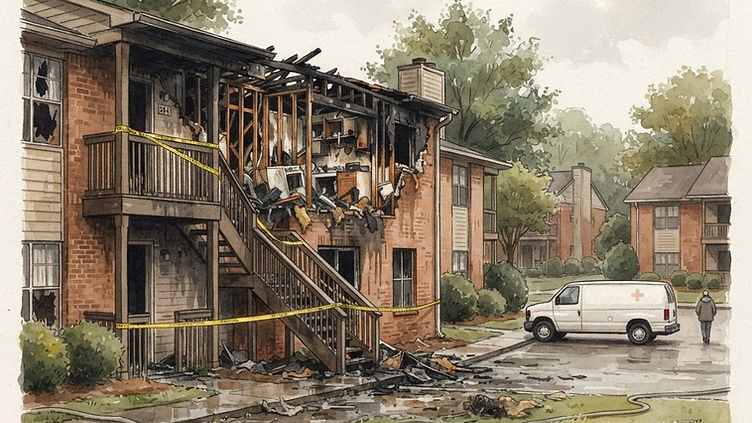
A fire that started in the laundry areas of a 16-unit apartment building at Park Canyon Apartments in Dalton spread into the concealed voids between the upstairs and downstairs units, damaging four apartments to the tune of roughly $50,000 and sending those households into temporary lodging with the American Red Cross while the other twelve units were cleared to return.
The building was released at 10:59 p.m., according to reporting by the Dalton Daily Citizen. Twelve of sixteen units reoccupied the same night. The four that did not are the story.
What has been confirmed
Firefighters responded to a 16-unit multi-family apartment building on Park Canyon Drive. The fire involved the laundry areas serving the upper and lower units and spread into concealed void spaces between them. Four apartment units sustained damage estimated at approximately $50,000. The occupants of those four units were displaced into temporary lodging arranged through the American Red Cross. The remaining twelve units were cleared for occupancy, and the incident was cleared at 10:59 p.m.
The reporting available at publication does not state whether anyone was injured, does not identify a cause, and does not give a restoration timeline for the four damaged units. Those details will be added here if the fire department or the property releases them.
What a concealed void is, and why fire likes it
A concealed space is any part of a building's construction that is enclosed by finish materials and not intended for occupancy: the cavity inside a wall, the space between a floor and the ceiling below it, the soffit over a cabinet run, the chase that carries plumbing from one floor to the next.
Two things make these spaces dangerous. The first is that they are continuous. A wall cavity runs from the foundation to the roof plate in a single uninterrupted channel unless something is built into it to stop the run. The second is that they are invisible. There is no detector inside a floor assembly and no sprinkler head in a two-by-ten joist cavity.
A fire that reaches one of these spaces has left the room where it started and entered a path that leads to the rest of the building. Firefighters describe the sound as a dull roar that moves, and the tactic it forces is opening the finish: pulling baseboard, cutting inspection holes, and in a bad case pulling ceiling. The damage from the fire and the damage from finding it are often comparable.
Why laundry areas are a predictable origin
A laundry area concentrates three things that start fires. It has the highest continuous electrical load in a residential unit, because a dryer draws on a dedicated 240-volt circuit and a washer draws on its own. It has an appliance whose entire function is to accumulate lint, a material designed to be flammable. And it has a vent that penetrates a wall or a floor and, when it is a flexible foil or vinyl duct, is a pathway as much as a flue.
The failure modes are well documented. Lint that escapes the filter and collects around the dryer's heating element ignites. A crushed or disconnected transition duct deposits lint in a wall cavity, where it accumulates for years. A dryer that continues to run after the drum stops turning overheats. And a cord or receptacle that has been loaded beyond its rating, in a closet with no air movement, fails thermally rather than dramatically, smoldering long enough to involve the surrounding framing before anyone smells it.
Where laundry equipment serves stacked units, the plumbing and venting for both pass through the same chase. That shared chase is exactly the void the Dalton fire used.
The twelve-and-four split is the hard part
Sixteen units, twelve cleared, four not. That ratio is typical of a void-space fire in a garden-style building, and it is why these incidents are harder to manage than a fire that guts one unit.
The twelve units that are cleared are cleared on a specific basis: no fire damage, no structural compromise, and the systems serving them are working. What that determination does not always account for is smoke. Smoke travels through the same voids fire does, and it deposits residue in apartments that never saw flame. The residue is acidic, it etches metal fixtures and electronics, and its odor returns in warm weather if the material was not cleaned. Residents in those twelve units should be looking at their belongings with that in mind, and documenting what they find.
The four that are not cleared have a different set of problems. Water from suppression sits in the floor assembly. The electrical circuits serving those units have been de-energized, which means no heat, no refrigeration and, in some configurations, no working smoke alarm because the alarm in the unit is powered by the building's system rather than by a battery. And the units are empty, which makes them the most attractive target in the complex.
The hot spot problem after the trucks leave
A void-space fire is the classic rekindle scenario. Crews open what they can reach, wet what they find, and leave. What remains is timber that has been charred on one face, insulation that has been soaked, and a cavity that will hold heat for hours.
That is the reason a fire watch after a fire of this type is not a formality. The watch walks the affected units and the units above and below them, checking surface temperatures and the smell of smoke in concealed spaces, and it has the authority to call the fire department back rather than investigate on its own. In a building with four vacant units, it also has a second job, which is keeping people out.
What the code expects while systems are impaired
Georgia has adopted the International Fire Code through its state minimum fire safety standards, and the IFC's out-of-service provisions apply here as they do anywhere: when a required fire protection system is out of service, the code official is notified and an approved fire watch is provided until it is restored. A four-unit section of a building with damaged circuits and a compromised alarm loop is a section that meets that description.
There is also a construction question that owners rarely think about until after the fact. Most garden-style apartment buildings of this vintage are protected by a 13R sprinkler system, which is designed for life safety in residential occupancies rather than for property protection, and which by design does not extend into combustible concealed spaces, attics or closets of certain sizes. That is not a defect. It is the standard the building was built to. But it explains how a fire can travel inside a wall in a sprinklered building and emerge in a room the sprinkler system was protecting.
Board-up is not security
The instinct after a fire is to board the windows and call it secured. Plywood over a window keeps casual eyes out and does nothing about a door. In a four-unit section where crews forced entry and left the doors off the latch, the actual openings are the doors, and they need to be secured with hardware that resists a shoulder, not with a screw through a strike plate.
The working combination for a damaged section of an occupied complex is a physical officer at the section entrance, a documented sign-in for the restoration contractor, and a nightly check that the temporary closures are still in place. Residents of the twelve occupied units will walk past that section every day, and they will notice within an hour if it is not held.
What the displaced households should do first
Document everything before it is cleaned. Photograph each room, including the rooms that look fine, because smoke residue is the claim most often denied for lack of evidence. Keep receipts for lodging, food, medication and clothing. Notify the property in writing of the address where mail can reach you, because the restoration timeline will be communicated to the address on the lease.
Then ask the property two questions in writing: which systems serving your unit are currently working, and what the specific condition is for reoccupancy. A date is not a condition. A passed electrical inspection and a working smoke alarm are conditions.
Related coverage
The Watchline has reported on partial-occupancy fires across the South this month. In North Naples, a fast-moving fire in an apartment complex emptied units overnight. In Corpus Christi, a pre-dawn second-floor fire left investigators working a Buford Street apartment building.
The service connection
USPA Nationwide Security provides fire watch, board-up security and post-fire access control for multi-family properties in Dalton, the greater Chattanooga corridor and north Georgia, including buildings where a void-space fire has left units vacant and alarm circuits impaired. Officers work documented rounds, hold the section entrance, and call the fire department directly when something is found. Requests can be made through the emergency fire watch page, the Dalton fire watch page, or by calling (800) 214-1448.
Sources and status
Reporting on the incident is attributed to the Dalton Daily Citizen. The cause, the injury status and the restoration timeline for the four damaged units remain open pending release by the Dalton Fire Department and the property. Technical references include NFPA 13R and NFPA 101, Life Safety Code.
Services in Dalton, GA
Sources
About the reporter
Staff Writer
Staff writer for the USPA Nationwide Security newsroom. Receives newsroom tips, corrections and editorial inquiries.
Author biography and credentialsMore from The Watchline

Fire Protection
A fire confined to one bathroom at Audubon Park Apartments still took a building's plumbing and alarm loop out of the argument
Daphne police and fire crews contained the late-night fire to a bathroom with no injuries reported. Investigators are still working the ignition source, and that is the period when the unit has to be held.
· Albina Bieci

Fire Protection
Two residents were displaced by an overnight fire at Quail Oaks Apartments, and the unit is now an open, unpowered space
Petersburg Fire Rescue stopped the fire before it reached the adjoining units. The cause is still under investigation, which means the damaged unit cannot be repaired yet and has to be held.
· Albina Bieci

Fire Protection
A third-floor fire on Warsaw Avenue did $100,000 in damage in thirty minutes, and displaced three people
Firefighters had the East Price Hill fire under control in about half an hour and carried a dog out of the building. Three residents were displaced from a three-story walk-up whose upper floor and roof assembly now have to be inspected.
· Albina Bieci