
A fast-moving fire in a North Naples apartment complex emptied units on Fountain View Circle

By Albina Bieci, Staff Writer
Greater Naples Fire Rescue District crews and sheriff's deputies cleared the building, and the Red Cross is coordinating emergency housing with property management. The damaged alarms and dead utilities are the part of this incident that outlasts the fire.
NAPLES, Fla.
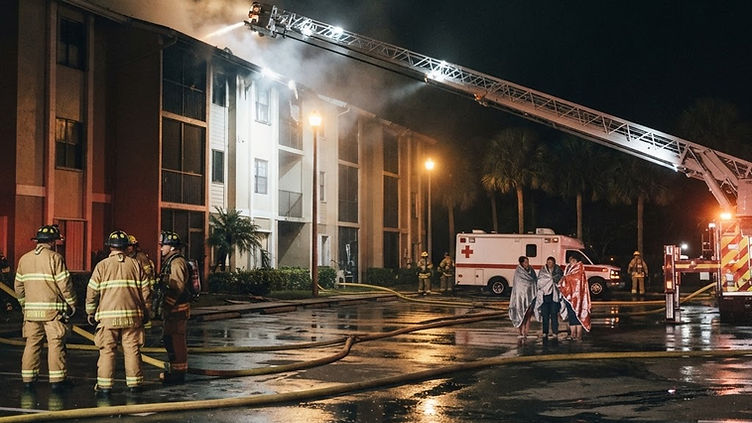
Greater Naples Fire Rescue District crews responded to a rapidly spreading fire in a multi-unit apartment complex on Fountain View Circle, where Collier County sheriff's deputies assisted with a large-scale evacuation and the American Red Cross began working with the property's management company on emergency housing for residents who could not return to their units, according to reporting by Gulf Coast News.
The fire is under control. What continues is the operation the fire leaves behind: several households without a place to sleep, a building with its detection and suppression systems out of service, and a management company responsible for both.
What has been confirmed
The Greater Naples Fire Rescue District handled the incident on Fountain View Circle. Deputies assisted with the evacuation of the complex. The Red Cross and property management are coordinating emergency housing for displaced residents.
Several facts that determine what happens to the building next have not been released. The number of units damaged, the number of residents displaced, whether anyone was treated for injury, and the cause of the fire are all open. Until the district or the state fire marshal's office publishes them, they should be treated as unconfirmed, including in any statement a property manager makes to tenants or an insurer.
Fountain View Circle sits in a dense residential corridor of North Naples where multi-unit rental buildings stand close together. A fire in one building puts the roof of the next within reach of radiant heat and ember cast, which is why evacuation at this scale is routine even when the fire is confined to one structure.
Why this building type burns the way it does
Most apartment complexes built in Collier County over the past four decades share a construction logic that favors open floor plans and continuous attic space. A common roof structure running the length of the building carries fire horizontally above the ceiling line, past the fire separations that divide the units below. Crews opening a ceiling find fire several units away from where it started, and the roof assembly becomes the controlling factor in the operation.
Balconies, soffits and vinyl or wood siding give flame a path from a lower floor to the eave. Once fire enters the attic, the building's own geometry works against the hose lines: the attic is hot, low and difficult to reach, and ventilation has to be coordinated or it pulls flame through the space faster than crews can advance.
That is the reason a fire in a building of this type is usually declared under control after significant damage to units that never burned. Smoke and water travel the same shared paths the fire used. Corridors stay impassable after the flames are out, and the units behind them are uninhabitable for reasons that have nothing to do with char.
The building after the fire is the harder problem
A residential fire that is under control has not finished with the property. Sprinkler risers in the affected wing have usually been shut down so crews could work, or because a line broke. The alarm panel in a building of this size is commonly reporting trouble on a dozen devices, or is dark because electrical service to the affected section was pulled. Standpipes may have been charged and drained. Corridors hold water and sheetrock hangs.
The units that did not burn are frequently the ones nobody can occupy, because the systems that make them habitable are shared with the units that did.
That condition is what raises the fire watch question. When detection and suppression systems in an occupied or occupiable building are out of service, the authority having jurisdiction can require a person to be physically present to detect a fire and notify occupants in place of the system that would have done it. Florida's fire prevention code adopts the model codes that carry that authority, and the fire marshal's office covering the district is the office that would issue such an order. The requirement is not automatic in every case, and a property manager walking the halls once a shift does not satisfy it.
A compliant watch in a building this size looks like a posted officer at each required location, a written log of rounds with times, a means to call 911 without abandoning the post, and an instruction sheet that names what the officer does when smoke is found. On a multi-building complex the assignment usually extends to the perimeter, because a building emptied of tenants and forced open by crews is an unoccupied structure holding furniture, appliances and copper.
Displacement creates a second exposure
The tenants who cannot return are the visible part of the incident. The part that draws less attention is the row of vacated units behind them. In a fire-damaged complex, the management company is now responsible for a building with open doors, failed locks, unlit corridors and a temporary fence line if one has been ordered. Remediation contractors, insurance adjusters, electricians and fire investigators will all need access in the first week, and each of them needs to be logged in and out of a building that is otherwise empty at night.
Thefts from fire-damaged apartment buildings are common enough that most institutional property managers build access control into the first 48 hours: one entrance, a sign-in sheet, an officer who can tell a resident retrieving medication from someone who has no reason to be inside. The same post carries the fire watch obligation while the systems are down, which is why the two functions are usually staffed together rather than purchased separately.
Related coverage
Two recent Watchline reports describe the same sequence in other markets. In Knoxville, a roof fire at The Elements at Cedar Bluff displaced 17 residents and closed all fourteen units. In South Bend, an overnight fire in a three-unit building hospitalized one man and displaced the rest of the tenants.
What the first 72 hours look like
Property management and the responding district usually work through the same sequence after a residential fire of this size.
The damaged section is separated from the habitable section with a barrier that survives a person pushing on it. Utilities to the affected wing are confirmed off, and the panel serving the rest of the complex is confirmed working, or the watch requirement is written into the file. A structural walk-through by the district or a licensed engineer establishes whether the roof over the burned units is safe for investigators to work beneath. The insurance carrier's adjuster gets a documented scene, which means the site is not left open overnight.
Then the tenants. Emergency housing through the Red Cross and the property's own relocation effort typically runs a few nights at a time while units are assessed. The schedule for retrieving belongings is set by the property manager, and an officer posted at the entrance during those windows keeps the process orderly and keeps the building from becoming a place people wander through.
The liability line owners should understand
The obligation to keep an occupied building safe sits with the owner and the management company, not with the fire department that responded. A district can order a fire watch; it does not staff one. Where a building has been left with impaired protection and no watch, the exposure is created in the hours after the news trucks leave, when the scene looks calm and the systems are still down.
Insurance carriers ask for the same records an owner should be keeping anyway: the date and time the system went out of service, who was notified, what interim measures were in place, and who was on post. An owner who can produce that record is in a different position from one who cannot.
The service connection
USPA Nationwide Security provides emergency fire watch and post-incident site security for commercial and multi-unit residential properties, including buildings in Collier County where a fire has left detection or suppression systems out of service. Coverage is staffed by uniformed officers who log rounds, keep the access record the property needs for its insurer, and call the fire department directly when something is found. Requests for the Naples area can be made through the emergency fire watch page or by calling (800) 214-1448.
For the technical basis of the requirement, the fire watch white paper sets out how a watch is defined, staffed and documented, and why a contractor's verbal assurance is not a substitute for a written post order.
How the evacuation was run
Clearing a multi-unit building at night is slower than the footage suggests. Deputies and crews work door to door, and a complex this size is usually arranged in wings with exterior walkways, so each floor has to be walked rather than called. Residents who are asleep, hard of hearing, or caring for someone who cannot move quickly have to be found rather than alerted.
Two things decide whether an evacuation of this kind succeeds. The first is whether the alarm reached every unit. A fire that starts on an exterior balcony or in a stairwell can leave the corridor detectors in the far wings unaffected for the first minutes, and in a building where the panel is already reporting trouble, audible notification is not guaranteed at all. The second is whether anyone knows who is inside. Properties that keep a current occupancy list, including the units with residents who need assistance to evacuate, give responders something to work against instead of a row of closed doors.
What a written post order contains
A fire watch is only as good as the document the officer works from. For a property of this size, a post order normally names the building and the specific system that is out of service; the location of each required post; the interval and route for rounds; what the officer checks at each stop; how a fire is reported and from where; the name and number to call when something is found; and the hours the post is staffed.
It also records what the officer does not do. A fire watch officer does not fight fire, does not enter a smoke-filled unit, and does not reset an alarm panel. The value of the post is early detection and a call that gets the fire department moving, and that value is lost if the officer leaves the post to investigate something.
That document is what the property's insurer will ask for, and it is the difference between a compliant watch and an officer sitting in a vehicle at the entrance.
Sources and status
Reporting on the incident is attributed to Gulf Coast News. The cause, the damage estimate and the displacement count remain open pending release by the Greater Naples Fire Rescue District. Technical references for the fire watch requirement include NFPA 1, Fire Code and NFPA 25, the standard for inspection, testing and maintenance of water-based fire protection systems. This article will be updated if the district releases additional detail.
Services in Naples, FL
Sources
About the reporter
Staff Writer
Staff writer for the USPA Nationwide Security newsroom. Receives newsroom tips, corrections and editorial inquiries.
Author biography and credentialsMore from The Watchline

Fire Protection
A two-alarm fire broke through the roof at The Hive apartments on Abrams Road and damaged six units
Fire broke through the roof of the northeast Dallas complex and six units were damaged. A roof breach and an impaired alarm panel are what put the neighboring wings into a fire watch posture.
· Brian Fitzgibbons

Fire Protection
A two-alarm fire on College Hill gutted one unit, displaced about 15 residents and sent a Pullman officer to the hospital
The fire ran through a six-unit building in the campus neighborhood, and a responding officer was treated for smoke inhalation. Smoke and water damage across the adjoining units is what forces the power and alarm shutdowns.
· Albina Bieci

Fire Protection
A three-alarm fire tore through the vacant former Stockton Record building on East Market Street
Crews fought the multi-story former newspaper office and warehouse complex defensively and closed downtown streets. A vacant building that has burned is a security assignment before it is anything else.
· Albina Bieci