
A three-alarm fire tore through the vacant former Stockton Record building on East Market Street

By Albina Bieci, Staff Writer
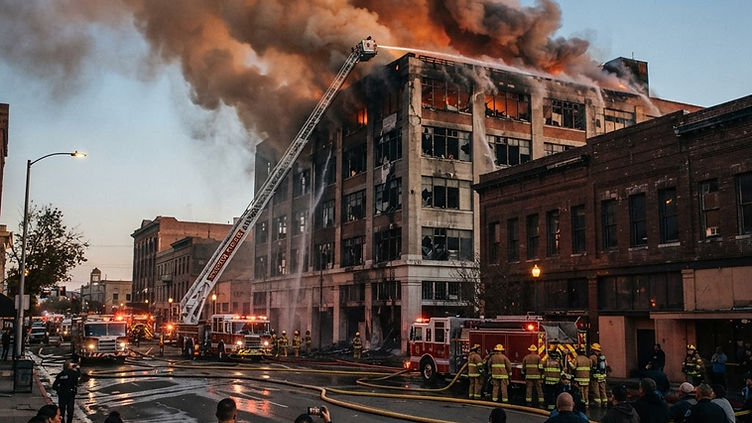
Crews fought the multi-story former newspaper office and warehouse complex defensively and closed downtown streets. A vacant building that has burned is a security assignment before it is anything else.
STOCKTON, Calif.
A three-alarm fire tore through the multi-story former Stockton Record office and warehouse complex on East Market Street in downtown Stockton, California, forcing firefighters into a defensive operation and closing streets around the block, according to reporting by Reuters.
Defensive means the building was not entered to fight the fire from inside. That decision is made when the structural condition, the volume of fire or the risk to crews makes an interior attack untenable, and it is made early. Once it is made, the building is fought from the street, exposures are protected, and the structure is allowed to burn until the fire is knocked down from outside.
What has been confirmed
The fire occurred at the former Stockton Record building, a multi-story office and warehouse complex on East Market Street. The alarm escalated to three alarms. Firefighting operations were defensive, and streets in the area were closed.
The cause has not been established in the reporting available at publication. No injury account and no damage estimate have been released. The building has been described as vacant, which is the detail that shapes everything else about this incident.
Vacant commercial buildings burn for specific reasons
A vacant building is not an empty building. It holds the residue of its last use: paper, pallets, furniture, carpet, stored files, and in a newspaper plant, quantities of both paper stock and the machinery that handled it. That material sits in a structure with no detection system in service, no occupants to smell smoke, and no one to call the fire department until a passerby sees flames.
The other factors are predictable. Vacant buildings attract unauthorized occupants and accumulate refuse. Copper and other metals are stripped, which means walls are opened and voids are created. Doors are forced, windows are broken and then boarded, and the boards come off again. Utilities are often shut off, so the building has no lighting, and any fire that starts after dark grows without being seen.
A fire in that condition has usually been burning for a while before the first call. By the time crews arrive, the fire has a head start on the building's structure, and the interior attack that might have saved a functioning commercial property is no longer an option.
What defensive operations leave behind
A building fought from the outside is left with an open roof, unsupported floors and walls that have been heated unevenly. The fire is out; the structure is not safe. That produces a set of obligations that fall on the owner and, in a downtown corridor, on the city.
A structural evaluation determines whether the building can be entered, whether it has to be fenced, and whether portions have to be demolished before the block can reopen. Until that evaluation is complete, the site is an exclusion zone with a fire department tape line that will not stay up on its own.
Fire investigators need the scene preserved, which is a security function as much as an investigative one. In a downtown location, an open building with a damaged roof and a collapsed section draws people in: the curious, the unhoused, and the people who strip metal. Each entry disturbs a scene and each entry is a life-safety risk, because a floor that held yesterday may not hold today.
Related coverage
Watchline reported yesterday on a three-alarm fire that burned through the roof of a vacant Johns Hopkins warehouse on Falls Road in Baltimore, where the building became an arson scene. In Syracuse, firefighters cleared a four-story warehouse as unsafe after a similar operation.
The downtown exposure question
East Market Street runs through a corridor of older commercial buildings that share walls, rooflines and, in places, utility penetrations. A fire in one building in that configuration threatens the adjacent structures through radiant heat and through openings that were never designed as fire separations.
The exposure problem is why a three-alarm response is requested for a vacant building. Apparatus is positioned to protect the neighboring structures, and the water goes to the buildings that can still be saved. For the owners of those neighboring properties, the incident is a reminder that their own protection depends partly on a building they do not control.
What the property needs now
For the owner of a fire-damaged vacant commercial building, the sequence is short and unforgiving. Secure the perimeter with something that resists a person who wants in. Post a watch if the fire official requires one or if the building's systems are out of service. Arrange the structural evaluation before anyone authorizes entry. Keep the record of what was done and when, because the insurer will ask.
A roving patrol is often the right fit for a large site like this one. A fixed post covers one door; a building with an open roof, a collapsed section and multiple street frontages needs an officer who walks the perimeter on a schedule and documents it.
The service connection
USPA Nationwide Security provides post-fire site security and fire watch for vacant and damaged commercial properties, including buildings in the Central Valley where a fire has left a structure open and its systems out of service. Officers patrol the perimeter, log rounds and keep unauthorized entry out of a building that cannot safely be entered. Requests can be made through the emergency fire watch page or by calling (800) 214-1448.
How a defensive operation is decided
The decision to fight a building from the outside is made by the first chief officer on scene, and it turns on a short list of observations: how much fire is showing when crews arrive, whether the interior layout can be read, whether the floors are sound, and whether the roof structure is already compromised. A vacant building with fire through the roof and a long unventilated burn behind it fails most of that list.
Once the decision is made, the operation changes shape. Crews are assigned to protect the exposures on either side, master streams are set up at a distance, and nobody enters. The fire is contained to the building it started in, which is the objective, and the building itself is written off as a total loss before the fire is out.
What a downtown block loses when it closes
Street closures around a fire of this size affect more than traffic. A closed block interrupts deliveries, keeps customers away from businesses that had nothing to do with the fire, and in a downtown corridor it can cut off access to a parking structure or a transit stop for most of a day. Merchants on the same block spend the following week explaining that they are open.
For the city, the closure is also a safety measure tied to the condition of the burned building. Until an engineer has looked at the walls and the roof, the sidewalk in front of the property is a falling-hazard zone, and the tape line has to be maintained by someone.
What vacancy does to an investigation
A fire in a vacant building is investigated differently from a fire in an occupied one. There are no occupants to interview about what was plugged in, no one who noticed a smell, and no interior condition that can be assumed to be as the last tenant left it. Investigators work from the exterior burn pattern, from the indicators that survive, and from whatever physical evidence can be recovered safely.
That process takes time, and the site has to hold until it is finished. A building walked through by curious neighbors, stripped of copper, or used as shelter overnight gives an investigator a scene that has been altered repeatedly. Preserving it is a security task, and in a downtown location it is not accomplished by a chain on a door.
What the owner's next 30 days look like
The owner of a burned vacant building is usually deciding between three paths: repair, demolish, or sell the shell. Each requires the same first step, a structural evaluation and a scope of work, and each requires the site to be secured while that happens. Demolition permits, asbestos surveys in older buildings and utility disconnects all run on their own timelines, and the building sits through all of it.
Insurance coverage on a vacant property is narrower than coverage on an occupied one, and carriers commonly require the owner to maintain security and report the loss promptly. A documented patrol is the least expensive way to answer that requirement.
A note on cause
The cause of the East Market Street fire remains open. Nothing in the reporting available at publication identifies a determination of arson, and the investigation should not be described as one until the Stockton Fire Department says so. A vacant building is frequently the subject of speculation in the days after a fire, and speculation of that kind is not evidence.
Sources and status
Reporting on the incident is attributed to Reuters. The cause, the damage estimate and the structural determination remain open pending release by the Stockton Fire Department and the city. Technical references include NFPA 1, Fire Code and the U.S. Fire Administration. This article will be updated as the investigation develops.
Services in Stockton, CA
Sources
About the reporter
Staff Writer
Staff writer for the USPA Nationwide Security newsroom. Receives newsroom tips, corrections and editorial inquiries.
Author biography and credentialsMore from The Watchline

Fire Protection
A two-alarm fire broke through the roof at The Hive apartments on Abrams Road and damaged six units
Fire broke through the roof of the northeast Dallas complex and six units were damaged. A roof breach and an impaired alarm panel are what put the neighboring wings into a fire watch posture.
· Brian Fitzgibbons

Fire Protection
A two-alarm fire on College Hill gutted one unit, displaced about 15 residents and sent a Pullman officer to the hospital
The fire ran through a six-unit building in the campus neighborhood, and a responding officer was treated for smoke inhalation. Smoke and water damage across the adjoining units is what forces the power and alarm shutdowns.
· Albina Bieci

Fire Protection
Sprinklers put out an overnight fire at a Perrysburg Township business, and the discharge is what closes it next
The building's automatic sprinkler system suppressed the fire before it reached major structural loss. Once a system discharges and comes offline for recharging and head replacement, the building is unprotected until it is put back in service.
· Brian Fitzgibbons