
Syracuse firefighters cleared a four-story warehouse as unsafe. An empty building with structural holes is a security assignment

By Albina Bieci, Staff Writer
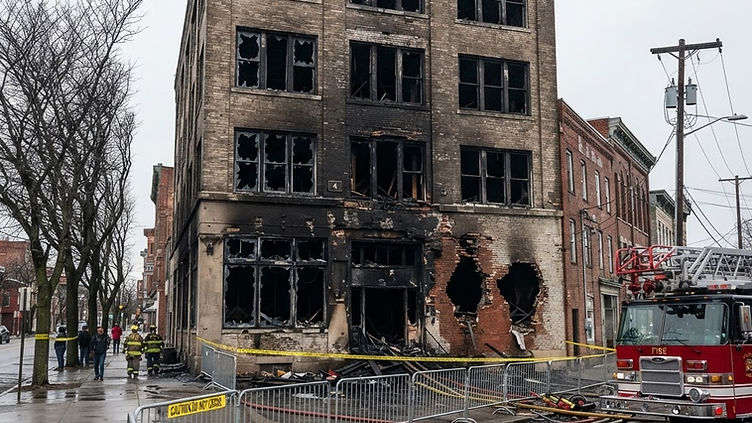
Crews knocked down a first-floor fire inside a four-story masonry warehouse on Maple Street, and fire officials then barred entry to a building with multiple structural holes.
SYRACUSE, N.Y.
SYRACUSE, N.Y. — Fire crews knocked down a fire inside the first floor of a four-story masonry commercial warehouse on Maple Street, and fire officials subsequently described multiple structural holes in the building and said it was too unsafe for investigators to enter immediately, according to CNY Central.
A first-floor fire in a masonry warehouse is normally a winnable fight, and it was won. The building is the casualty. Masonry walls that have been heated and then hit with water lose the integrity that made them stand, and the fire service's practice of cutting ventilation openings adds more holes to the same damaged envelope.
What remains is a tall, empty building that is not safe to enter, cannot be fully searched, and cannot simply be left alone.
Why the investigation delay matters to the owner
The fire department's inability to enter changes the timeline for everything downstream. Cause and origin work waits for a structural evaluation. The insurer's adjuster waits for the cause report. The demolition or repair scope waits for the adjuster. And all of it waits on a building that has to be held, not merely closed.
In the meantime, the owner has an unsecured building with an open roof line or breached wall sections. Two things follow. First, the interior is now exposed to weather, and a masonry building with a wet interior and a freeze overnight is a building that further deteriorates. Second, the building is physically enterable by anyone willing to move a barricade, which is a far lower barrier than most owners assume.
The vacant commercial building problem, stated plainly
Syracuse, like most upstate cities, has an established inventory of large older commercial and industrial buildings whose highest and best use has changed. When one of them burns, the sequence is familiar: an owner who is underinsured, a building that is not worth repairing, a delay while that conclusion is reached, and a vacant structure in the middle of an occupied neighborhood for months or years.
Fire watch and site security are what compress that sequence. A post on the building from the night of the fire accomplishes four things that no temporary fence does:
- It keeps the exclusion zone honest. Officials said the building was too unsafe to enter. That determination only holds if somebody is enforcing it.
- It documents the building's condition. Time-stamped rounds with photographs establish what happened to the property between the fire and the first contractor's visit, which is exactly what an insurer asks about later.
- It catches the second fire. A damaged building with open voids, debris and no detection is a rekindle risk, and empty buildings catch fire from causes that have nothing to do with the original incident.
- It preserves the investigation. A scene that has been walked through by the public is a scene that has been destroyed.
The specific hazards in a post-fire masonry shell
An officer assigned to a building of this type is briefed on hazards that are not obvious from the street:
Falling masonry from parapets and window heads, which is the most common cause of injury at a post-fire shell. Floor openings where stair treads or decking burned away. Water on every surface. Loose sheets of roofing and flashing at the roof edge. And, in a building that has been vacant for some time, whatever was already inside it.
That briefing is what distinguishes a professional post from a person in a chair. The officer needs to know the safe approach distances, the areas that are off limits even to staff, and the reporting chain for structural movement, smoke or entry.
What the owner should arrange today
Confirm in writing what the fire department wants held and at what perimeter. Arrange boarding at every ground-level opening that can be reached. Get a structural evaluation scheduled, because every other decision depends on it. And put a documented overnight post on the building starting the first night, with a written log that names every person who enters and why.
USPA Nationwide Security staffs fire watch and vacant-structure security details in Syracuse and across Central New York, with written round logs and 24-hour dispatch at (877) 246-4253.
Services in Syracuse, NY
Sources
About the reporter
Staff Writer
Staff writer for the USPA Nationwide Security newsroom. Receives newsroom tips, corrections and editorial inquiries.
Author biography and credentialsMore from The Watchline

Fire Protection
New York ordered inspections at 100 Brooklyn sites after a fatal collapse. Stop-work orders create a security problem at scale
A fatal three-story collapse in Brooklyn has produced a citywide structural investigation across 100 building sites, stop-work orders, and evacuated neighboring apartment buildings.
· Albina Bieci

Fire Protection
A Bethlehem duplex fire displaced several families. The building that remains is the liability
A two-alarm fire through the second floor of a multi-family duplex on East Union Boulevard displaced several households and brought the Red Cross in for emergency housing.
· Albina Bieci

Fire Protection
A Clearlake builders supply burned to a shell. The neighboring storefronts are the part still at risk
Lake County and Northshore crews fought a defensive fire at a commercial building on Olympic Drive and Old Highway 53, then stayed for hours of overhaul while the businesses next door stayed open.
· Albina Bieci
