
A Bethlehem duplex fire displaced several families. The building that remains is the liability

By Albina Bieci, Staff Writer
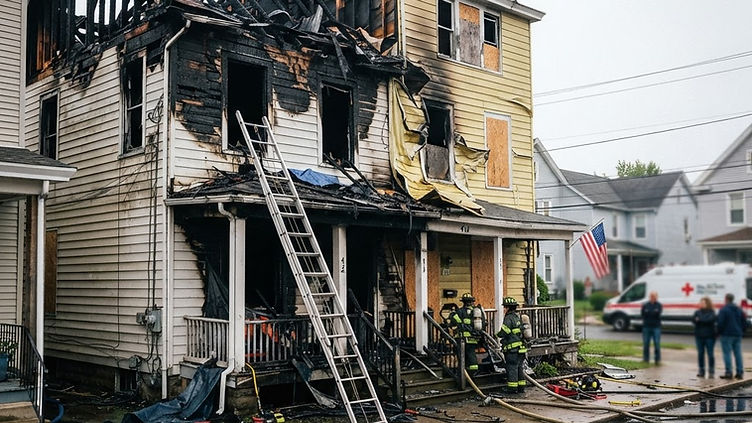
A two-alarm fire through the second floor of a multi-family duplex on East Union Boulevard displaced several households and brought the Red Cross in for emergency housing.

BETHLEHEM, Pa.
BETHLEHEM, Pa. — A two-alarm fire tore through the second floor of a multi-family duplex on East Union Boulevard, displacing several families and bringing the Red Cross in for emergency housing, according to WFMZ-TV 69 News.
The people are out, which is the outcome that matters most. What is left behind is a building that is partially burned, fully closed, and entirely empty, in the middle of a residential block.
That is a harder property to protect than the reporting on the fire suggests, and the reason is that a burned multi-family building is not one structure after the fire. It is two households' worth of independent damage behind one shared roof.
What separates a duplex fire from a house fire
In a duplex, the fire rarely stops at a party wall. Firefighting operations open the wall to check for extension, which creates a path between units that the building did not have. The roof is usually continuous, so a hole cut over the damaged unit opens the attic above the unit next door. And the electrical service is commonly a single drop with separate meters, which means a decision to cut power for safety affects both households, not one.
Three consequences follow that owners are usually not ready for:
- Both units are uninhabitable even when one is undamaged. A unit with no power, no heat and an open connection to a burned unit is not a place a family can stay, and the displacement list grows.
- The building is now unattended on both sides. A vacated duplex is an empty building with two front doors.
- The evidence and the belongings are in the same rooms. Everything the displaced families still own is inside a building nobody can safely enter, which makes access control an emotional and legal problem at the same time.
The code position on watching a burned dwelling
Section 901.7 of the International Fire Code requires a fire watch where a fire protection system is out of service, with the watch defined as an assigned person patrolling on a regular interval, recording the rounds, and prepared to notify the fire department. Pennsylvania has adopted the International Fire Code family of codes statewide, and Bethlehem enforces fire prevention provisions through its own code office.
A dwelling that has lost its smoke alarms and its service is exactly the case the section anticipates. In practice, a municipality may impose the requirement formally through a notice, or an insurer may require it as a condition of coverage on a displaced property. Either way, the substance is the same: somebody has to be looking at the building between now and when the utilities come back.
What actually needs protecting
A displaced multi-family building has four distinct exposures, and a single guard post can cover all of them if the post is briefed properly.
The building itself. Overnight rounds for a rekindle, checking the burned unit's openings, the attic space over the intact unit, and the basement, where suppression water collects. A wet basement with a live service panel is a fire risk on its own.
The contents. Displaced families' belongings sit in a building that is open at the roof. Documented entry, with names and times, protects the owner from an accusation and the tenants from a loss they did not cause.
The neighborhood. An apparently empty house on an occupied block draws attention within days. A visible, uniformed presence and a properly boarded facade are what keep that from becoming a squatter problem before the repairs even start.
The contractors. Boarding crews, restoration crews, adjusters and the fire investigator all arrive in the first week, usually without a schedule. Somebody has to be the person who lets them in and writes down when they left.
What the owner should do in the first 24 hours
Board every ground-level opening, including the unit nobody thinks is damaged. Photograph the condition of both units before any contractor touches anything. Send written notice to both households about access and property retrieval, so the retrieval happens on a schedule rather than on demand. And put a documented overnight post on the building until the service is restored and the structure is closed.
That sequence protects the insurance claim, the tenants' belongings and the neighbors at the same time, and it is considerably cheaper than the alternative once a building has been entered, stripped, or burned a second time.
USPA Nationwide Security provides fire watch and vacant-property security for multi-family losses in the Lehigh Valley and across Pennsylvania, with written round logs and dispatch at (877) 246-4253.
Services in Bethlehem, PA
Sources
About the reporter
Staff Writer
Staff writer for the USPA Nationwide Security newsroom. Receives newsroom tips, corrections and editorial inquiries.
Author biography and credentialsMore from The Watchline

Fire Protection
New York ordered inspections at 100 Brooklyn sites after a fatal collapse. Stop-work orders create a security problem at scale
A fatal three-story collapse in Brooklyn has produced a citywide structural investigation across 100 building sites, stop-work orders, and evacuated neighboring apartment buildings.
· Albina Bieci

Fire Protection
Syracuse firefighters cleared a four-story warehouse as unsafe. An empty building with structural holes is a security assignment
Crews knocked down a first-floor fire inside a four-story masonry warehouse on Maple Street, and fire officials then barred entry to a building with multiple structural holes.
· Albina Bieci

Fire Protection
A Clearlake builders supply burned to a shell. The neighboring storefronts are the part still at risk
Lake County and Northshore crews fought a defensive fire at a commercial building on Olympic Drive and Old Highway 53, then stayed for hours of overhaul while the businesses next door stayed open.
· Albina Bieci
