
A Clearlake builders supply burned to a shell. The neighboring storefronts are the part still at risk

By Albina Bieci, Staff Writer
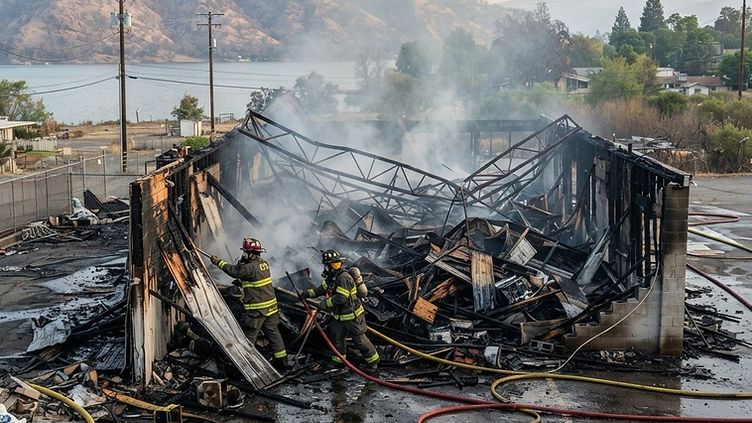
Lake County and Northshore crews fought a defensive fire at a commercial building on Olympic Drive and Old Highway 53, then stayed for hours of overhaul while the businesses next door stayed open.
CLEARLAKE, Calif.
CLEARLAKE, Calif. — Lake County and Northshore fire crews fought a defensive fire Tuesday morning at a commercial building on Olympic Drive at Old Highway 53, associated with Four Corners Builders Supply, and remained on scene for hours of overhaul and hot-spot monitoring, according to Lake County News.
Nobody was reported injured. The building did not survive as a building. What did survive, and what now carries the risk, is the row of commercial property around it.
Defensive operations mean the structure was written off early and the effort went into keeping the fire inside its original footprint. In a builders supply, that is the correct call. Lumber, bagged goods, roofing materials and palletized stock burn hot and fast, and a metal-roofed retail building of that type can fail over the sales floor within minutes of a free-burning fire in the racking.
The exposure problem does not end at the property line
When a commercial fire is fought from the outside, three things happen to the neighboring businesses that do not show up in the initial reports:
- Water and smoke travel. Suppression water carries smoke residue and fine ash, and it pools in the low spots and drains that neighboring properties share. Alarm panels, fire alarm control units, electrical rooms and exterior disconnects are commonly mounted at grade, exactly where that water ends up.
- Alarm systems end up impaired. A panel that has taken water will either fault or fail, and a business whose fire alarm is in trouble is a business with a fire watch obligation under the International Fire Code at Section 901.7, whether or not the fire was in its building.
- The site stays open. A burned retail building has no doors and no windows worth the name. Until it is boarded and fenced, the neighboring lots inherit the traffic that a ruined building attracts.
What "hot-spot monitoring for hours" means
The phrase describes the least visible and most consequential part of the operation. Overhaul is where fire departments open up concealed spaces and wet down debris, and hot-spot monitoring is the check that follows. In a metal-framed building with a collapsed roof deck, the deck layers, insulation and stock beneath hold heat for a long time. Firefighters stand watch on it with handlines and thermal imaging while an excavator or a hook pulls material apart.
That work continues past the point where the department can keep an engine committed for the day. And after it stops, the pile is still there, still capable of producing a rekindle, and now unstaffed unless somebody has hired a watch.
The neighboring businesses should be checking three things today
For the owners of the adjacent retail buildings on Olympic Drive and the frontage road, the practical checklist is short and can be done by the manager on duty.
- Look at the fire alarm panel. Any trouble, supervisory, or ground-fault condition that appeared after the fire should be treated as an impairment and reported to the alarm company the same day. Do not silence a water-damaged panel and reopen.
- Check the exterior electrical equipment. Marshalling yards, meter banks and disconnect enclosures serving the adjacent buildings should be inspected if they were in the runoff path.
- Ask about the site plan for the burned building. Boarding, fencing, demolition schedule. A neighboring business that knows the timeline can plan around the traffic and the dust; one that does not finds out the hard way.
Why a burned commercial property needs people, not just barriers
Boarding and fencing are the first step and they are not sufficient. A burned commercial site attracts two distinct populations: people looking for salvageable material, and people looking for a dry place to be. Both are dangerous in a building with a collapsed roof, floor openings and unstable racking, and both are the property owner's liability.
A documented fire watch on a burned commercial building does three jobs at once. It watches the debris for rekindle, it controls and records access for the demolition and salvage crews that will be in and out for weeks, and it provides a visible, uniformed presence at a site that otherwise reads as abandoned. Where the exposure to neighboring businesses matters, the post typically includes the shared property line rather than sitting at the front door of the burned building.
USPA Nationwide Security provides fire watch and site security for commercial losses in Lake County and across Northern California, with documented rounds and dispatch at (877) 246-4253.
Sources
About the reporter
Staff Writer
Staff writer for the USPA Nationwide Security newsroom. Receives newsroom tips, corrections and editorial inquiries.
Author biography and credentialsMore from The Watchline

Fire Protection
New York ordered inspections at 100 Brooklyn sites after a fatal collapse. Stop-work orders create a security problem at scale
A fatal three-story collapse in Brooklyn has produced a citywide structural investigation across 100 building sites, stop-work orders, and evacuated neighboring apartment buildings.
· Albina Bieci

Fire Protection
A Bethlehem duplex fire displaced several families. The building that remains is the liability
A two-alarm fire through the second floor of a multi-family duplex on East Union Boulevard displaced several households and brought the Red Cross in for emergency housing.
· Albina Bieci

Fire Protection
Syracuse firefighters cleared a four-story warehouse as unsafe. An empty building with structural holes is a security assignment
Crews knocked down a first-floor fire inside a four-story masonry warehouse on Maple Street, and fire officials then barred entry to a building with multiple structural holes.
· Albina Bieci