
New York ordered inspections at 100 Brooklyn sites after a fatal collapse. Stop-work orders create a security problem at scale

By Albina Bieci, Staff Writer
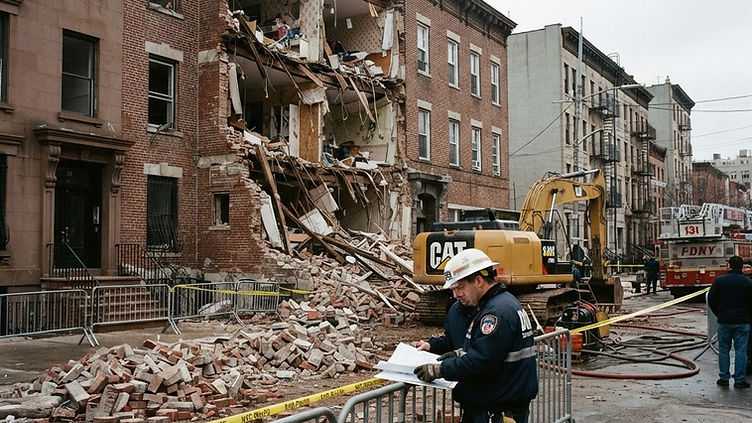
A fatal three-story collapse in Brooklyn has produced a citywide structural investigation across 100 building sites, stop-work orders, and evacuated neighboring apartment buildings.
BROOKLYN, N.Y.
BROOKLYN, N.Y. — New York City officials have launched a structural investigation across 100 building sites following the fatal collapse of a three-story mixed-use apartment and commercial building in Brooklyn, Insurance Journal reported Tuesday.
The collapse was triggered by adjacent excavation rather than by fire, and that detail is the reason the response reaches so far past one address. Where a building fails because the ground beside it was removed, every site with a similar excavation condition becomes a candidate, and a citywide inspection program is the only defensible answer.
For the owners and managers of the buildings caught in that sweep, the immediate result is not a repair order. It is a stop-work notice, an evacuation, and a life-safety system that is no longer being supervised by anyone living in the building.
What a stop-work order changes about a building
A stop-work order is a safety instrument, and it does what it says. It also has a side effect that is rarely discussed and shows up in the first week: a building that had people in it now does not.
Three things follow immediately:
- The alarm system becomes an orphan. A fire alarm in an occupied building is monitored, tested by its occupants every time somebody burns toast, and answered by a responding company. In an emptied building, a supervisory signal goes to a central station and then to an owner who is not on site. Nobody investigates a smell of smoke.
- Standpipes and sprinklers lose their periodic attention. A system that is intact but unheated, unmonitored and untested for weeks is a system nobody can vouch for.
- Access fragments. The owner, the general contractor next door, the Department of Buildings inspector, the structural engineer and the tenants retrieving belongings all need entry, and none of them share a schedule.
New York's Fire Code, like the model International Fire Code at Section 901.7, requires a fire watch wherever a fire protection system is out of service, and requires the watch to be conducted by an assigned person on a documented round. Where a building has been vacated by order, that requirement attaches to the owner whether or not anyone has handed them a piece of paper about it.
The excavation-adjacent problem
The condition that produced this collapse is one of the most predictable in urban construction and one of the least visible to a building's occupants. A building founded on shallow footings beside a deep excavation is supported by soil that the excavation has removed. Movement typically shows up as new cracks in plaster, sticking doors, a slope in a floor, or a separation at a party wall, none of which an occupant reads as an emergency.
A neighboring property can buy real protection with three low-cost steps:
- Pre-construction survey. Document the condition of the adjacent building before the excavator starts. Without that baseline, damage is arguable.
- Monitoring. Crack gauges and, on larger excavations, survey points on the neighboring facade. The data is the argument.
- A named contact on the construction side. The person a building manager can call at 7 a.m. when a door stops closing.
What 100 sites means for staffing
Nothing in the reporting suggests that all 100 sites will be evacuated, and most will resolve with an engineering letter. But a meaningful share of them are likely to sit in a legal limbo for weeks, and limbo is when a building is least protected. Owners in that position are, in practice, being asked to hold a property that is simultaneously off limits and required to remain safe.
The practical answer is a documented post. An officer assigned to a vacated building during a stop-work period:
- Walks the building and its perimeter on an interval, checking for water intrusion, new movement, and signs of entry.
- Verifies that life-safety systems in the building remain in a known state, and reports any change.
- Controls the door for contractors, engineers and inspectors, with a written log naming each person and time.
- Provides immediate notification to the owner and the fire department if conditions change.
That is the substance of what a fire watch does on an unoccupied building, and it is the reason the requirement exists rather than being satisfied by a padlock.
For owners currently under an order
Get the engineer scheduled immediately, because the order does not lift until the report exists. Keep the building's systems in a defined state and write down what that state is. Board and secure every accessible opening, including service doors and roof hatches. Then staff the building until it is either reoccupied or demolished.
USPA Nationwide Security provides fire watch and vacant-building security for New York City properties under stop-work and evacuation orders, with documented rounds and dispatch at (877) 246-4253.
Services in Brooklyn, NY
Sources
About the reporter
Staff Writer
Staff writer for the USPA Nationwide Security newsroom. Receives newsroom tips, corrections and editorial inquiries.
Author biography and credentialsMore from The Watchline

Fire Protection
A Bethlehem duplex fire displaced several families. The building that remains is the liability
A two-alarm fire through the second floor of a multi-family duplex on East Union Boulevard displaced several households and brought the Red Cross in for emergency housing.
· Albina Bieci

Fire Protection
Syracuse firefighters cleared a four-story warehouse as unsafe. An empty building with structural holes is a security assignment
Crews knocked down a first-floor fire inside a four-story masonry warehouse on Maple Street, and fire officials then barred entry to a building with multiple structural holes.
· Albina Bieci

Fire Protection
A Clearlake builders supply burned to a shell. The neighboring storefronts are the part still at risk
Lake County and Northshore crews fought a defensive fire at a commercial building on Olympic Drive and Old Highway 53, then stayed for hours of overhaul while the businesses next door stayed open.
· Albina Bieci