
A two-alarm fire broke through the roof at The Hive apartments on Abrams Road and damaged six units

By Albina Bieci, Staff Writer
Fire broke through the roof of the northeast Dallas complex and six units were damaged. A roof breach and an impaired alarm panel are what put the neighboring wings into a fire watch posture.
DALLAS, Texas
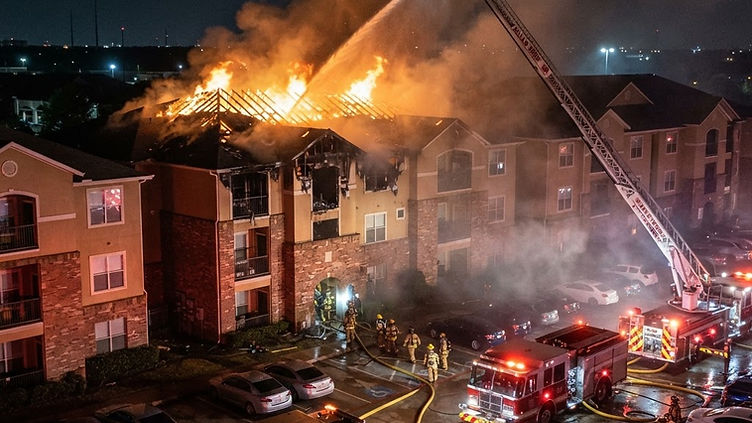
A two-alarm fire broke through the roof of The Hive apartment complex on Abrams Road in northeast Dallas, damaging six residential units and drawing a response that Dallas Fire-Rescue described in the dozens of fire department units, according to reporting by The Dallas Morning News.
That figure refers to fire department apparatus and companies, not to apartments. A response of that size is what a working fire in a large wood-frame residential building produces in Dallas, where the department dispatches on a structure fire assignment that scales quickly when the first company reports fire through the roof.
What has been confirmed
The fire occurred at The Hive apartments on Abrams Road in northeast Dallas. The alarm escalated to two alarms. Fire broke through the roof of the building. Six residential units were damaged.
No confirmed account of injuries has been released. The cause has not been established in the reporting available at publication, and no damage estimate has been made public. Dallas Fire-Rescue has not announced an investigative finding, and any statement about origin at this stage is preliminary.
Roof fire in a wood-frame apartment building
When fire breaks through the roof of a three-story residential building, the fire has usually been traveling in a concealed space for longer than anyone on scene would like. A wood-frame apartment building with a continuous attic or a common roof structure gives fire a horizontal highway above the ceiling line. Crews working the interior below hear it and feel the heat, and the company on the roof opens the deck to release it.
Opening the roof is a decision with two consequences. It stops the fire from spreading laterally through the attic, which saves the neighboring wings. It also commits the building to water damage in every unit below the opening, and it leaves a structure that has to be covered before the next rain.
The report of six damaged units in a complex of this size is consistent with a fire that was stopped at a compartment line. The units that took the water and the smoke are counted with the units that burned, because after the fire they are in the same condition: uninhabitable until they are dried, cleaned and inspected.
The alarm panel is the second casualty
In a large apartment complex, the fire alarm system is addressable and shared. A fire in one building puts the panel into alarm, and the suppression of the fire, the opening of the roof and the water used to finish the job put devices on that panel into trouble or into a fault condition. When the panel cannot be restored the same night, the buildings it serves are left without automatic detection.
That is the condition that produces a fire watch requirement. Texas adopts the International Fire Code locally, and Dallas Fire-Rescue's fire marshal's office has the authority to require a watch when a required protection system is out of service. On a multi-building complex, the order is usually limited to the buildings affected by the impairment rather than the entire property, which is why the scope has to be written down rather than assumed.
For the property, the practical questions are which buildings are affected, whether the affected buildings are occupied, and who is on post in each of them overnight. A guard at the leasing office does not answer any of those questions.
Related coverage
Watchline has reported on roof and attic fires in multi-unit buildings in three other markets recently. In Knoxville, a roof fire at The Elements at Cedar Bluff displaced 17 residents and closed all fourteen units. In St. Paul, an attic fire collapsed the roof of a 20-unit complex and emptied the buildings beside it. In South Bend, an overnight fire in a three-unit building hospitalized one man and displaced the rest of the tenants.
What the first week looks like for the property
The damaged units get secured. That means doors that close and lock, windows that are boarded from the inside where the glass is gone, and a barrier between the damaged section and the occupied section that a person cannot push through. In a complex with open breezeways and exterior stairs, that barrier is often a posted officer rather than a wall.
Residents in the undamaged units need to know what is working and what is not. If the alarm in their building is down, the property has an obligation to tell them, and in most jurisdictions that obligation is tied to the same order that requires the watch.
Contractors and adjusters will want access within days. Each of them needs to be logged in and out, because a building with six empty units and a damaged roof is a building where a stranger carrying a clipboard is not questioned by anyone.
The service connection
USPA Nationwide Security provides emergency fire watch and post-fire site security for apartment complexes across the Dallas–Fort Worth area, including properties where a fire has left the alarm or sprinkler system impaired in one or more buildings. Officers are posted in the affected buildings, log rounds, control access to damaged units and call the fire department directly when something is found. Requests can be made through the emergency fire watch page or by calling (800) 214-1448.
The fire watch white paper covers how post orders are written when only part of a property is impaired, which is the usual situation at a complex like this one.
How a structure fire assignment escalates
A structure fire response in a large city starts with a fixed assignment of engines, trucks and a command officer. The first company on scene reports conditions, and that report drives the escalation: a second alarm brings another group of companies and additional chief officers, and a third follows if the building is large, the fire is not being controlled, or the exposures demand it.
A working apartment fire draws a response measured in dozens of fire department units because the work is divided. Companies are assigned to fire attack, to search, to ventilation, to water supply and to exposure lines on either side of the building. Each assignment needs its own crew, and each crew needs relief after a period of work in heat.
Sprinkler status depends on when the building was built
Whether an apartment building of this type is sprinklered turns on its construction date and the code edition the jurisdiction was enforcing when the permit was issued. Buildings from the 1970s and 1980s in many Texas cities were permitted without residential sprinklers, while buildings from the 2000s onward were commonly required to have them, either through local adoption of the International Fire Code or through a city ordinance.
That distinction matters after a roof fire. A sprinklered building gives crews time to reach the seat of the fire before it enters the attic; an unsprinklered building gives them the fire they find. The difference shows up in the number of units damaged, and in whether the roof has to be opened.
What six damaged units mean for the property
A fire that damages six units in a large complex creates obligations running on different clocks. The damaged units have to be secured within hours. The residents have to be relocated, which falls to the property unless the building is condemned. The undamaged units in the same building have to be assessed for smoke and water intrusion, which is frequently more extensive than the fire damage and takes longer to remediate.
Then there is the alarm system. Restoring an addressable panel after a working fire requires a technician, a device-by-device check, and often replacement of devices exposed to heat or water. Until that is done, the building is a residential occupancy without automatic detection, and the fire official decides what that requires.
The morning after a roof fire
An open roof is a countdown. The building below it is now exposed to whatever weather arrives before the structure can be covered, and water intrusion through an opened deck reaches ceilings, insulation and wall cavities well beyond the units that burned. Most restoration contractors want the roof tarped or the opening closed within a day, and the property usually has to arrange that independently of the insurance adjustment.
Covering the opening is also a security measure. A building with a hole in its roof and six empty units is a building that people can enter from above as easily as from the breezeway. Until the deck is closed and the damaged units are secured, the property is managing an open structure at night with residents still living in the same building.
Sources and status
Reporting on the incident is attributed to The Dallas Morning News. The cause, the injury account and the damage estimate remain open pending release by Dallas Fire-Rescue. Technical references include NFPA 1, Fire Code, NFPA 25 and the U.S. Fire Administration. This article will be updated as the investigation develops.
Services in Dallas, TX
Sources
About the reporter
Staff Writer
Staff writer for the USPA Nationwide Security newsroom. Receives newsroom tips, corrections and editorial inquiries.
Author biography and credentialsMore from The Watchline

Fire Protection
A two-alarm fire on College Hill gutted one unit, displaced about 15 residents and sent a Pullman officer to the hospital
The fire ran through a six-unit building in the campus neighborhood, and a responding officer was treated for smoke inhalation. Smoke and water damage across the adjoining units is what forces the power and alarm shutdowns.
· Albina Bieci

Fire Protection
A three-alarm fire tore through the vacant former Stockton Record building on East Market Street
Crews fought the multi-story former newspaper office and warehouse complex defensively and closed downtown streets. A vacant building that has burned is a security assignment before it is anything else.
· Albina Bieci

Fire Protection
Sprinklers put out an overnight fire at a Perrysburg Township business, and the discharge is what closes it next
The building's automatic sprinkler system suppressed the fire before it reached major structural loss. Once a system discharges and comes offline for recharging and head replacement, the building is unprotected until it is put back in service.
· Brian Fitzgibbons
