
A roof fire at The Elements at Cedar Bluff displaced 17 residents and closed all fourteen units

By Albina Bieci, Staff Writer
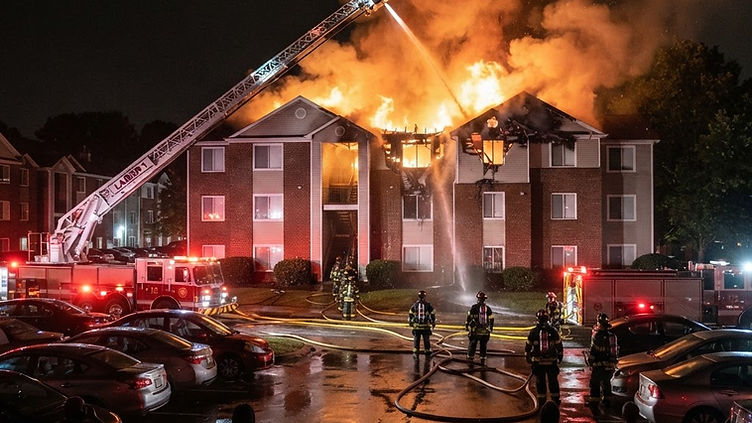
The fire went through the roof of a 14-unit building at the Cedar Bluff complex, heavily damaging five units. Two assessments now decide whether nine other households can return, and the fire-protection one starts a clock.
KNOXVILLE, Tenn.
A multi-alarm fire tore through the roof of a 14-unit apartment building at The Elements at Cedar Bluff, heavily damaging five units and displacing 17 residents, WATE 6 and WBIR 10 reported.
The building is now the subject of two separate assessments. One answers a structural question: whether the roof, the framing beneath it and the load path down to the foundation are sound enough for anyone to live under. The other answers a fire-protection question: what remains of the alarm system, the sprinkler system covering the affected units, and the water supply that feeds both.
Both matter for the same reason. A 14-unit building with five heavily damaged units is a building where nine households and a burned wing share walls, a stair and a single address, and nobody can return to any part of it until someone qualified says which parts are safe and which systems still work.
What has been confirmed
WATE 6, the ABC affiliate in Knoxville, and WBIR 10, the NBC affiliate, reported that the fire went through the roof of a 14-unit building at The Elements at Cedar Bluff, that five units were heavily damaged, that 17 residents are displaced, and that structural and fire-protection assessments are required before occupancy resumes.
Not established in the public reporting: the cause, the number of alarms struck, whether anyone was injured, the role of the building's alarm and sprinkler systems, whether the affected units had attic protection, and how long the building will be closed. Those questions are open. A fire under investigation is under investigation, and a determination that a system failed or a code was violated is a finding for the fire department, the state fire marshal or a court to make.
Why a roof fire ends occupancy for an entire building
An apartment roof is rarely just shingles. Under the finish there is sheathing, then a structure that in garden-style and low-rise multifamily construction is usually engineered lumber: parallel chord trusses, plywood or oriented strand board gussets, and a rated ceiling assembly below that is supposed to buy time for people to leave.
Fire that reaches that assembly behaves differently from a fire in a room. The attic or truss space acts as a horizontal channel, and once the fire is inside it there is little to stop lateral spread short of a fire-rated separation. That is why roof involvement converts a single-unit fire into an all-units emergency, and it is why the response escalates to multiple alarms: the water has to come from outside and above rather than from a line inside a corridor.
Overhaul is the second reason the building closes. Opening a roof and pulling ceilings to find hidden fire puts hundreds of gallons of water into insulation, drywall and floor assemblies. A unit that shows no fire damage still sits under a roof that has been cut, over a ceiling that has been removed, and above insulation that is soaked. None of that is habitable, and none of it is a question a property manager can answer without an engineer.
The arithmetic of 14 units and 17 residents
Seventeen residents out of a 14-unit building indicates roughly one person or more per unit across most of the building, which is normal for a complex of this type and is the number that matters for sheltering. In practice, a displacement of this shape divides into three groups, and they move on different clocks.
The five households in heavily damaged units are out for months. Their recovery runs through insurance, a restoration contractor and a rebuild that starts only after the cause determination and the engineer's report. The nine households in units that took smoke, water or power loss are out for days to weeks while cleanup and testing occur. The property, meanwhile, is out of revenue on 14 units regardless of which category each falls into.
That last point is the one owners tend to underweight. A building that cannot be occupied still has to be protected, and the cost of protecting it does not pause while the insurance claim develops.
What the two assessments actually cover
The structural assessment answers specific questions: whether the roof structure over each unit retains its capacity, whether any bearing wall or floor assembly was compromised by fire or water, and whether the building can be occupied in whole or in part. In a building with a shared roof plane over multiple units, a partial occupancy answer usually requires temporary separation between the occupied and unoccupied sections, and that separation has to be accepted by the authority having jurisdiction before anyone moves back in.
The fire-protection assessment is the one that carries a code obligation with a deadline attached. If sprinkler piping in the affected wing was drained or damaged, if detection devices in the burned units were destroyed, or if the fire department shut a control valve to protect equipment, then a portion of the building's designed protection is out of service. The applicable provision is Section 901.7 of the International Fire Code, which requires notification of the fire code official when a required system is out of service and, where the system cannot be restored, a fire watch. The Knoxville Fire Department is the authority that will decide what this building needs and for how long.
There is a mechanical wrinkle worth stating plainly. A dry system that was charged after the fire, a wet system that was refilled without a proper restoration test, or a detection loop repaired by a contractor without documentation all produce a building that looks protected and cannot prove it. NFPA 25 calls for the restoration test and the record, and that record is what an insurer asks for after the next event.
Fire watch and security are two different assignments
A partially vacated building needs both, and they are not interchangeable.
A fire watch exists because a fire protection system is impaired. The officer walks a defined route on a stated interval, looks for smoke, heat and water where neither belongs, records each round, and escalates to the fire department without delay. The assignment ends when the system is restored and tested, not when the fire is out.
A security post exists because the property is empty or half empty and its contents are exposed. Burned units standing open, a parking lot with residents' vehicles still in it, a leasing office with records and keys, contractors moving in and out during the day and nobody on site at night. That is an access-control problem, and it is answered by a post at the point people actually enter, a log, and supervision of the damaged units while salvage and restoration work proceeds.
In a complex like this one, both assignments usually run at the same time and can be handled by the same officers only if the watch route and the security post are written as separate duties with separate logs. Combining them informally is how a watch becomes a guard standing in a lobby.
Related coverage
Roof involvement is the through-line in several recent multifamily reports. In Manhattan, a four-alarm fire on West 107th Street took the roof of a walk-up and turned the fire into a long operation (read that report). In Providence, an apartment fire took the breaker panels and the smoke detectors with it, leaving the building without the systems a nighttime evacuation depends on (that story is here). In Orlando, a condemned building on Rio Grande Avenue turned a fire into a perimeter problem (previously reported).
Coverage for Knoxville properties
A Knoxville property facing an impaired alarm or sprinkler system, a partial occupancy hold, or a fire marshal's order can review what documented coverage involves on the Knoxville fire watch page and on the national emergency fire watch page. The technical basis for the requirement, including how a watch is scoped and documented, is set out in the fire watch white paper.
Nothing in that material implies USPA responded to or was retained for this incident. It was not.
The revenue and insurance clock
Fourteen units out of service is fourteen units of rent that stop while the mortgage does not. Most multifamily policies cover lost rent for a stated period, and that period starts on the date of loss, which means the repair schedule and the coverage window begin together and rarely end together. A rebuild that runs past the coverage window becomes an out-of-pocket loss, and properties discover that only after the engineer's report moves the completion date.
That is the practical argument for resolving the fire-protection assessment first. Structural repair is planned work with a known sequence. Restoring a sprinkler system and getting it tested is faster, cheaper and it is the item that governs whether part of the building can be reoccupied at all.
What to watch next
The cause determination and the engineer's report will set the timetable. The fire-protection assessment sets the obligation, and the obligation begins the moment a required system goes out of service, whether or not the building is empty. A property that documents the impairment, the watch and the restoration test ends this incident with a file. A property that waits for the claim to resolve before restoring protection ends it with an exposure it cannot document.
WATE 6 and WBIR 10 are the primary accounts of this incident at this stage. This article will be updated if the fire department or the property releases information that changes the sequence above, and any update note will state what changed.
Services in Knoxville, TN
Sources
- WATE 6 (ABC Knoxville) — report on The Elements at Cedar Bluff fire
- WBIR 10 (NBC Knoxville) — report on the Cedar Bluff apartment fire and displacement
- National Fire Protection Association — NFPA 25, inspection, testing and maintenance of water-based systems
- U.S. Fire Administration — multifamily residential fire loss research
About the reporter
Staff Writer
Staff writer for the USPA Nationwide Security newsroom. Receives newsroom tips, corrections and editorial inquiries.
Author biography and credentialsMore from The Watchline

Fire Protection
After three alarms on West Broad Street, the fight is over who enters a five-story building nobody may occupy
The three-alarm fire is out, but the five-story building on West Broad Street is still held: residents and businesses are out, and the terms of securing the property and letting people back in are the unresolved part.
· Albina Bieci

Fire Protection
Private hydrants at a Huntsville complex could not hold pressure, so crews ran hose to the street instead
Crews ran more than 100 feet of hose to street hydrants after the property's own hydrants could not hold pressure. Fifteen families are out, and the flow test that was never produced is the document that now matters most.
· Albina Bieci

Fire Protection
Sprinklers held a Deerfield Beach office fire to one room, and the discharge is what closes the building next
Broward Sheriff Fire Rescue found the fire in a third-floor office at 800 Fairway Drive already suppressed by the building's own system. The water that stopped it is what puts part of the building's protection out of service until the system is drained, repaired and recertified.
· Albina Bieci
