
A four-alarm fire on West 107th Street took the roof of a Manhattan walk-up, and the building is now a long operation

By Albina Bieci, Staff Writer
A partial roof collapse and gutted units end the residential use of the building and begin a forensic and clearing phase that has to be secured while the structure is still failing.
NEW YORK
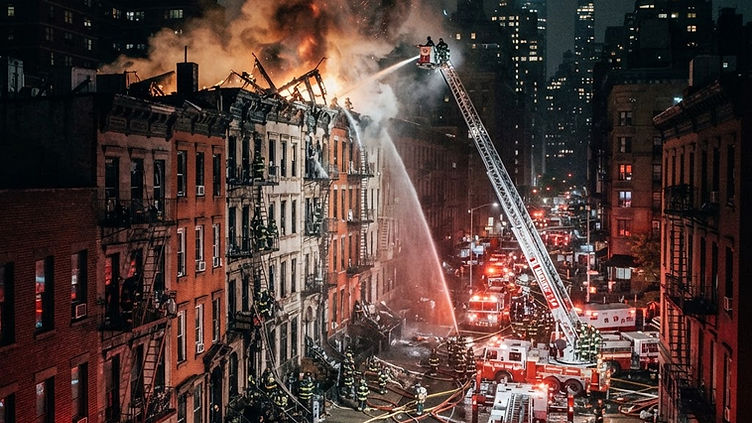
NEW YORK — A four-alarm fire broke out on West 107th Street and ripped through a dense multi-family residential building, producing a partial roof collapse and leaving multiple units completely gutted.
In a building of that type, on a block of that density, the fire is the beginning of a months-long operation. The structure is compromised, the cause is under investigation, and the property has to be protected while both of those are true.
What was reported
The account published by ABC7 New York describes a four-alarm fire in a multi-family building on West 107th Street, a partial roof collapse and multiple units gutted. Those three facts define the phase the building has entered: no occupancy, active structural concern, and a cause investigation that will need the scene undisturbed.
A roof collapse changes the building's classification
A walk-up that loses part of its roof is no longer an occupied building with damage. It is a structure whose top-floor load path and weather envelope are both open, in a city where the next rain arrives within days and water travels down through a building in ways that are invisible from the street.
That has two consequences for a watch. The first is access: the top floor and the areas under the collapsed section are not walkable, and the route has to be built around them rather than through them. The second is condition monitoring: a compromised roof and its supporting walls move, and the signs of movement are what a post is looking at when it is not looking for smoke.
The investigation constrains everybody
When a fire of this size is under investigation, the scene is evidence. Access is controlled by the investigating agency, and any private presence on site has to work inside that control rather than around it. An officer who moves debris, opens a door for a contractor or lets a resident upstairs is interfering with an investigation, however well-intentioned.
The practical expression of that is a post whose authority is clearly written: who may enter, on whose authorization, with what escort and recorded how. On a building of this kind the answer is usually that nobody enters except the fire department, the investigating agency, the engineer and named contractors working under a permit.
Why asset protection runs beside the fire watch
In a dense Manhattan block, a gutted building on a scaffolded street attracts three predictable kinds of entry: residents trying to retrieve belongings, people taking what is not theirs, and people who are simply curious. All three are dangerous in a structure with a partial roof collapse, and the second one is the reason the assignment is not purely about fire.
Asset protection at this stage is mostly a matter of denial and record. Doors secured and re-secured, openings closed, the perimeter walked, and any entry logged. For residents, it means a process: identification, an appointment, an escort, a time limit, and somebody who knows which parts of the building are safe to reach. That process is the difference between a controlled retrieval and an injury claim.
Why it lasts for months
A building with gutted units, a partial roof collapse, an open investigation and an insurance claim does not return to occupancy on the fire department's schedule. It returns when the investigation releases the scene, the structural engineer signs off, the repair scope is priced and permitted, and the work is done and inspected. In New York that sequence routinely runs past a year.
Through all of it the property carries a fire risk, because a partially demolished, unoccupied structure with exposed voids and intermittent contractor work is exactly where a small fire becomes a large one unnoticed. That is the reason a watch persists after the news cycle rather than for the two weeks the street stays closed.
USPA staffs emergency fire watch and vacant-structure security in New York City and the surrounding boroughs, with posts written to coexist with an active fire investigation. Dispatch answers continuously, and the company's regulatory knowledge base sets out how a post is scoped against a specific structural impairment.
Scaffolding and weather change the perimeter
A building with a partial roof collapse in a dense block is usually wrapped in protection within days: a sidewalk shed, netting, a construction fence, sometimes a standpipe and temporary lighting. Those measures protect the public. They also change what a post can see, which is why the route has to be rewritten after the shed goes up rather than inherited from the first week.
Weather is the second variable. An open roof in a city that rains means water entering the structure for as long as the opening exists, and water in a burned building finds the ceilings below, the electrical, and any area where debris is collecting. A post that records standing water and reports it is doing structural monitoring as well as fire watch, and on a building of this kind that is not an overreach.
How residents get back to their property
The retrieval process is where a secured building either maintains order or loses it. It starts with a single published point of contact, because twelve different phone numbers circulating in a tenant group chat produce twelve people arriving at different hours and expecting entry.
The working format is straightforward. Identify the tenant against the lease or the fire department's record. Schedule a window. Confirm before the appointment, so the building is not opened for someone who is not coming. Escort to the unit, with the officer knowing which floors are accessible and which are not. Limit the time, provide bags or boxes, and document what was removed. Then secure the unit again and record that too.
Residents who are treated consistently accept the rules. Residents who watch someone else get in without the process abandon it, and a security presence that is no longer respected is a cost with no benefit.
What the insurer will ask, and when
The questions arrive in this order: was the building secured, who secured it, on what basis, and can you prove the condition of the property at the point it was secured. Photographs taken on the first shift answer most of that, and a log that runs without gaps answers the rest.
The mistake properties make is treating the claim adjuster as the audience for the repair scope. The audience for the watch record is different and often later: a subrogation inquiry, a tenant action, or an examination under oath about what the property knew and when it acted. Documenting from the first night costs nothing. Reconstructing it a year later costs considerably more.
The fire department's schedule is not the building's schedule
The fire department releases a scene when its work is done and its investigation allows. It does not release a building for occupancy, and it does not take on the property's obligation to secure a structure it has left. Those are separate events with separate authorities, and the gap between them is where a building sits empty and unwatched.
Properties that plan for that gap treat the first night after the trucks leave as an operational task rather than a surprise. Somebody is on post before the last company clears, the perimeter is walked with the property's own record of what was secure on arrival, and the access authority is confirmed in writing the same day. That sequence is the difference between a secured scene and a building that is discovered, on a Monday, with a door standing open.
What a secured building looks like from the street
The measure of a secured structure is not the presence of a uniform. It is whether a person who does not belong can get in. That question is answered by walking the perimeter the way an intruder would: the rear service door, the basement entry under the stoop, the alley gate, the first-floor window with fire damage behind it, the roof hatch that somebody will find if the shed gives access.
A building on a busy street is harder to enter by the front and easier by the back. A building on a corner has two exposed sides and two that are not. A building with a construction fence has a perimeter that looks controlled and often is not, because the gates are latched from the outside and the panels can be shifted. Post orders that name those specific points are worth more than an instruction to conduct rounds.
What the property should be able to produce
Three things, on request. The current access authority, in writing, with the name of the agency and the contact who granted it. The post orders, describing the route, the denied areas and the escalation path. And the log, continuous from the first shift. A building in this condition is judged on those documents long before it is judged on its repairs.
Services in New York, NY
Sources
About the reporter
Staff Writer
Staff writer for the USPA Nationwide Security newsroom. Receives newsroom tips, corrections and editorial inquiries.
Author biography and credentialsMore from The Watchline

Fire Protection
A storage-area fire on East Las Olas Boulevard damaged the monitoring circuits, and the businesses cannot reopen without a person on patrol
Contained fire damage and a dead alarm circuit are not the same problem. The second one keeps storefronts shut until a human being is walking the building.
· Albina Bieci

Fire Protection
A Providence apartment fire took the breaker panels and the smoke detectors with it
Interior framing failed and utility service was cut to the block, which puts an emptied building back to the condition fire codes were written to prevent: no power, no detection, no occupants to notice.
· Albina Bieci

Fire Protection
Orlando condemned the building on Rio Grande Avenue. What follows is a perimeter problem, not a fire problem
A fast fire took the roof and the second-floor platforms, inspectors condemned the complex, and the ordinance that follows requires round-the-clock security of an emptied building.
· Albina Bieci