
Sprinklers put out an overnight fire at a Perrysburg Township business, and the discharge is what closes it next

By Albina Bieci, Staff Writer
The building's automatic sprinkler system suppressed the fire before it reached major structural loss. Once a system discharges and comes offline for recharging and head replacement, the building is unprotected until it is put back in service.
PERRYSBURG TOWNSHIP, Ohio
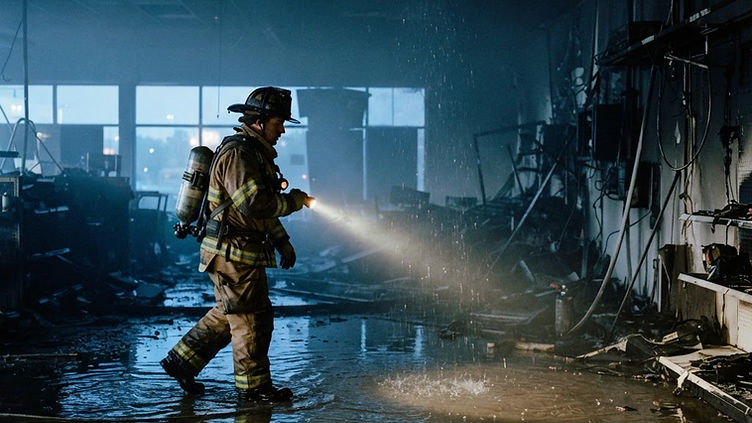
An overnight fire at a commercial business in Perrysburg Township, Ohio, activated the building's automatic fire sprinkler system, which suppressed the flames before the fire produced major structural loss, according to reporting by WTOL 11.
That is the outcome the system was installed to produce. It is also the beginning of a second problem, and the second problem is the one that catches commercial tenants by surprise. A sprinkler system that has flowed water is out of service from the moment it is shut down, and the building it protects has no lawful substitute for it until the system is repaired, tested and returned to service.
What has been confirmed
The fire occurred overnight at a commercial business in Perrysburg Township. The building's sprinkler system activated and suppressed the fire, limiting structural damage. The cause has not been established in the reporting available at publication, and no damage estimate has been released.
What the reporting establishes is the sequence that matters operationally: fire started, sprinkler operated, fire stopped. What remains open is how many heads fused, how long water flowed before the supply was shut, and what the water did to the space below it.
What one head actually does
A commercial sprinkler system is designed around a specific fire, not around the worst fire imaginable. Heads fuse individually when the air above them reaches their temperature rating, which is why the common description of the system is that it applies water where the fire is and nowhere else. In a fire that a single head controls, that means one head flowing roughly fifteen to thirty gallons a minute, often for ten or fifteen minutes before the fire department arrives and shuts the supply.
The fire loss in that scenario is small. The water loss is not. Sprinkler water travels down, and everything under the head gets it: ceiling tiles, insulation, office equipment, inventory on lower shelves, electrical panels mounted at the wrong height, and the subfloor. A business that loses a single aisle of stock to fire can lose the room beneath it to water, and the remediation timeline runs on drying rather than on rebuilding.
The impairment rule is the part owners miss
Once the fire is out and the supply is shut, the system is impaired. Heads must be replaced with matching units, the piping must be inspected for damage, the riser and the alarm devices must be checked, and the system has to be returned to service and confirmed. That work does not happen at two in the morning. It happens when a sprinkler contractor has a crew available and the right parts on the truck.
In the interval, the building is a commercial occupancy with no automatic suppression. Ohio's fire code adopts the model codes, which give the local fire official authority to require a fire watch when a required protection system is out of service, and to set the terms of that watch. NFPA 25, the standard that governs inspection, testing and maintenance of water-based systems, describes the impairment procedures that go with taking a system offline: notify the fire department, notify the occupants, and where the authority having jurisdiction requires it, post a fire watch until protection is restored.
A watch is not a formality on a commercial property. A business with combustible stock, a loading dock, hot equipment and a building full of cardboard is a fire load that the system was sized to control. Without it, the same fire that produced a few thousand dollars of damage runs until the fire department arrives, and the difference between those two outcomes is measured in minutes.
What a watch looks like on an impaired system
A posted officer walks the building on a documented route and interval, looks for smoke and heat where the system would have detected them, checks that exits remain clear and that fire doors are closed, and knows where the nearest alarm pull and phone are. The officer logs the rounds with times.
On a building that has already flowed water, the assignment usually includes two additional items. The first is monitoring the affected area for the smell of smoke in concealed spaces, because a fire that has been knocked down in a ceiling void can sit and redevelop. The second is access control, since a commercial building with wet floors, exposed wiring and contractors working after hours is a building where a stranger walking in is not immediately noticed.
Related coverage
Watchline has reported on the same impairment problem twice in the past week. In Deerfield Beach, Florida, sprinklers held an office fire to one room, and the discharge is what closed the building next. In Lubbock, a split sprinkler line ahead of the first freeze put a building in the same position without a fire at all.
The insurance and lease angle
Commercial property policies commonly include protective safeguards endorsements, which require the insured to maintain the sprinkler system and to report when it is not working. A tenant operating under a lease that requires the landlord to maintain fire protection may find that the obligation to vacate or to post a watch falls to whoever controls the space, and the two parties rarely agree on that point at six in the morning.
The practical answer is to document everything: the time the system was shut down, the reason, who was notified, what interim measures were put in place, and who performed them. That record is what a carrier reviews when it decides whether a subsequent loss was mitigated properly.
The service connection
USPA Nationwide Security provides sprinkler impairment and fire alarm impairment fire watch for commercial properties in northwest Ohio, including buildings where a discharge or a failed component has taken a system out of service. Officers are posted on site, log rounds, and maintain the written record the property needs for its insurer and the fire official. Requests can be made through the emergency fire watch page or by calling (800) 214-1448.
The fire watch white paper explains how a post order is written for an impaired system, and NFPA 25 is the reference the contractor and the fire official will both be working from.
What the contractor does before the system goes back on
Returning a sprinkler system to service after a discharge is a defined sequence, and it takes longer than owners expect. Every fused head has to be replaced with a unit of the same temperature rating, orifice size and response type, because a mismatched head changes how the system behaves over the fire it was designed for. The spare head cabinet is supposed to hold replacements for the heads installed, and in older buildings that cabinet is frequently empty or holds heads that no longer match.
The affected section is then inspected for damage to the piping, branch lines and hangers. The alarm check valve is opened and tested, the retard chamber and the flow switch are checked, and the riser is brought back up to pressure. Where the fire department connection was used, it is inspected and the clapper checked. Only then does the contractor issue the documentation that the system is back in service, and that document is what closes the impairment.
What the fire official will ask
The first question from the fire official's office is not how the fire started. It is whether the building is protected right now. An owner who answers that with a contractor's schedule for tomorrow and nobody on site tonight is in a different conversation from one who can produce a post order with times on it.
The second question is scope. A building with part of its system still in service may not need a full watch, and a building drained at the riser usually does. Getting the scope wrong in either direction is expensive: too little coverage leaves the exposure the order was written to close, and too much is a cost the owner carries for no reason.
The fire load in a typical commercial tenant space
A business in a suburban commercial building is storing more fuel than its occupants tend to think about. Packaging and palletized stock, paper records, upholstered furniture in a lobby, plastic shelving and the building's own combustible construction in older properties all contribute. A sprinkler design for a light hazard occupancy assumes a fire that grows at a certain rate and is controlled by a small number of heads. Take the heads away and the same fuel produces a fire that reaches flashover in a room in minutes.
That is why the impairment requirement exists, and why a watch is staffed on site rather than promised over the phone.
Sources and status
Reporting on the incident is attributed to WTOL 11. The cause, the number of sprinkler heads that operated and the damage estimate remain open pending release by the Perrysburg Township Fire Department and the property owner. Technical references include NFPA 25 and NFPA 13, Standard for the Installation of Sprinkler Systems. This article will be updated if additional detail is released.
Sources
About the reporter
Staff Writer
Staff writer for the USPA Nationwide Security newsroom. Receives newsroom tips, corrections and editorial inquiries.
Author biography and credentialsMore from The Watchline

Fire Protection
A two-alarm fire broke through the roof at The Hive apartments on Abrams Road and damaged six units
Fire broke through the roof of the northeast Dallas complex and six units were damaged. A roof breach and an impaired alarm panel are what put the neighboring wings into a fire watch posture.
· Brian Fitzgibbons

Fire Protection
A two-alarm fire on College Hill gutted one unit, displaced about 15 residents and sent a Pullman officer to the hospital
The fire ran through a six-unit building in the campus neighborhood, and a responding officer was treated for smoke inhalation. Smoke and water damage across the adjoining units is what forces the power and alarm shutdowns.
· Albina Bieci

Fire Protection
A three-alarm fire tore through the vacant former Stockton Record building on East Market Street
Crews fought the multi-story former newspaper office and warehouse complex defensively and closed downtown streets. A vacant building that has burned is a security assignment before it is anything else.
· Albina Bieci
