
Sprinklers held a Deerfield Beach office fire to one room, and the discharge is what closes the building next

By Albina Bieci, Staff Writer
Broward Sheriff Fire Rescue found the fire in a third-floor office at 800 Fairway Drive already suppressed by the building's own system. The water that stopped it is what puts part of the building's protection out of service until the system is drained, repaired and recertified.
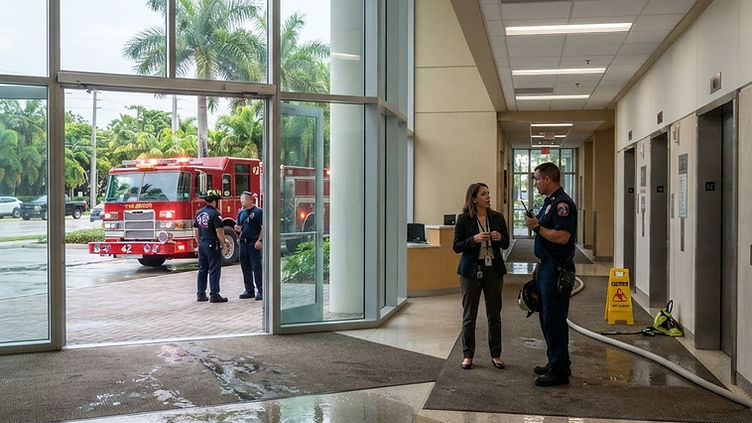
DEERFIELD BEACH, Fla.
Broward Sheriff Fire Rescue responded to a four-story commercial office building at 800 Fairway Drive after smoke and flames broke out in a third-floor office, and the building's own sprinkler system put the fire out before it could move to another floor, WSVN 7News reported.
That outcome is what a working suppression system is supposed to produce. It is also the beginning of a second problem for the property, because a sprinkler discharge leaves a commercial building with protection that is out of service until the system is drained, repaired, tested and put back in service.
What has been confirmed
WSVN 7News reported that Broward Sheriff Fire Rescue responded to the office building at 800 Fairway Drive after smoke and flames erupted in a third-floor office, and that the building's active fire sprinkler system suppressed the blaze before it spread across floors.
Not established in the public reporting: the cause, the number of sprinkler heads that operated, the extent of water damage, whether any floor was closed, whether anyone was injured, and when the building returned to normal occupancy. A fire under investigation remains under investigation until the authority having jurisdiction closes it, and no finding of a code violation or a system failure has been announced.
What a sprinkler activation actually does to a building
A commercial sprinkler system is designed to control a fire, not to flood a building. One or two heads near the ceiling open when their thermal elements fail, and the water that reaches the seat of the fire is the water that stops it. The rest of the system stays charged. The 2019 and later editions of NFPA 13, the installation standard, are built around that principle: design the system so the first heads do the work and the building stays standing.
What follows the fire is administrative and physical at the same time. The control valve serving the affected zone is closed so heads can be replaced. With the valve closed, that portion of the system is impaired. Water still in the piping drains out, and in a multi-story building that water finds elevator pits, electrical rooms, ceiling plenums holding cable trays, tenant improvements, file storage and the floor below. Water mitigation begins on the same night as the fire, and in an occupied office building it determines when a tenant can work again more often than the fire damage does.
The building's protection status is the part that carries legal weight. The building is not protected to its design basis while any part of the system is out of service, and the fire code treats that condition as something the property must handle deliberately.
Why the fire code requires a person on patrol
Section 901.7 of the International Fire Code addresses a required fire protection system that is out of service. The fire code official is to be notified, and where the system cannot be restored, a fire watch is required for the affected area. Florida adopts the International Fire Code through the Florida Fire Prevention Code, administered by the Division of State Fire Marshal and enforced locally by the authority having jurisdiction, which for this building is Broward Sheriff Fire Rescue.
That is the mechanism behind a requirement property managers meet for the first time after an event like this. The trigger is not the fire. The trigger is the impairment. A building with a closed valve, a drained section, an offline alarm zone or a fire pump out of service needs a compensating human presence, and the requirement comes from the code the property already operates under.
NFPA 25, the standard for inspection, testing and maintenance of water-based systems, sets out the impairment procedure in Chapter 15: an impairment coordinator, notification of the fire department, a tag on the valve, interim protection, and a restoration test with documentation before the system is returned to service. The documentation is the deliverable. An insurer, a lender, a tenant's risk manager and the fire department will all ask for the same file.
The four things a fire watch is doing in this building
A fire watch in an impaired commercial building is not a security guard standing in a lobby. The assignment has defined tasks, and the code's intent is that a person is doing them continuously for as long as the protection is out.
First, the rounds. The officer walks the affected area on a stated interval, looking for smoke, heat, water where it should not be, and the smell of overheated wiring in the places a detection system would normally watch. Second, notification. The watch exists to shorten the gap between ignition and the fire department's arrival, which means the officer carries a working radio or phone and knows the building's address, the hydrant location and the access route for apparatus. Third, the log. Every round is recorded with a time and an observation, because the record is what demonstrates the watch was actually performed. Fourth, escalation. Anything found gets reported to the property contact and to the fire department without a debate in the corridor.
In a multi-tenant office building, a watch also covers the hours the property cannot staff itself: overnight, weekends and holidays, which is when an impaired building is most exposed and least observed.
Water, tenants and the second wave of contractors
A building that took a sprinkler discharge will fill with equipment within a day. Extractors, air movers, dehumidifiers, generators and dumpsters arrive, and every one of them needs power, an elevator, a loading dock and a door propped open. Restoration crews work in shifts, and in a building with tenants trying to reopen on other floors, the traffic is continuous.
That is where a fire incident becomes an access-control problem without anyone noticing. Suite doors left unlocked for crews, a loading dock that no one is watching, a freight elevator being run by a contractor, and a lobby with no one at the desk after 6 p.m. The property's own insurance file will later depend on what was recorded, and an incident during restoration is a claim inside a claim.
Security coverage during water mitigation is a staffing answer: a post at the point of entry that equipment and crews actually use, a log of who is in the building after hours, supervision of the affected suites, and a documented handoff between shifts. Where a fire watch is already in place for the impaired system, those duties can be assigned to the same post rather than doubling the headcount in a lobby that cannot support it.
What the property should be able to produce within a week
Four documents will decide how this resolves. The first is the alarm and sprinkler event record showing what operated and when. The second is the impairment tag and notification record under NFPA 25 Chapter 15. The third is the fire watch log covering every hour the protection was out. The fourth is the restoration test result confirming the system is back at design performance, signed by whoever performed it.
A property that produces all four without a chase has closed the incident. A property that cannot produce the third has no evidence that the building was protected while it was exposed, and that gap is what insurers and fire departments find hard to accept after the fact.
Related coverage
Florida properties have been through this sequence repeatedly in recent months. On East Las Olas Boulevard in Fort Lauderdale, a storage-area fire damaged monitoring circuits and the businesses could not reopen without a person on patrol (read that report). In Miami, a pre-dawn three-alarm fire destroyed a fourth-floor corridor and took the building's only elevator (that story is here). In Salt Lake City, a commercial fire next door to a full apartment building became an exposure problem before it became a ruins problem (previously reported).
Coverage in Deerfield Beach
A Broward County property facing an impaired sprinkler or alarm system, or a fire marshal's order requiring a compensating presence, can review the local service pages for fire watch in Deerfield Beach and security guard services in Deerfield Beach, or the national emergency fire watch page for the general requirement. The documented-rounds model and the code basis behind it are set out in the fire watch white paper.
Nothing in that material implies USPA responded to or was retained for this incident. It was not.
What to watch next
Two things will settle this story. The first is the fire department's account of where the fire started and what the system did, which will be the record that matters if an insurance dispute follows. The second is how long the affected zone stays impaired, because the fire watch requirement runs for that period and not for a convenient shorter one.
WSVN 7News's reporting is the primary account of this incident at this stage. This article will be updated if the department or the property releases information that changes the sequence above, and any update note will state what changed.
Services in Deerfield Beach, FL
Sources
- WSVN 7News — initial report on the Fairway Drive office building fire
- Broward Sheriff's Office, which operates BSO Fire Rescue — the responding agency
- National Fire Protection Association — NFPA 13, installation of sprinkler systems, and NFPA 25, inspection, testing and maintenance
- U.S. Fire Administration — commercial fire loss and sprinkler performance research
About the reporter
Staff Writer
Staff writer for the USPA Nationwide Security newsroom. Receives newsroom tips, corrections and editorial inquiries.
Author biography and credentialsMore from The Watchline

Fire Protection
After three alarms on West Broad Street, the fight is over who enters a five-story building nobody may occupy
The three-alarm fire is out, but the five-story building on West Broad Street is still held: residents and businesses are out, and the terms of securing the property and letting people back in are the unresolved part.
· Albina Bieci

Fire Protection
Private hydrants at a Huntsville complex could not hold pressure, so crews ran hose to the street instead
Crews ran more than 100 feet of hose to street hydrants after the property's own hydrants could not hold pressure. Fifteen families are out, and the flow test that was never produced is the document that now matters most.
· Albina Bieci

Fire Protection
A roof fire at The Elements at Cedar Bluff displaced 17 residents and closed all fourteen units
The fire went through the roof of a 14-unit building at the Cedar Bluff complex, heavily damaging five units. Two assessments now decide whether nine other households can return, and the fire-protection one starts a clock.
· Albina Bieci