
A pre-dawn three-alarm fire in Miami destroyed a fourth-floor corridor and took the building's only elevator

By Albina Bieci, Staff Writer
More than 100 firefighters worked a 2:30 a.m. blaze in a five-story building where the residents who remain displaced are the ones least able to use the stairs.
MIAMI
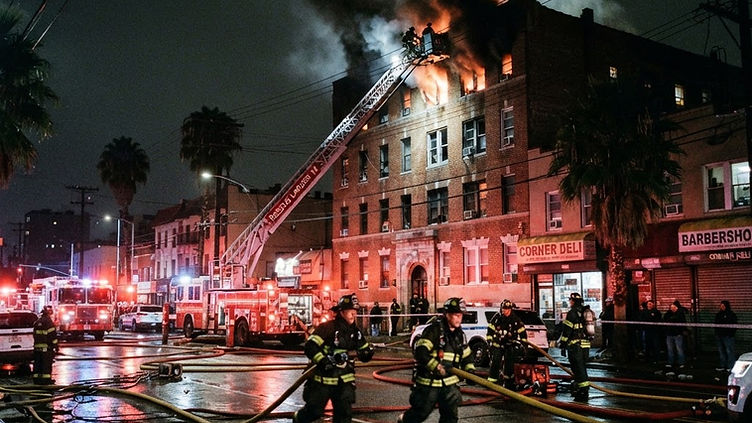
MIAMI — A three-alarm fire broke out before dawn on the fourth floor of a five-story apartment building near Northwest 7th Street and 53rd Avenue, drawing more than 100 firefighters into heavy black smoke and corridors they could not see through, and leaving behind a building that can be neither safely occupied nor left unattended.
The fire destroyed the fourth-floor corridors. Water damage from the attack knocked out the building's only elevator. Residents are displaced, and a substantial number of them are elderly or use wheelchairs. Access control is a memory: doors that were held by hardware, alarms and staff are now damaged, propped or open.
That combination is what produces a fire watch order. The mechanics of the order are worth understanding, because the same conditions recur in almost every occupied building that takes a serious fire.
What was reported
The account published by WSVN 7News describes a 2:30 a.m. alarm, more than 100 firefighters on scene, heavy black smoke and zero-visibility hallways, and a fourth floor whose corridors were destroyed. It reports extensive water damage and the loss of the building's sole elevator.
Everything else in this article is analysis of what those facts mean for the building, not additional reporting from the scene.
The elevator was a life-safety system
The elevator is usually discussed as an amenity until the day it stops working and the building turns out to depend on it. For a five-story building with elderly and mobility-impaired residents, it is the difference between an evacuation and a rescue. A person who cannot use stairs is not slow to evacuate. That person cannot evacuate, and on an upper floor of a building with smoke in the stairwell, that is the whole problem.
This is why the elevator's condition belongs in the fire watch brief rather than the property manager's repair list. A building whose only vertical route for non-ambulatory residents is out of service has a documented life-safety impairment, and an authority having jurisdiction may direct that it be staffed while it lasts. The alternative is a building full of people who would need assistance that nobody on site is assigned to give.
The corridor is how a fire travels
The fourth-floor corridor was destroyed, which sounds like a room-and-contents loss and is not. In a residential building, the corridor is the shared means of egress, the surface a fire uses to spread laterally, and the route the fire department needs clear to work. A corridor consumed by fire means the floor cannot be reoccupied until it is rebuilt, inspected and reapproved, whatever the condition of the individual units behind their doors.
Exit routes and their operating features are not decorative requirements. The federal standards address them directly at 29 CFR 1910.36 and 1910.37, and the local fire code that governs a multifamily building treats a compromised corridor as an occupied-building emergency rather than a repair item.
Access control is the second failure
Water damage is a slower catastrophe than fire and, in a building that has just been emptied, a more immediate one. Electrical distribution is suspect, elevators are out, and the hardware that kept the lobby locked and the service door shut may be running on nothing. A displaced building with open doors and no alarm is a building where a displaced family's possessions are available to anyone who notices.
Fire watch is often described as a fire function. In practice, a mandated watch on a vacated or partially vacated building is a fire function and a security function performed by the same person on the same round: observe for smoke and heat, confirm that the building is empty of unauthorized people, verify that doors and openings are secured, and record what was found and when.
What a mandated watch actually does
A fire watch officer does not fight fire. The assignment is detection, notification and denial. The officer walks a defined route on a defined interval, checks the areas where a rekindle would present first, keeps a written log with times, and calls the fire department on the first credible sign of smoke or heat rather than investigating alone. On the security side, the same round confirms that the perimeter is intact and that nobody is inside who should not be.
The record matters as much as the round. When an insurer, an inspector or a lawyer asks whether the building was watched, the answer is the log, the post orders and the names of the officers. A verbal assurance that somebody was there is not evidence of anything.
How long it lasts
The watch does not end when the trucks leave. It ends when the impaired systems are restored and accepted: the alarm and detection in service, the corridor rebuilt and inspected, the elevator returned with its recall and power functions tested, and the authority having jurisdiction satisfied that the building can protect its occupants again. In a five-story building with a gutted floor and a dead elevator, that is a schedule measured in weeks and sometimes months.
USPA staffs emergency fire watch posts in Miami-Dade and nationwide, including long-duration assignments on occupied buildings with impaired protection. Owners and managers who need coverage tonight can reach dispatch around the clock, and the operational reasoning behind the assignment is set out in the company's regulatory knowledge base.
Why the drill is the first thing to fix
Buildings in this condition usually discover, in the week after the fire, that no one has ever practised an evacuation with the people who were hardest to evacuate. A drill conducted with ambulatory staff and volunteers in daylight does not tell a property manager how long it takes to move a floor of residents who use wheelchairs, walkers or oxygen, and it does not reveal the residents who would need two people and a stair chair that the building does not own.
That arithmetic belongs in the plan rather than in the incident. A building that has lost its elevator should be able to state, floor by floor, how many residents need assistance, who is assigned to assist them, what equipment is on site, and where the alternative route is if the primary stair is smoke-logged. In a five-story building with a damaged fourth floor, the honest answer for some residents is that the building is not suitable for them until the elevator returns, and that is a relocation decision rather than a staffing one.
The fire watch does not solve any of that. What the watch does is give the property a person whose assigned job is to notice before the alarm does, while the property works through the decisions it should have made earlier.
What the next thirty days look like
The immediate period after a fire of this kind runs on parallel tracks, and the property is the only party on all of them. The insurer wants a cause position and a scope of damage. The restoration contractor wants access and power. The elevator company wants its machine room dried and its equipment inspected before it will quote a repair. The fire department wants its report closed. Residents want to know when they can return, and their relatives want to know who is responsible for them in the meantime.
The watch sits across all of it as the one continuous presence on site. That gives the property something it did not have on the night of the fire: a person who can say what the building did at 3 a.m., whether the contractor's temporary power is energised, whether a door was left open, and whether the smell in the second-floor corridor is the same smell that was there last night or a new one. None of those observations replaces an engineer or a contractor. All of them are the kind of fact that is otherwise lost.
The cost conversation
A property carrying a mandated watch should expect the question from an owner or a board, and the useful answer separates the watch from the loss. The fire itself is an insurance event. The watch is an operating cost incurred to prevent a second one, and it is normally recoverable under the part of a policy that requires the insured to protect the property from further damage, provided it was reasonable and documented.
What makes it arguable rather than payable is improvisation: cash arrangements, no written scope, no log. A property that can produce an order, a schedule and a record of what each shift actually did is in a much stronger position than one explaining that somebody was there because the fire department said so.
What residents should ask
Two questions are worth asking of any manager in this position. Who is in the building right now, and how do I know? The first is a staffing answer. The second is a records answer, and a building that cannot give the second has not really answered the first.
Services in Miami, FL
Sources
- WSVN 7News Miami, report on the Northwest 7th Street apartment fire
- OSHA, 29 CFR 1910.36: Design and construction requirements for exit routes
- OSHA, 29 CFR 1910.37: Maintenance, safeguards and operational features for exit routes
- NFPA 25, Standard for the Inspection, Testing, and Maintenance of Water-Based Fire Protection Systems
About the reporter
Staff Writer
Staff writer for the USPA Nationwide Security newsroom. Receives newsroom tips, corrections and editorial inquiries.
Author biography and credentialsMore from The Watchline

Fire Protection
A storage-area fire on East Las Olas Boulevard damaged the monitoring circuits, and the businesses cannot reopen without a person on patrol
Contained fire damage and a dead alarm circuit are not the same problem. The second one keeps storefronts shut until a human being is walking the building.
· Albina Bieci

Fire Protection
A four-alarm fire on West 107th Street took the roof of a Manhattan walk-up, and the building is now a long operation
A partial roof collapse and gutted units end the residential use of the building and begin a forensic and clearing phase that has to be secured while the structure is still failing.
· Albina Bieci

Fire Protection
A Providence apartment fire took the breaker panels and the smoke detectors with it
Interior framing failed and utility service was cut to the block, which puts an emptied building back to the condition fire codes were written to prevent: no power, no detection, no occupants to notice.
· Albina Bieci
