
A Salt Lake City commercial fire next door to a full apartment building is an exposure problem before it is a ruins problem

By Albina Bieci, Staff Writer
Radiant heat and smoke crossed the property line to the Hendry apartments, which is why the watch that follows an unstable commercial ruin is often posted for the neighbour.
SALT LAKE CITY
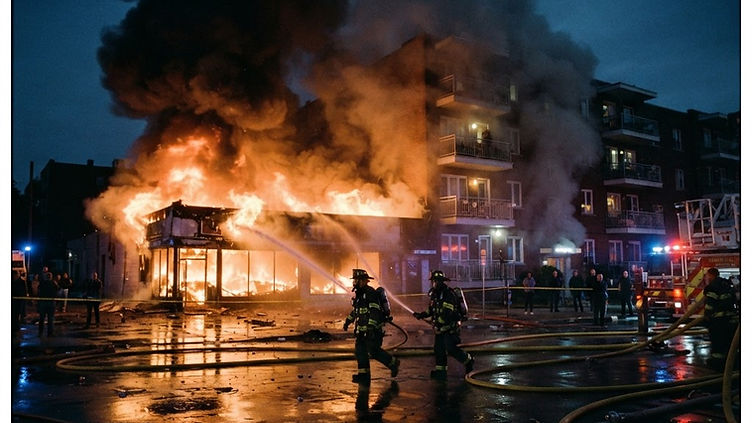
SALT LAKE CITY — The Salt Lake City Fire Department battled a three-alarm fire in a commercial structure at 356 W 700 South, immediately adjacent to the occupied Hendry apartment building, where radiant heat and heavy smoke infiltration reached the residential complex next door.
Fire watch is deployed at a scene like this to monitor the structural boundary and hold the perimeter while the commercial ruin remains unstable and hot spots are worked. Understanding why that post exists clarifies what it can and cannot do.
What was reported
The account published by ABC4 Utah describes a three-alarm commercial fire at 356 W 700 South, heavy involvement, and impact on the adjacent apartment building through radiant heat and smoke. Both structures sit within a dense downtown block where a fire in one is a fire next to the other.
The neighbour is the client
An exposure fire is the term for a fire that threatens a separate property through heat transfer or smoke. It is the reason building codes set separation distances, fire-resistive exterior walls, protected openings and sprinkler criteria by occupancy, and it is the reason a fire department will commit companies to protect an exposure it has no intention of entering.
From the neighbour's side, the experience is specific: radiant heat on the facade, smoke drawn into units through windows and mechanical intakes, water and debris on the shared lot line, and a street closed for days. For the residents of the Hendry building, the fire next door is not somebody else's emergency. It is an event that may have compromised their building's exterior, filled their corridor with smoke and made their entrance unusable.
Why the ruin keeps threatening
The fire is out and the building is not safe. A commercial structure that has burned through its roof or lost interior framing can collapse without warning, and collapse zones are established for that reason. Hot spots can persist in concealed spaces for days, and a partially collapsed wall or a sagging floor can move when water is applied or when debris shifts.
That is the condition the watch is posted against: a structure that is no longer a building but is still a hazard, sitting within falling distance of occupied property and the public way. The officer's job is to notice change, keep people out of the zone, and call for the fire department when something moves, brightens or starts smoking again. It is not to make the structure safe, and any provider implying otherwise is describing a capability nobody has.
What a boundary watch looks like on a shift
A post of this kind is usually a fixed position with a patrol element. The fixed position controls the perimeter: nobody enters the collapse zone, no resident walks the alley behind the ruin, no contractor starts work without authority. The patrol element checks the boundary of the burned structure and the exposure side of the occupied building, looking for new smoke, new cracks, water intrusion and the debris that accumulates at a fire scene.
Documentation follows the same rules as any other watch. Times, observations, contacts made, and escalation. If a resident reports smoke in a unit, that report belongs in the log and on the radio, not in a conversation at the door.
What residents of the exposure building should expect
Two things matter to the occupied building. First, that its own systems are intact: smoke detectors, alarm, sprinklers and exits should be checked before anyone assumes the emergency is confined to the address next door. Second, that its perimeter is controlled, because a fire scene attracts people and a residential lobby with a broken street outside is easier to walk into than it looks.
USPA staffs emergency fire watch posts for impaired and exposed buildings nationally, and the operational basis for scoping a boundary post against a specific structure is set out in the company's regulatory knowledge base. Owners and managers can reach dispatch at any hour through the contact desk.
Smoke is the exposure nobody photographs
The visible damage at a scene like this is the burned building. The damage that generates claims is the smoke in the one next door. Smoke moves through window seals, mechanical intakes, elevator shafts and shared wall assemblies, and it deposits residue that is acidic, odorous and difficult to remove from soft furnishings, ductwork and electronics.
For an occupied apartment building, that means a building that looks untouched can be uninhabitable on the third floor for weeks. Residents with respiratory conditions are affected first, and a management company that tells them the building is fine because the fire was next door is a management company generating a complaint file. The correct sequence is assessment, cleaning, verification and only then reoccupation, and the assessment should be documented by someone with a method rather than an opinion.
What a boundary post is not
The failure mode in exposure protection is the assumption that any uniform at the tape line is doing the job. A boundary post on a fire scene has a narrow and specific purpose: control the collapse zone, watch the burned structure and the exposed building for change, and call for the fire department immediately when something does. It is not a traffic control service, a public information desk, or a demolition supervisor, and an officer assigned those additional tasks will do none of them well.
That distinction should be in the post orders and in the invoice. An owner who understands what the assignment is can hold a provider to it, and an owner who does not will pay for a presence that satisfies nobody.
Reading a ruin on the round
An officer checking a burned commercial structure is looking for a small set of things, and they are learned rather than intuitive. Smoke that changes density between rounds. A wall that has moved, or a new crack running from a window opening. Water pooling where it was not pooling at the previous check. The sound of something shifting inside a structure that should be silent. Warmth on an exterior surface that was cold two hours earlier.
None of those requires the officer to enter the building, and none should involve entering it. The value of the round is that a human being is present often enough to notice a difference, and that the difference is reported rather than explained away.
The property line is not a boundary in a fire
Building separation is a design concept, and a fire does not read the drawings. Radiant heat transfers to a facade across a narrow lot, convection carries embers to a roof, and smoke enters a neighbouring building through openings nobody thought of as openings. Codes address this with separation distances, protected openings and exposure protection, and every one of those measures assumes the neighbouring structure behaves predictably.
A commercial building in a dense block does not. A storage occupancy with an unknown fuel load burns hotter and longer than its classification suggests, and a building that has been subdivided, renovated or used inconsistently with its original design changes the calculus the neighbour was designed against. That is not an argument for alarm, it is an argument for knowing what is next door, and for having a plan that does not assume the wall will hold.
Who pays for watching someone else's ruin
An owner whose building burns is responsible for securing it. That responsibility extends to the hazard it presents to everyone else. In practice, exposure protection is often paid by the exposed property rather than the burning one, because the exposed property cannot wait for an insurance determination to protect its residents.
That asymmetry is worth understanding before an incident. The building next to a commercial occupancy at risk of fire is a building with an exposure it does not control, and the practical question is whether its own protection, its own alarm and its own staff can cover the gap while somebody else's structure is unstable. For most apartment buildings the honest answer is no, which is why the watch is posted on the occupied side of the line.
The part that ends last
The fire department will leave, the street will reopen, and the ruin will sit there while insurance, demolition and litigation work through it. The boundary watch usually persists through that period, because the hazard does not end when the incident does. That is the unglamorous arithmetic of exposure: the building that burned is a total loss, and the building next door is the one that has to be protected until the site is cleared.
Sources
About the reporter
Staff Writer
Staff writer for the USPA Nationwide Security newsroom. Receives newsroom tips, corrections and editorial inquiries.
Author biography and credentialsMore from The Watchline

Fire Protection
A storage-area fire on East Las Olas Boulevard damaged the monitoring circuits, and the businesses cannot reopen without a person on patrol
Contained fire damage and a dead alarm circuit are not the same problem. The second one keeps storefronts shut until a human being is walking the building.
· Albina Bieci

Fire Protection
A four-alarm fire on West 107th Street took the roof of a Manhattan walk-up, and the building is now a long operation
A partial roof collapse and gutted units end the residential use of the building and begin a forensic and clearing phase that has to be secured while the structure is still failing.
· Albina Bieci

Fire Protection
A Providence apartment fire took the breaker panels and the smoke detectors with it
Interior framing failed and utility service was cut to the block, which puts an emptied building back to the condition fire codes were written to prevent: no power, no detection, no occupants to notice.
· Albina Bieci