
Lubbock is past its average first freeze, and a split sprinkler line carries no grace period

By Albina Bieci, Staff Writer
Lubbock's average first freeze was October 31 and the latest on record arrived November 23, so the season is already open. The exposure is the water sitting in wet-pipe sprinkler and standpipe systems in unheated riser rooms, attic runs and warehouse mezzanines.
LUBBOCK, Texas
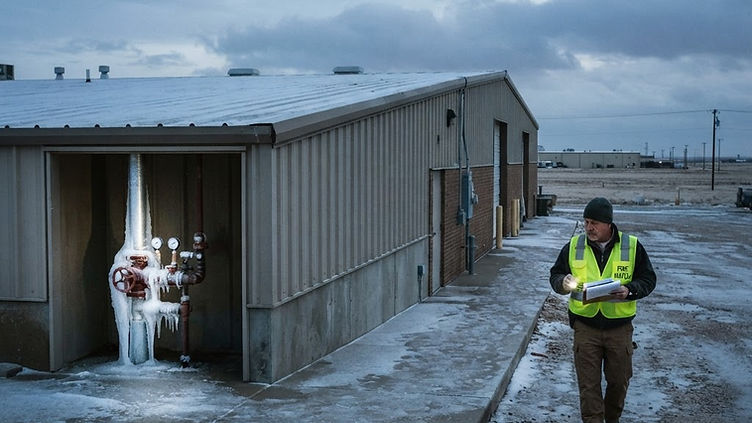
LUBBOCK, Texas — Lubbock passed its average first freeze on October 31, and the latest first freeze on record here did not arrive until November 23, 2003. The cold season is open either way, and what it exposes in this city is not the ice on the street. It is the water sitting in fire protection piping: riser rooms on exterior walls, attic runs above the insulation, warehouse mezzanines, unheated additions, and a unit heater nobody has switched on since March.
No freeze warning was in effect for the South Plains on Monday. NOAA's outlook for December through February, released October 15, leans wetter than average across the southern tier of the country, warmer than average across the north, and toward drought improvement in the Southern Great Plains. It does not forecast cold outbreaks, and the agency is explicit that snowfall is not predictable more than about a week out. What the outlook describes is the setup that makes a High Plains freeze expensive: more moisture moving over a region that can still be 20 degrees at dawn.
What a polar vortex does to a place like Lubbock
The polar vortex is a ring of strong wind high over the Arctic that ordinarily keeps the coldest air contained there. When that circulation stretches or splits, Arctic air is pushed south, occasionally as far as Texas. NOAA's climate reporting documents the mechanism and treats the timing of any disruption as a forecast question, not a settled one. That is the honest reading for a Lubbock property manager this week: the delivery is possible every winter, and no seasonal outlook says which week it lands.
Lubbock's building stock is exposed in specific ways. Flat roofs pond snowmelt and refreeze it at drains and parapets. Sprinkler and standpipe runs in attics sit above the insulation line, in the coldest air in the building. Riser rooms and fire pump rooms are routinely built on exterior walls, often with a combustion-air louver and a small electric heater. Cotton gins and food plants finish harvest with their systems still wet and their crews gone. Campus, medical-district and warehouse buildings keep occupied space conditioned and leave back-of-house space at whatever the thermostat said in October.
A wet-pipe system does not need a hard freeze to fail. Piping in an unheated space loses heat to the structure around it, water in a branch line or a drop freezes first, and ice expands with enough force to split the pipe or push a fitting apart. Nothing shows on the outside until the ice thaws and the water starts moving.
When a line splits, the building loses two things at once
A frozen and burst sprinkler line produces a water loss and a fire protection outage in the same event. Wet ceiling tiles, soaked stock and a shut valve are the visible result. The consequence that carries legal weight is the second one: a required fire protection system out of service in an occupied building.
Lubbock adopted the 2021 International Fire Code under City Code Article 10.03, by Ordinance 2024-O0035, enforceable from June 3, 2024. Section 901.7 of that code is the provision that attaches when a system goes out of service. The fire code official may require a fire watch, may order the building evacuated, and may require standby fire service personnel at the owner's expense while protection is missing. The duty begins when the system goes out of service, not when a contractor arrives and not when the water is finally mopped up.
Two notifications, one dedicated patrol, and no waiting period
The Lubbock Fire Marshal's directive is more specific than most cities', and it is where freeze-season planning usually goes wrong.
Two channels, both required. The completed Fire Watch Information and Requirements form goes by email to fireprevention@mylubbock.us, and someone separately calls the city's non-emergency dispatch line at 806-775-2635. Either one alone leaves the notice incomplete, and the sent email is the record that proves it happened.
A dedicated post. The watch member does nothing else. The directive names security firms, off-duty peace officers, off-duty fire personnel and qualified on-site managers as the people a watch may be staffed with, subject to approval and competent performance. Reception duty, deliveries and maintenance calls do not run alongside a patrol requirement.
Reflective identification. The current form requires a reflective high-visibility vest or similar garment marked FIRE WATCH, visible over winter clothing and around equipment.
Rounds inside 60 minutes. The guard circulates continuously and completes every checkpoint within an hour, recording each round on the city's standardized hourly log: date, time, areas inspected, hazards found, action taken and a signed name. A route that cannot be walked in an hour does not comply, whatever the square footage suggests.
A plan past 24 hours. A watch expected to run longer submits a dated staff schedule with shift times, a floor plan showing the path of travel, and contact numbers, for Fire Marshal review and acceptance.
Those are the rules in the directive. The four-hour figure that circulates in freeze planning belongs to federal conditions of participation for ambulatory surgical centers and governs those facilities, not Lubbock commercial property generally. A sprinkler outage in a warehouse does not get a ten-hour window either. USPA's Lubbock fire watch regulations volume records both as verified absences in the adopted code and the posted form, with the citations behind the finding.
Who is exposed first in this market
- Hotels and motels. Guest wings are heated; back-of-house corridors, stair towers and the riser room off a loading dock often are not. A winter outage in a sleeping-occupancy building is the assignment that runs longest.
- The medical district. UMC and Covenant buildings cannot empty an occupied wing for a closed valve. Coverage runs around the clock for the length of the impairment, with the log continuous through shift changes.
- Warehouses and distribution. High-piled racking puts sprinkler heads near the roof deck, where heat stratifies and cold air pools at the eaves and at every overhead door.
- Campus and laboratory buildings. Texas Tech and the surrounding research space carry detection, suppression and fume systems that trigger watches on their own outages, independent of the weather.
- Agricultural processing and gins. Harvest ends, the crew leaves, and the system stays wet through the coldest months of the year.
- Vacant and seasonal buildings. A thermostat set at 50 with nobody walking the property is not freeze protection.
What to do before the first hard freeze
Walk the riser rooms with a thermometer rather than a memory, and confirm the heat actually works while someone is standing there. Verify that low-temperature and supervisory signals reach the monitoring center and that a named person answers when they do. Check air pressure on dry-pipe systems, because a compressor that has been idle since spring loses the charge that keeps water out of the branch lines. Confirm that attic and mezzanine runs are insulated and, where the code requires it, heat-traced. Identify the watch provider before the water is on the floor, and keep a copy of the city form where the building's on-call manager can reach it at 2 a.m.
What to do the night a line splits
- Isolate the affected section through the licensed contractor or the building engineer, and record the time protection was lost.
- Make both notifications: the email to the Fire Marshal and the call to non-emergency dispatch.
- Post a dedicated watch on the route the official accepts, with FIRE WATCH identification and rounds inside the hour.
- Log every round on the city form as it happens, including hazards found and who was called.
- Repair through a licensed Texas fire sprinkler or alarm firm, with stopgap work treated as provisional until the system is recertified.
- Restore, test, and email the completed log to the Fire Marshal, keeping the sent evidence with the service records and the insurer's file.
The bill arrives twice
The first invoice is the water damage and the pipe. The second is the coverage: an unheated riser room that splits a main in January typically means a watch measured in days, reinforced staffing if the official orders standby personnel, and a repair scheduled behind every other building in the city that froze the same night. Properties that plan the watch before the freeze buy it at a normal rate. Properties that call at midnight with water running buy the same service on an emergency basis and pay for the privilege.
The record is what decides how that reads afterward. Hourly logs, the two notifications, the licensed repair ticket and the restoration test answer the insurer, the fire marshal and the tenant at once. Missing them turns a weather event into an argument about who was responsible for a building that sat unprotected for two days.
USPA Nationwide Security staffs fire watch in Lubbock and across the South Plains, stages emergency fire watch for systems already out of service, monitors hot work during freeze repairs, and publishes a reference on what the fire codes require of a property while protection is missing. The Lubbock Fire Marshal office page carries the office details and the notification route.
Services in Lubbock, TX
Sources
- NWS Lubbock: normal and record freeze dates for Lubbock (KLBB)
- NWS Lubbock: winter weather
- NOAA: El Nino looms large over U.S. Winter Outlook (October 15, 2026)
- NOAA Climate.gov: predicting the chances of a polar vortex disruption
- NFPA 25: Standard for the Inspection, Testing, and Maintenance of Water-Based Fire Protection Systems
- International Fire Code, Section 901.7 (fire watch)
- Ready.gov: winter weather
About the reporter
Staff Writer
Staff writer for the USPA Nationwide Security newsroom. Receives newsroom tips, corrections and editorial inquiries.
Author biography and credentialsMore from The Watchline

Fire Protection
Fire in a vacant third-floor apartment displaces 10 in New Bedford
The New Bedford Fire Department says the fire was contained to a vacant third-floor apartment with no injuries, leaving a building that is damaged inside, still occupied around the damage, and under an open cause investigation.
· Albina Bieci

Fire Protection
Fall River's burned Columbian Building will sit open for weeks, with demolition priced above $1.2 million
More than seven weeks after fire destroyed the Columbian Building and damaged the unsprinklered property next door, the full demolition is still out of contract, four bids are in, and the scar in downtown Fall River stays an open structure in the meantime.
· Albina Bieci

Fire Protection
A South Los Angeles flooring warehouse reignites, turning a firefight into a multi-day debris operation
A 15,000-square-foot commercial flooring warehouse reignited early Tuesday, burning overhead power lines and leaving the Los Angeles Fire Department in an exterior suppression and debris-removal operation that heavy timber loads are stretching across multiple days.
· Albina Bieci
