
Fall River's burned Columbian Building will sit open for weeks, with demolition priced above $1.2 million

By Albina Bieci, Staff Writer
More than seven weeks after fire destroyed the Columbian Building and damaged the unsprinklered property next door, the full demolition is still out of contract, four bids are in, and the scar in downtown Fall River stays an open structure in the meantime.
FALL RIVER, Mass.
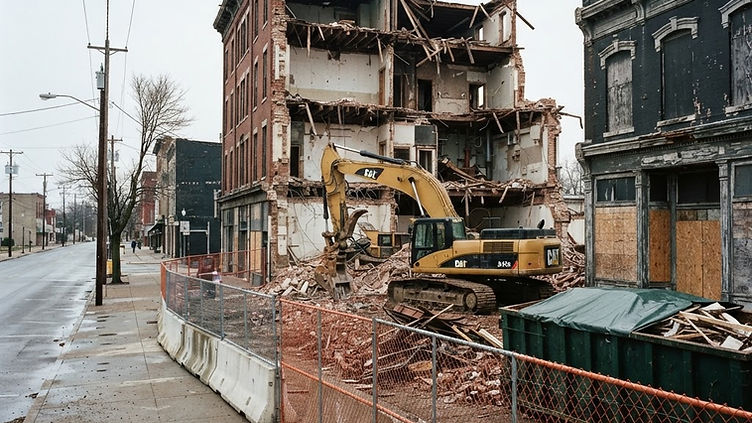
FALL RIVER, Mass. — The fire that destroyed the Columbian Building at South Main and Rodman streets is long out, and the building is still standing in the middle of downtown. The Herald News reported this week that the full demolition could cost upwards of $1.2 million, that the city put the entire building out to bid on October 7, that four contractors returned bids by an October 22 deadline, and that an eventual demolition is approaching but could take a while. More than seven weeks after the September 24 fire, the corner remains a charred ruin.
What has already happened is the emergency work. City officials ordered an immediate partial demolition of the unstable upper walls the day after the fire, to stop masonry from coming down into the street on its own schedule. What has not happened is the removal of the rest, and the interval between those two milestones is the part of a demolition that nobody budgets for.
What the fire left, and what partial demolition did not fix
The fire started in what the Herald News described as a vacant historic building at 308-318 South Main Street and spread into the neighboring commercial property at 298 South Main Street. Neither building had a sprinkler system, a detail the paper reported in the days after the fire and the detail that explains the spread better than anything else in the record.
The emergency demolition took down the upper reach of the walls. It did not remove the floor framing, the roof structure where any of it survived, the contents of the building, or the debris that fell inside it. It also did not restore the streetscape: a downtown block that had a continuous facade along its sidewalks now has a gap in it, fenced and closed, with a masonry shell inside the fence.
That is a normal intermediate state for a serious downtown fire. It is also the state in which the property is least self-protecting.
Why demolition runs weeks behind the walls coming down
The public record already explains most of the delay. A demolition of this size is a public procurement, not a phone call to a contractor with a track record at the site. The city advertised the work, set a bid deadline, and received four responses. Awarding the contract means reviewing qualifications, confirming insurance and bonding, and reconciling the scope with whatever the insurer will pay. The city told the Herald News it hopes its insurance policy covers the price tag, which is itself a negotiation with a schedule attached.
Then the physical constraints start. A 19th-century masonry commercial building does not come down in isolation; it comes down while sharing party walls and lot lines with structures that are still in use. A demolition contractor working in that condition has to sequence the removal so the neighbors' walls stay supported, which means engineering rather than a wrecking ball. Utilities have to be confirmed dead and disconnected before heavy equipment works inside the footprint. The material that comes out has to be surveyed and handled under the asbestos and lead provisions that apply to buildings of that era, and the debris has to leave a downtown site through a traffic control plan the city approves.
Each step is short. In sequence, with a public bid and an insurance claim in the middle of it, they add up to weeks. The result is exactly what the corner looks like now: a stabilized ruin that nobody is working on yet.
Two buildings without sprinklers, standing next to buildings without sprinklers
The absence of sprinklers in the two fire buildings is not an anomaly in a New England downtown. The stock along streets like South Main predates the sprinkler requirements in the model codes, and the code does not retroactively install a system in a building that has not changed occupancy or undergone substantial alteration. A vacant building can sit for decades in that condition, legally, because no trigger has ever forced the question.
The consequence becomes visible when a fire starts in one of them and the neighboring buildings have the same gap. Suppression then depends entirely on the fire department's arrival time and on how far the fire has traveled through shared walls and cocklofts before the first line is charged. Fall River's fire did what fires do in that geometry: it used the neighbor as fuel.
For the owners of the buildings that survived, the exposure did not end with the fire. It transferred to the ruin next door.
An open ruin is an occupancy problem before it is a fire problem
A fenced, partially demolished building in a downtown corridor is entered by people. The fence is a legal boundary, and it is not a physical one. Scrap crews work masonry buildings for pipe and wire. People who need shelter use the parts of the structure that still have a roof. Kids get in during the evening because the corner is dark and nobody is watching that block after the businesses close.
Every one of those entries is a fire risk in a structure that has already burned. Candles and lighters in a building with dry, charred timber; a cutting torch used to free copper; a warming fire in a doorway. The building cannot be made safe from the inside, because there is no detection, no suppression and, in most of the footprint, no power. The only control that works is a person on the property, on a route, through the overnight hours.
That is not a security preference. Section 901.7 of the International Fire Code, as Massachusetts adopts it, permits the fire code official to require a fire watch when protection systems are out of service or conditions constitute a hazard, and NFPA 601 describes what the watch consists of: scheduled rounds, recorded conditions, and immediate notification to the fire department.
The demolition itself is a hot work operation
The weeks of work that follow the bid award carry their own fire risk, and it is the kind of risk that has its own standard. Structural steel and heavy timber come apart with torches and saws. Cutting, welding and grinding during demolition are hot work under NFPA 51B, which requires a permit, a fire watch during the operation, and a watch on the area afterward, typically for at least 30 minutes, to catch what the sparks started.
On a site like this, the spark lands in debris that has already burned once. A contractor with a good program posts the watch and holds the permit. The property's problem during that phase is that the watch belongs to the contractor, whose scope ends with its own work, while the site's exposure to the businesses and the sidewalk outside the fence does not.
The neighbors are carrying an exposure they did not create
A fire in the ruin at three in the morning has a running start. There is no alarm in the burned building to report it, no sprinkler to hold it, and no occupant to call 911. The first reliable notice comes from someone in the buildings beside it, which is the same position those owners were in during the September fire.
That is the argument for a property watch that covers the ruin continuously rather than only during working hours. It is also the argument the owners of the adjacent buildings should be making: their insurance premiums, their business interruption and their tenants' safety are all downstream of how well a structure they do not own is supervised.
What the record will be asked for
When the demolition is finally awarded, the sequence that matters is documentary. Who secured the site during the interval, on what schedule, with what written authority, and what was found on each round. The city, the owner's carrier and the demolition contractor will each need that account, and after the building is gone it is the only account of the seven weeks it stood open.
USPA Nationwide Security provides fire watch coverage in Fall River and the South Coast from the same New Bedford dispatch, emergency fire watch for buildings whose protection is out of service, and hot work supervision for demolition phases that involve cutting and welding. The company's published reference sets out what the fire codes require of a property between the fire and the wrecking ball.
Sources
- The Herald News: When will Fall River's Columbian Building be demolished?
- The Herald News: Downtown Fall River buildings destroyed in fire had no sprinklers
- The Herald News: Fall River fire at South Main and Rodman streets
- International Fire Code, Sections 901.7 and 3303 (fire watch, demolition)
- NFPA 241, Standard for Safeguarding Construction, Alteration, and Demolition Operations
- NFPA 51B, Standard for Fire Prevention During Welding, Cutting, and Other Hot Work
- Massachusetts Department of Fire Services
About the reporter
Staff Writer
Staff writer for the USPA Nationwide Security newsroom. Receives newsroom tips, corrections and editorial inquiries.
Author biography and credentialsMore from The Watchline

Fire Protection
Fire in a vacant third-floor apartment displaces 10 in New Bedford
The New Bedford Fire Department says the fire was contained to a vacant third-floor apartment with no injuries, leaving a building that is damaged inside, still occupied around the damage, and under an open cause investigation.
· Albina Bieci

Fire Protection
A South Los Angeles flooring warehouse reignites, turning a firefight into a multi-day debris operation
A 15,000-square-foot commercial flooring warehouse reignited early Tuesday, burning overhead power lines and leaving the Los Angeles Fire Department in an exterior suppression and debris-removal operation that heavy timber loads are stretching across multiple days.
· Albina Bieci

Fire Protection
UPDATE: Goodwin Hotel fire traced to a wall around an 1881 cast-iron column
Hartford's fire marshal and city licensing inspectors have opened a formal origin-and-cause investigation after confirming the fire traveled inside an exterior wall, through the decorative woodwork enclosing a cast-iron support column, with all 124 guestrooms still open.
· Albina Bieci
