
UPDATE: Goodwin Hotel fire traced to a wall around an 1881 cast-iron column
Updated with the confirmed fire path inside the wall assembly and the formal origin-and-cause investigation.

By Albina Bieci, Staff Writer
Hartford's fire marshal and city licensing inspectors have opened a formal origin-and-cause investigation after confirming the fire traveled inside an exterior wall, through the decorative woodwork enclosing a cast-iron support column, with all 124 guestrooms still open.
HARTFORD, Conn.
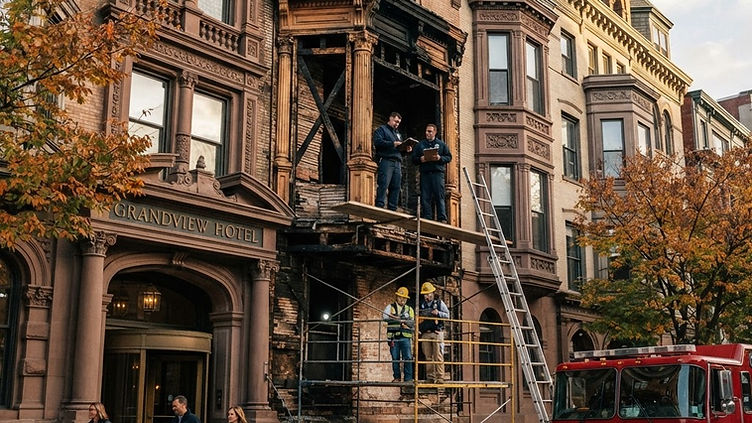
HARTFORD, Conn. — The fire at the Goodwin Hotel did not burn in a room. Investigators have determined it traveled inside an exterior wall of the 1881 building, along decorative woodwork that encloses a cast-iron support column, which explains how crews called Saturday for a smoke condition in the basement found fire in a place with no room to burn. Hartford Fire District Chief Mario Oquendo's account, reported by CT Insider, moved the incident from "contained" to a concealed-space fire in a fully occupied historic hotel. The Hartford Fire Marshal's Office and city Licensing and Inspection have opened a formal origin-and-cause investigation. All 124 guestrooms have remained operational.
What changed since our first report
Our initial report described a fire controlled within minutes, no injuries, and a cause under investigation. The new detail is the path. The fire was not in a room or a mechanical space: it moved through the wall assembly itself, inside the custom woodwork built around a structural cast-iron column, and it was found there rather than in an open area.
- Fire path confirmed: inside an exterior wall, within decorative woodwork surrounding an enclosed cast-iron support column.
- Formal origin-and-cause investigation opened by the fire marshal alongside city licensing and inspection officials.
- All 124 guestrooms remained open throughout.
Why an enclosed column assembly burns out of sight
A cast-iron column in a building of this era is almost never left bare. It is cased in wood, often with decorative trim and a hollow space between the metal and the finish — an air gap that runs the full height of the building. That gap behaves like a flue. In a masonry wall with wood furring, the same cavity connects to floor voids and to the trim assemblies at each level, so heat and flame can travel vertically through a building without ever entering a room.
A fire that is travelling inside a wall shows up as a smoke condition first, usually at the lowest point where the cavity vents. That is why the original call was reported in the basement, and it is why "contained" is a statement about what crews could see rather than what the assembly was doing. Concealed fires in historic construction also punish the standard opening-up technique: the moment a wall is opened, the void that fed the fire becomes a path for air, and the fire can move before it is reached.
The complication is that the building stayed open
A hundred and twenty-four rooms remained in service while investigators worked. That is the right business decision for the hotel and the hardest possible condition for fire protection, because the building is simultaneously a working occupancy and a fire scene.
Every stage of the work that follows creates an impairment. Walls have to be opened to expose the column and any connected voids. Detection covering the affected area may be isolated during that work, and cutting and demolition generate dust that trips detectors elsewhere. Repairs to the woodwork and the surrounding assembly bring hot work — soldering, cutting, grinding — into the same cavity that carried the original fire. Temporary lighting and cords get strung through corridors that guests are walking at midnight.
Section 901.7 of the International Fire Code lets the fire code official require a fire watch wherever a required protection system is out of service, and the official can order one wherever conditions in the building constitute a hazard. An occupied hotel with an opened exterior wall, an isolated detection zone and active hot work is precisely the situation that order is written for. NFPA 601, the standard for security services in fire loss prevention, describes how the watch is supposed to be conducted once it is ordered.
What a watch in an occupied hotel actually covers
A post in the lobby does not watch a building. On a concealed-space loss in an occupied property, coverage has to follow the assembly that carried the fire: the affected elevation and the rooms behind it, the stack from the basement through the top floor, the stairwells, and the path crews use to haul materials in and out.
- Rounds at a defined interval on the affected stack and the exterior wall line, at every hour the zone stays impaired.
- A written log of each round, conditions observed, and any contact with the fire department or the hotel's engineering staff.
- Immediate notification of the fire department on any smoke, heat or odor of burning, and of management on any entry or equipment issue.
- A clear, maintained route for guests and for the fire department if it has to come back into a building that is still trading.
The watch stays in place until the marshal and the code official release the building — not until the visible work is finished.
What happens next at the Goodwin
The marshal's findings will determine the scope of the repair to the column enclosure and the surrounding wall, and city licensing and inspection will review the building's life-safety systems as part of that work. Until the assembly is closed back up and detection is fully restored, the hotel is operating with a known fire path in a wall it is still using. USPA Nationwide Security provides fire watch and emergency fire watch coverage in Hartford and across Connecticut for occupied buildings under investigation or repair, staffed around the clock with written documentation from the first round.
Services in Hartford, CT
Sources
About the reporter
Staff Writer
Staff writer for the USPA Nationwide Security newsroom. Receives newsroom tips, corrections and editorial inquiries.
Author biography and credentialsMore from The Watchline

Fire Protection
A South Los Angeles flooring warehouse reignites, turning a firefight into a multi-day debris operation
A 15,000-square-foot commercial flooring warehouse reignited early Tuesday, burning overhead power lines and leaving the Los Angeles Fire Department in an exterior suppression and debris-removal operation that heavy timber loads are stretching across multiple days.
· Albina Bieci

Fire Protection
UPDATE: Deerfield fire leaves four apartments uninhabitable for up to a year
Four units are gutted and boarded, all 16 affected apartments are without power, and displaced residents have been told to expect three months to a year while ComEd, North Shore Gas and the village building department work through restoration.
· Albina Bieci

Fire Protection
Two fires in one night leave a Shelby Street building unsafe to occupy
Indianapolis firefighters returned at 2:12 a.m. to a building they had worked the previous evening and found heavy fire inside, leaving crumbling walls, a damaged roof and a site that now needs a documented watch.
· Brian Fitzgibbons
