
Union Township storefronts are open to the street and their alarms are not working
Expanded Nov. 28 with full commercial-exposure and recovery analysis.

By Albina Bieci, Staff Writer
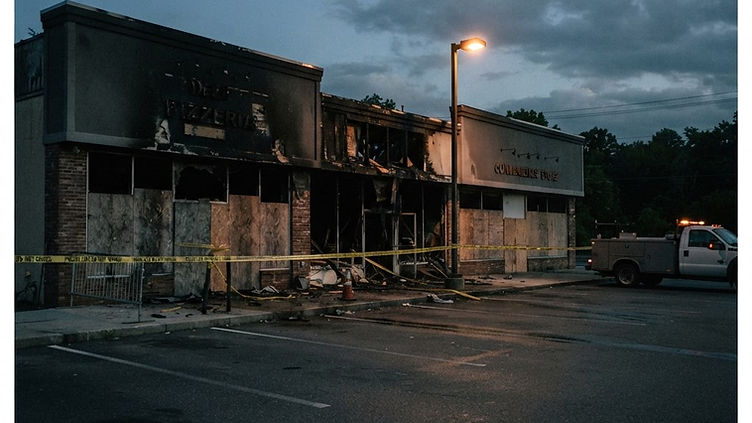
Business owners in Union Township are starting recovery after a fire that damaged multiple storefronts. A commercial strip with no glass and no alarm is a target before it is a construction site.
UNION TOWNSHIP, N.J.
Business owners in Union Township, New Jersey are beginning recovery operations after a commercial structure fire heavily damaged multiple storefronts and commercial spaces, according to News 12.
Emergency fire watch
Alarm or sprinkler system out of service? USPA can post a fire watch on site within 60 minutes.
Trained officers, documented patrol rounds and direct 911 notification, scoped to the order your fire marshal actually issued.
Live dispatch, 24 hours. In an emergency, call 911 first.
The reporting is early and the incident is not. A fire that reaches several storefronts in one building leaves a row of retail spaces that are open to the street, without power, without alarms, and full of the fixtures, inventory and records that make a small business worth anything.
For the owners, the fire is the beginning of a sequence in which the largest single risk is not the damage they can see. It is what happens to the building overnight, while they are at a hotel or a relative's house, waiting for an adjuster.
What the record establishes
As of Nov. 28, the published reporting establishes the following, and nothing more:
- A commercial structure fire occurred in Union Township, New Jersey.
- Multiple storefronts and commercial spaces were heavily damaged.
- Local business owners have begun recovery operations.
The cause, the number of businesses affected and the damage estimate have not been established in the reporting. Nothing here should be read as a finding about any of them.
A storefront is designed to be seen into
Retail space is built to be transparent. Plate glass, an open sales floor, a lit sign, a door that opens to the pavement. That design is a commercial asset for fifty years and a security liability the night after a fire.
Remove the glass and cut the power and the same frontage becomes a display of exactly what is inside and exactly how little stands between it and the sidewalk. In a strip of connected storefronts, that display runs the length of the block.
There is a second exposure that is less obvious. Commercial strips share more than a facade: rear service corridors, roof access, basements, utility rooms and, in older buildings, common attic space. A fire in one unit breaches those shared spaces, and the openings that result are not all on the street where a passer-by would see them.
What actually disappears
The list is consistent across the country, and it is rarely what the owner expects.
Cash registers and safes go first, because they are portable and obvious. Then tools and equipment — kitchen equipment in a restaurant, lifts and diagnostic gear in an auto shop, machines in a light-industrial unit. Copper wiring and piping are stripped from walls that are already open. HVAC components and stainless fixtures follow. Inventory that survived the fire disappears, and so do the paper records that were not digitized.
The theft usually happens in the first several nights, before the owner has a contractor and before anyone has been hired to watch. It is frequently committed by people who saw the damage on the news, drove past the boarded front, or were told about it by someone who did.
Board-up is not security
The reflex after a commercial fire is to board the openings and wait for the adjuster. Boarding is necessary and it is not sufficient.
- Plywood over a storefront window is a delay of seconds for anyone who intends to enter, and it advertises vacancy to everyone who passes.
- A boarded building with no alarm has no way to detect entry at all.
- A commercial strip with rear service doors, roof access and shared basement or corridor space has far more openings than the front elevation suggests.
- A building whose fire alarm system is offline also loses its sprinkler supervision, which means the next fire — including one started deliberately in a pile of debris — has nothing to interrupt it.
What changes the outcome is presence: a marked patrol on a documented schedule, a controlled point of contact for the contractors and adjusters who need in, and a posted notice that the site is monitored. Where the property is large enough or the loss severe enough, a stationary post is better than a patrol.
USPA provides fire watch and vacant commercial security nationally and covers the Newark and Union County market through its New Jersey fire watch service.
The alarm and suppression question at a strip
A multi-tenant commercial building usually has one fire alarm system serving all the units, often with tenant-specific devices and a common panel. When fire damages several units, the system as a whole is compromised, and every tenant's occupancy is affected by a panel that serves a space they do not control.
That produces a legal condition most small tenants have never encountered. Their unit is required to have working detection and notification, the system that provides it is out of service, and the responsibility for restoring it sits with a landlord who is dealing with a total loss next door. In the interim, the code framework's answer is a fire watch, and the owner's answer is usually a delay while the insurance question is sorted out.
The delay is the risk. A strip of storefronts with no detection, no suppression supervision, debris inside and plywood outside is the most predictable second-fire scenario in commercial property.
Patrol or post: choosing the deployment
The choice between a roving patrol and a fixed post is an engineering decision dressed as a budget one.
A post is appropriate where the exposure is concentrated and the site is compact: one entrance, one parking apron, a building small enough that a single officer can see the front, the rear and the side. A strip of storefronts on a main road often fits this model better than owners expect, because the officer at the front is also the officer at the only realistic approach.
A patrol is appropriate where the property is large, where there are multiple buildings, or where the exposure is spread across a site that a single officer cannot observe — an industrial parcel, a shopping centre with a parking field, a complex of connected structures.
Most fire-damaged commercial strips need a combination: a post during the hours when the site is most exposed, and documented patrol rounds that cover the rear and the roof access. The schedule should be written down, because the schedule is what an insurer, a fire marshal and a plaintiff will each ask to see.
The recovery sequence, and where security fits into it
The recovery process for a small business after a fire runs on a sequence that has nothing to do with the fire's severity.
Access comes first. The owner needs to get in to document inventory, salvage records and photograph the loss, which requires the building to be safe and the site to be controlled.
Preservation comes second. Theft and secondary damage in the first fortnight can turn a repairable loss into a total one, and insurers ask specifically about site security when a commercial claim is large.
A timeline comes third. Restoration cannot start until the structure has been assessed, and assessment cannot happen while a damaged roof or a compromised wall is a hazard to the people doing it.
Reopening comes last, and it depends on inspections the owner does not control: electrical, fire alarm, suppression, and in many municipalities a certificate of occupancy review for the altered space.
Every one of those steps depends on somebody being at the property, and the party that is there is the one that determines whether the owner's next month is spent rebuilding or arguing with an insurer about a theft that should not have happened.
The businesses that do not come back
The economics of a storefront fire are unforgiving. A restaurant that closes for eight weeks loses its staff, its bookings and a meaningful share of its customers, and many never reopen. A service business with a customer list and a phone number can survive. A retail shop with seasonal inventory cannot.
That arithmetic is why the security response at a commercial fire is not a formality. The building is the asset that has to survive until the business can return to it, and the window in which it can be lost is measured in nights, not months.
The landlord, the tenant and the shared system
A multi-tenant commercial building usually runs one fire alarm system across every unit, with a common panel and tenant-specific devices. When fire damages several units, the system as a whole is compromised, and each tenant's occupancy is affected by equipment they do not own and cannot repair.
That produces a condition most small business owners have never encountered. Their unit is required to have working detection and notification, the system providing it is out of service, and the responsibility for restoring it sits with a landlord dealing with a total loss next door. In the interim, the answer is a fire watch, and the owner's instinct is to wait while the insurance question is sorted out.
The wait is the risk. A strip of storefronts with no detection, no suppression supervision, debris inside and plywood outside is the most predictable second-fire scenario in commercial property, and the exposure belongs to every tenant on the block, not only the ones whose units burned.
What the fire marshal will ask for
When a commercial occupancy is damaged and the owner wants to reopen, the questions that decide the date are consistent: is the alarm system restored and tested, is the suppression system back in service, is the egress intact, and is the structure sound.
Those are answered by contractors, and each answer requires access to a building that must be secured between visits. Managing that access — who enters, when, with what escort, and what the log shows — is a security function, and at a damaged commercial strip it is the function that keeps the reopening on schedule rather than slipping by weeks.
Related coverage: a Maryville commercial building that lost its floors and closed a downtown block and a Pooler commercial fire where water damage outlasted the flames.
Reference and services
Knowledge base
NFPA 25 Impairment Protocols (2026): Fire Watch, the Ten-Hour Framework and System Restoration
National reference · 23 pages, citation registry attached
Read the volumeService
Fire watch services
How USPA staffs this work, with the coverage, licensing and dispatch terms for the assignment.
See the serviceSources
About the reporter
Staff Writer
Staff writer for the USPA Nationwide Security newsroom. Receives newsroom tips, corrections and editorial inquiries.
Author biography and credentialsMore from The Watchline

Fire Protection
Superior's John Avenue fire burned through the roof. Now the building has to survive the water and the cold
A nearly three-hour fire in a two-story Superior apartment building injured a firefighter and caused an estimated $300,000 in damage. The remediation window is the most dangerous part.
· Albina Bieci

Fire Protection
In Maryville, the fire was inside the walls and the front wall is still standing
A concealed fire at 310 North Main Street collapsed interior floors and shut a block of Maryville's downtown square. The hazard that closed the street is the wall nobody can move.
· Albina Bieci

Fire Protection
Manchester declared a building uninhabitable. The security problem starts at that sentence
Occupants of an Englewood Drive building got themselves out before crews arrived. Once a fire marshal declares a multi-unit property unfit, the property needs someone standing in it.
· Albina Bieci