
Manchester declared a building uninhabitable. The security problem starts at that sentence
Expanded Nov. 28 with full vacant-building and access-control analysis.

By Albina Bieci, Staff Writer
Occupants of an Englewood Drive building got themselves out before crews arrived. Once a fire marshal declares a multi-unit property unfit, the property needs someone standing in it.
MANCHESTER, Conn.
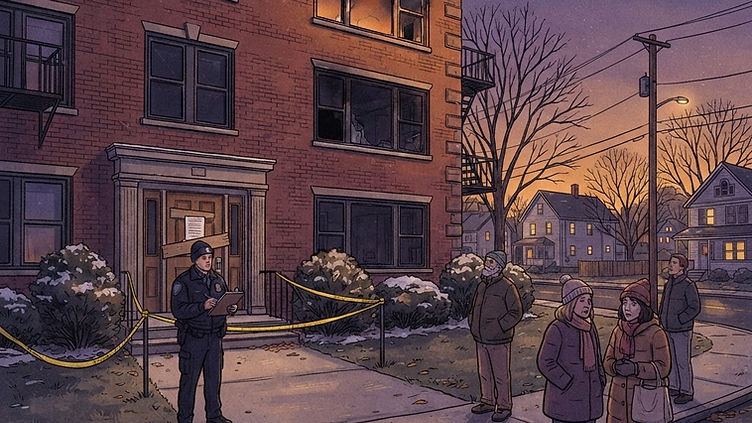
Firefighters responded to a structure fire in the area of Englewood Drive in Manchester, Connecticut, where occupants had evacuated on their own before crews arrived, according to WFSB Eyewitness News 3.
Emergency fire watch
Alarm or sprinkler system out of service? USPA can post a fire watch on site within 60 minutes.
Trained officers, documented patrol rounds and direct 911 notification, scoped to the order your fire marshal actually issued.
Live dispatch, 24 hours. In an emergency, call 911 first.
One person was treated by EMS for minor burns. Fire officials declared the building temporarily uninhabitable because of fire and smoke damage, and the American Red Cross was called in to assist the people who had been living there.
That sequence — self-evacuation, a minor injury, an uninhabitable declaration — is the best available outcome of a residential fire. It is also the moment the building changes category. A multi-unit property with people in it is a property with eyes on it. The same property with nobody in it, damaged, and with its utilities disconnected is a building under no supervision at all, in a town where nobody is assigned to watch it unless someone is hired to.
What the record establishes
As of Nov. 28, the published reporting establishes the following, and nothing more:
- A structure fire occurred in the area of Englewood Drive in Manchester, Connecticut.
- Occupants self-evacuated before fire crews arrived.
- One person was treated by EMS for minor burns.
- Fire officials declared the building temporarily uninhabitable because of fire and smoke damage.
- The American Red Cross was assisting displaced occupants.
The cause has not been established in the reporting. Nothing here should be read as a finding about it.
"Temporarily uninhabitable" is a legal status with an operational consequence
The declaration is made by the fire department, sometimes jointly with a building official, and it means the property cannot lawfully be occupied until the conditions that produced it are corrected and the building is cleared.
It is temporary in principle. In practice it lasts weeks, because the correction list runs through smoke remediation, electrical inspection, alarm and sprinkler restoration and, in many cases, a permit process that has its own queue. A building declared uninhabitable on a Friday is typically still empty a month later, and the owner is carrying a mortgage, insurance and an empty structure in the middle of a residential neighbourhood.
During that period the owner carries two obligations that do not appear in the insurance policy: keeping the building secure and keeping it monitored. Connecticut, like most states, places responsibility for securing a vacant structure on the owner, and municipalities can act against owners who do not — at the owner's expense, with a lien attached.
The four things that happen to an empty building
The threats at a building like this are unglamorous and consistent, and they arrive in a predictable order.
Squatting comes first. An empty multi-unit building with a working door, and often with heat and water still on, is shelter. In a cold-weather month that process takes days. Once someone is inside, removing them becomes a legal proceeding rather than a security response, and the property owner discovers that the police cannot simply eject an occupant of a building they do not own.
Theft of building systems comes second. Copper piping and wiring, water heaters, appliances, fixtures, brass and even the panel boxes are the standard haul. A stripped building loses its certificate of occupancy and its insurability along with its value, and the loss is not covered in the way a fire loss is.
Vandalism and secondary fire come third, and the third one matters most. A vacant building with no alarm, no power and combustible debris is where the next fire starts. Fire service response to a vacant building is more dangerous for crews than a response to an occupied one, because there are no occupants to report conditions and no interior layout that can be trusted.
Unauthorized re-entry by former occupants comes fourth. It is not a crime in the way the others are, and it is a real safety exposure when the structure has not been cleared, as well as a frequent source of conflict at the site.
Board-up is a delay, not a control
The reflex after a residential fire is to board the openings and wait for the adjuster. Boarding is necessary and it is not sufficient.
Plywood over a window is a delay measured in seconds for anyone who intends entry, and it advertises vacancy to everyone who passes. A boarded building with no alarm has no way to detect entry at all. A multi-unit property has more openings than its front elevation suggests: rear doors, basement access, fire escapes, roof scuttles, and windows on sides that no neighbour overlooks.
What changes the outcome is presence: a marked patrol on a documented schedule, a controlled point of contact for the contractors and adjusters who need in, and a posted notice that the site is monitored. Where the property is large enough or the damage severe enough, a stationary post is better than a patrol.
What supervision actually looks like
For a building in this condition, the deployment is a combination of two services that are often bought separately and should not be.
A fire watch provides scheduled documented patrols of the interior and exterior, with thermal imaging where fire damage is present, and a direct line to the fire department. It exists because the building's own detection and suppression systems are down or degraded.
Physical security provides a controlled access point, identity checks on anyone who claims to be a contractor or an inspector, and a perimeter that keeps casual entry from becoming a nightly occurrence.
The two belong together because the same crew is usually the only person on site after dark, and the value of that crew is that it can do both jobs with one set of rounds.
USPA provides fire watch nationally and vacant-property security alongside it, and the two are typically the same deployment at a residential loss of this size.
The restoration clock
The building's return to occupancy depends on a sequence that the owner does not control: the fire investigation's release of the scene, the structural assessment, the smoke remediation, the electrical inspection, the alarm and sprinkler restoration and re-acceptance, and the building official's clearance.
Each step has its own contractor, and each contractor needs access to a building that must be unlocked for them and locked again behind them. That access management is a security function, and it is the reason a fire watch at a vacant building is also, in practice, the site's access control system.
The people
The Red Cross piece of this story is the human part, and it is genuinely the most important one: a family that was in its home yesterday is in a shelter tonight, and one person is carrying a burn injury that will need follow-up.
The building they left is what has to survive until they can come back. Nothing about the fire itself secured it, and nothing about the news coverage will check whether it was secured. That work happens quietly, overnight, for as many nights as the restoration takes.
The insurance and liability arithmetic
An owner reading this will make one calculation quickly: what it costs to leave the building unwatched, against what it costs to staff it.
The insurance side is not neutral. Most commercial property policies contain protective-safeguard conditions requiring the insured to take reasonable steps to protect the property after a loss, and a vacant, damaged, unalarmed building that is burglarized or burns a second time invites a coverage dispute. A documented watch is the cheapest evidence an owner can produce that they did what the policy asked.
The liability side is worse. A person who enters a vacant building and is injured has a claim, and so does a contractor who falls through a floor that nobody marked. Where a building is open and unsupervised, the owner's position in that claim is difficult, and the fire watch log is the record that shows the site was controlled.
What the owner should document from day one
- The declaration itself, in writing, with the conditions named by the fire department.
- The date the building was made secure, with photographs of every opening.
- The watch schedule and the logs, retained for as long as the claim and the restoration run.
- Every entry, with a name, an affiliation and a time, including the ones that were turned away.
- Every change in condition, reported the same day: water where it should not be, a door found open, a smell of smoke.
None of that is administrative decoration. It is what the owner has instead of a working alarm system, and it is what the restoration contractor, the insurer and the building official will each ask for in turn.
The municipal clock runs on its own schedule
The owner is not the only party with a timeline at a building like this.
A municipality that has declared a structure unsafe and uninhabitable has an enforcement interest that continues after the fire department leaves. Inspectors re-visit, code violations are issued, and where an owner does not secure the property, the town can board it, secure it and bill for the work with a lien attached. In Connecticut, as elsewhere, that process is faster than most owners expect and considerably more expensive than hiring a crew.
The practical consequence is that the security decision is not open-ended. An owner who arranges a documented watch and a secured building in the first days is dealing with a fire. An owner who waits is dealing with a fire, a code file and a municipal bill, and the third one is the easiest of the three to avoid.
Related coverage: a Superior apartment fire that left a building open to the weather and a Union Township storefront fire that exposed a commercial strip.
Reference and services
Knowledge base
NFPA 25 Impairment Protocols (2026): Fire Watch, the Ten-Hour Framework and System Restoration
National reference · 23 pages, citation registry attached
Read the volumeService
Fire watch services
How USPA staffs this work, with the coverage, licensing and dispatch terms for the assignment.
See the serviceSources
About the reporter
Staff Writer
Staff writer for the USPA Nationwide Security newsroom. Receives newsroom tips, corrections and editorial inquiries.
Author biography and credentialsMore from The Watchline

Fire Protection
Union Township storefronts are open to the street and their alarms are not working
Business owners in Union Township are starting recovery after a fire that damaged multiple storefronts. A commercial strip with no glass and no alarm is a target before it is a construction site.
· Albina Bieci

Fire Protection
Superior's John Avenue fire burned through the roof. Now the building has to survive the water and the cold
A nearly three-hour fire in a two-story Superior apartment building injured a firefighter and caused an estimated $300,000 in damage. The remediation window is the most dangerous part.
· Albina Bieci

Fire Protection
In Maryville, the fire was inside the walls and the front wall is still standing
A concealed fire at 310 North Main Street collapsed interior floors and shut a block of Maryville's downtown square. The hazard that closed the street is the wall nobody can move.
· Albina Bieci