
Superior's John Avenue fire burned through the roof. Now the building has to survive the water and the cold
Expanded Nov. 28 with full water, freeze and remediation analysis.

By Albina Bieci, Staff Writer
A nearly three-hour fire in a two-story Superior apartment building injured a firefighter and caused an estimated $300,000 in damage. The remediation window is the most dangerous part.
SUPERIOR, Wis.
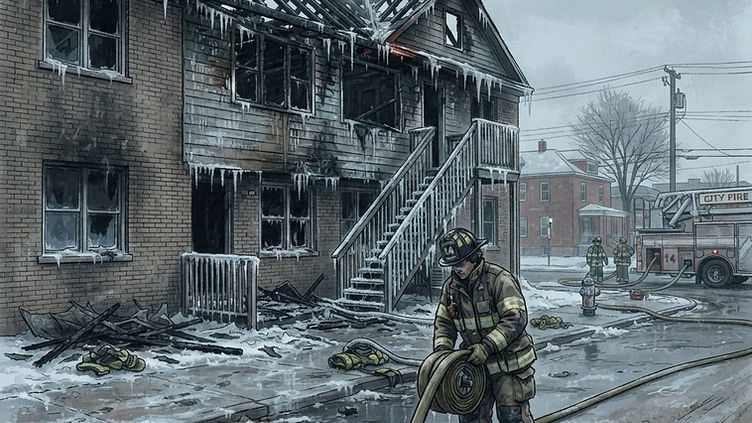
Superior Fire Department crews battled a nearly three-hour blaze at a two-story apartment building on John Avenue in Superior, Wisconsin, after flames broke through the roof, according to FOX 21 News.
Emergency fire watch
Alarm or sprinkler system out of service? USPA can post a fire watch on site within 60 minutes.
Trained officers, documented patrol rounds and direct 911 notification, scoped to the order your fire marshal actually issued.
Live dispatch, 24 hours. In an emergency, call 911 first.
Five residents were evacuated, one firefighter was injured, and the building sustained an estimated $300,000 in structural roof and water damage across all units.
Three hours is a long time for a building of that size, and the length is a description of where the fire was. A fire that takes three hours and vents through the roof has been in the attic or the roof assembly, which is the one part of a wood-frame residential building that is hardest to reach and most consequential to lose.
It also describes the water. Three hours of suppression in a two-story building puts an enormous volume of water into the structure, and that water is now doing more damage than the fire did.
What the record establishes
As of Nov. 28, the published reporting establishes the following, and nothing more:
- The fire occurred at a two-story apartment building on John Avenue in Superior, Wisconsin.
- Superior Fire Department crews fought the fire for nearly three hours.
- Flames broke through the roof.
- Five residents were evacuated.
- One firefighter was injured.
- The building sustained an estimated $300,000 in structural roof and water damage affecting all units.
The cause has not been established in the reporting. Nothing here should be read as a finding about it.
A roof fire removes the building's first line of defence, permanently
The roof assembly of a residential building is not just weather protection. In a two-storey apartment building it is where the structure's continuity across the top is maintained, where the insulation and vapour barrier determine whether the building can be dried, and where a fire crew would perform vertical ventilation if the roof were still intact.
Once fire has broken through, all of that goes at once. The building is open to the sky. Rain, snow and meltwater enter the same voids the fire burned through, and they keep entering until the roof is covered. The insulation is burned away or saturated, which means it stops insulating at the moment the building has no heat.
That is why emergency tarping is the first contractor task at a loss like this and why it is rarely fast enough. In northern Wisconsin at the end of November, the weather is not a background condition. It is a second source of damage with its own schedule, and it does not wait for the adjuster.
The water is now the larger loss
The $300,000 figure spans the roof and the water, and the water is usually the part that decides whether the building is repairable.
Suppression water in a two-storey building travels down through the floor assembly into the ceilings below, into wall cavities and into the basement. It saturates insulation, which stops insulating. It reaches the electrical system, which cannot be re-energized until it has been inspected and, in most cases, partly replaced. It reaches the fire detection wiring. And it reaches the building's finishes, which in an older apartment building are often the expensive part.
The detection wiring is the part that matters most for the next fire. Smoke detectors and alarm initiating circuits run through the same concealed spaces the water went through. A building that has been wet in those spaces does not have a functioning alarm system until an electrician and a fire alarm contractor say it does, with documentation.
In a Wisconsin winter there is an additional failure mode that appears at almost every cold-weather fire loss: freeze damage to any piping the building still has pressure in. Wet sprinkler pipe in an unheated, roof-damaged, power-down building will split, and the split is not discovered until the water is turned back on — at which point the building floods a second time, from the inside.
What the building needs between now and remediation
The interval between the fire and the start of real repairs is when most of the avoidable loss happens. At a five-unit building on John Avenue, that interval has a short list of requirements.
Tarping and weather-tightening of the roof opening, done by a contractor with fall protection and documented, so the owner and the insurer can see when the building was made weather-tight.
Water extraction and drying started immediately, with moisture readings recorded by area. The drying log is the evidence that the building was handled correctly, and it is what supports the claim.
Electrical and alarm isolation until inspection, with the systems clearly tagged out rather than left in an ambiguous state where a contractor assumes a circuit is dead.
Winterization of the plumbing and any remaining wet systems, because a frozen building becomes a demolition.
Continuous fire watch through the remediation period. A roof-damaged building with debris, contractors using heat and power tools, and no working detection is a fire risk that remediation itself creates. This is the part owners most often skip, and it is the part that produces the second fire.
USPA provides fire watch nationally for buildings in remediation, and its crews work alongside restoration contractors rather than replacing them.
The firefighter injury
One firefighter was injured, and the reporting does not describe the mechanism. What can be said without speculation is that roof operations are the highest-consequence work at a fire like this.
Opening a roof requires a crew to be above the fire, on a surface whose structural integrity is already in question, with a saw that weighs as much as a small child and a hole about to be created beneath their feet. Falls through a burned roof, burns from venting gases and musculoskeletal injuries from the work are all routine hazards of that assignment, and all of them are reasons the roof is treated as a specialist operation rather than an extension of the interior attack.
For the building, the injury has a secondary consequence: the fireground operation changes when a member goes down. Companies are reassigned, the safety officer's posture tightens, and the attack that was underway is completed more cautiously. That is the right trade. It also means more water and more time.
Five residents, one injured firefighter, and a building still standing
The casualties here are the whole story for the people involved: five people out of their homes, and a firefighter hurt doing the work. Everything else is property.
But the property is what those five residents will return to or lose, and the difference between the two is usually made in the first seventy-two hours, by whoever is standing in the building keeping it dry, keeping it dark, and keeping everyone else out. That work does not appear in a damage estimate. It is what determines whether the estimate is the final one.
Remediation is the next fire risk
The building survived the fire. The work to restore it is a new ignition exposure, and it arrives with the contractors.
Remediation at a roof-damaged building involves heat: propane torches for membrane work, roofing kettles, temporary heaters to keep the building above freezing, generators and power tools on cords run through wet structures. It also involves combustible debris — torn-out lath, insulation, carpet, cabinetry — piled in and around a building with no detection and no suppression.
That combination is the standard origin of the second fire at a fire loss, and it is why fire watch at a building in remediation is not the same assignment as fire watch at a vacant building. The rounds have to include the work areas, the temporary heating equipment, the generator placement and the debris pile, and the crew has to have the authority to stop work when a condition is unsafe.
Hot work permits, a fire watch during and after any cutting or soldering, and a clear rule about where heaters can be placed are the contractor's responsibility. Confirming that they happen is the owner's, and it is the part easiest to delegate to nobody.
What the five residents should ask for
The residents of this building have a practical interest in three questions, and none of them is about the fire.
- Who has my belongings, and who is responsible for them now? In a damaged, unalarmed building, that is a security question before it is an insurance one.
- When can I get in to document what I lost? Access should be arranged through the owner with an escort, and it should happen before debris removal.
- What will tell me the building is safe to return to? The answer is a set of inspections and a re-acceptance test, not a coat of paint.
A fire watch that keeps a building secure and documented is also, for those residents, the thing that keeps their remaining property from disappearing before they can claim it.
Related coverage: a Thanksgiving fire that displaced 36 people from a St. Paul building and a sprinkler save in Titusville that left the system impaired.
Services in Superior, WI
Reference and services
Knowledge base
NFPA 25 Impairment Protocols (2026): Fire Watch, the Ten-Hour Framework and System Restoration
National reference · 23 pages, citation registry attached
Read the volumeService
Fire watch services
How USPA staffs this work, with the coverage, licensing and dispatch terms for the assignment.
See the serviceSources
About the reporter
Staff Writer
Staff writer for the USPA Nationwide Security newsroom. Receives newsroom tips, corrections and editorial inquiries.
Author biography and credentialsMore from The Watchline

Fire Protection
Union Township storefronts are open to the street and their alarms are not working
Business owners in Union Township are starting recovery after a fire that damaged multiple storefronts. A commercial strip with no glass and no alarm is a target before it is a construction site.
· Albina Bieci

Fire Protection
In Maryville, the fire was inside the walls and the front wall is still standing
A concealed fire at 310 North Main Street collapsed interior floors and shut a block of Maryville's downtown square. The hazard that closed the street is the wall nobody can move.
· Albina Bieci

Fire Protection
Manchester declared a building uninhabitable. The security problem starts at that sentence
Occupants of an Englewood Drive building got themselves out before crews arrived. Once a fire marshal declares a multi-unit property unfit, the property needs someone standing in it.
· Albina Bieci