
In Maryville, the fire was inside the walls and the front wall is still standing
Expanded Nov. 28 with full collapse-zone and downtown-block analysis.

By Albina Bieci, Staff Writer
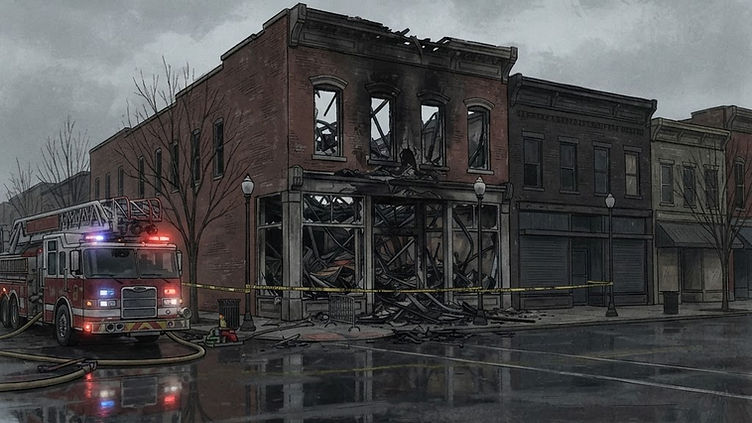
A concealed fire at 310 North Main Street collapsed interior floors and shut a block of Maryville's downtown square. The hazard that closed the street is the wall nobody can move.
MARYVILLE, Mo.
A region-wide mutual aid response fought an extensive concealed fire in a commercial building at 310 North Main Street in Maryville, Missouri, that caused interior floors to collapse and spread smoke damage into adjacent businesses on the downtown square, according to KMAland News.
Emergency fire watch
Alarm or sprinkler system out of service? USPA can post a fire watch on site within 60 minutes.
Trained officers, documented patrol rounds and direct 911 notification, scoped to the order your fire marshal actually issued.
Live dispatch, 24 hours. In an emergency, call 911 first.
Officials closed the 300 block of North Main Street because of severe collapse hazards from the remaining front brick wall.
Two details in that account describe the whole operational problem, and neither of them is the fire. The first is "concealed." The second is that the most dangerous thing at the site is a wall that is still standing.
A downtown square is the densest built environment a small city has, and a fire in one of its buildings is never a single-building event. It is a block event, and it lasts longer than the fire.
What the record establishes
As of Nov. 28, the published reporting establishes the following, and nothing more:
- The fire occurred in a commercial structure at 310 North Main Street in Maryville, Missouri.
- The response involved mutual aid from across the region.
- The fire was concealed within the structure.
- Interior floors collapsed.
- Smoke damage affected adjacent downtown square businesses.
- The 300 block of North Main Street was closed because of collapse hazards from the remaining front brick wall.
The cause has not been established in the reporting. Nothing here should be read as a finding about it.
Concealed fire in an old commercial building is a construction problem
A commercial building on a courthouse square is usually the oldest building stock a town has. Load-bearing masonry walls, wood joist floors, plaster on lath, and a century of remodels layered on top of each other — dropped ceilings, furred-out walls, new storefronts built inside old openings, mechanical systems run through spaces that were designed as closets.
That assembly hides fire. It travels inside wall cavities, above ceilings, under floors and through the chases between floors, and it can burn for a long time before it produces smoke anywhere a passer-by can see it. The mutual aid response is a measure of what that means in practice: a fire that stays concealed until it is well developed is a fire that requires more companies than the town has, and the request for those companies takes time that the fire uses.
There is a second construction reality that shapes the outcome. Older downtown buildings were built with balloon-frame or early platform framing in which the wall cavities run the full height of the building without fire-stopping. Once fire enters a wall, it has a continuous path from the foundation to the roof, and the only reliable way to stop it is to open the wall — which is precisely what the floor collapse later made unsafe.
Why the floors came down
Interior floors that collapse tell you the fire burned in the joist bays long enough to consume them. That is the mechanism: fire below the floor, or inside the ceiling void below it, heating the joists until they lose section, and then a floor that was carrying a load stops carrying it.
What is left is a masonry shell with its diaphragms gone. The masonry walls that used to be braced at every floor line by the floor structure are now standing on their own, and an unreinforced brick wall without lateral support is the classic collapse hazard in American downtowns. The wall does not have to be visibly bowed to be dangerous. It has to be tall, unbraced and old.
The collapse zone is the security perimeter
Fire service practice for a damaged wall is a collapse zone: an area around the wall roughly equal to its height, kept clear of people and vehicles, because masonry walls fail outward and without much warning. That zone is what closed the 300 block of North Main Street.
Closing a street is easy. Keeping it closed is not. A downtown square is the most heavily used public space in a small city, and the block will draw pedestrians, residents, delivery drivers, journalists and the owners of the affected businesses, each of whom believes they have a reason to be inside the tape.
Every one of those people has to be turned around by someone with the authority and the manner to do it without a confrontation, at 2 p.m. and at 2 a.m., for as long as the wall stands. That is the assignment at this site, and it has four parts:
- Hold the exclusion zone, day and night, including the alley and the rear access that a street closure does not cover.
- Control access for the parties who must enter — fire investigators, structural engineers, utility crews, and later shoring or demolition contractors — with a log and an escort.
- Monitor the exposed neighbouring buildings, which share party walls and have now been through a fire next door without a fire in them.
- Watch for re-ignition in the debris and in the shared wall cavities, which is a thermal-imaging patrol rather than a visual one.
USPA provides fire watch nationally and perimeter security for fire-damaged commercial structures, including collapse-zone enforcement during investigation and demolition.
The neighbours are part of the incident
The reporting notes smoke damage across adjacent businesses on the square, and that phrase understates what those owners are facing.
A business that did not burn can still be closed for weeks. Smoke residue settles in inventory, finishes, upholstery and HVAC systems. Water from the firefight reaches shared basements and party walls. And the part that decides how long the closure lasts is not cosmetic: a fire alarm system and an electrical service cannot be certified while the building next door is unsafe to enter, and an owner cannot open a storefront that the fire marshal has not cleared.
There is a legal dimension as well. Where a shared wall or a common basement is involved, the investigation of one building becomes the access question for two, and the owner of the undamaged property has a legitimate interest in the site that has to be accommodated without letting the public in.
For a downtown square, the economic dimension is the one that outlasts the news. A closed block suppresses foot traffic for every business on it, including the ones that are open, and the recovery of the block is a collective problem that each owner will experience privately.
What happens to the wall, and on whose schedule
The front wall comes down or it is shored, and that decision belongs to a structural engineer working for the owner, in consultation with the fire department and the city.
Demolition of an unstable facade in a downtown block is not a quick operation. It requires the street closure to remain, protection for the neighbouring structures, utility disconnects, asbestos and lead surveys in a building of that age, and a contractor willing to work next to a wall that may fall. It also requires the investigation to be complete, because demolition destroys evidence.
That sequencing — investigation, engineering, abatement, demolition — is why a collapse-zone closure at a downtown commercial fire routinely runs for weeks rather than days. The street does not reopen when the fire is out. It reopens when the hazard is gone.
What Maryville has on North Main Street this morning
A burned-out commercial shell with its floors in the basement, an unsupported front wall facing the town's main street, an active investigation, an unknown number of neighbouring businesses displaced, and a street closure that will outlast the news cycle.
None of those conditions resolves itself. Until the wall is down or shored, the block belongs to whoever is standing at the barrier. That is a staffing decision, and it is the one decision at this incident that is entirely within the owner's control.
The investigation, and the evidence the wall is protecting
There is a second reason the block stays closed beyond the wall's geometry, and it is evidentiary.
An origin-and-cause investigation at a concealed fire is a destructive process by necessity. Investigators open ceilings and walls, remove debris in layers and reconstruct the fire's travel through the voids. That work requires the building to be stable enough to enter safely and the scene to be unaltered by anyone else — which means the site has to be controlled from the moment the fire is out until the investigator releases it.
The wall standing over the fire floor complicates that directly. Investigators work from the outside in where a floor has collapsed, and they need the space in front of the building that the street closure has taken. The closure and the investigation are therefore the same problem, and the party managing access is managing the case.
For the owner, that is an argument for one point of contact rather than three. The investigator, the engineer and the demolition contractor are sequencing against each other, and the site log is what keeps the sequence honest.
Related coverage: a Los Angeles commercial fire fought from the roof and a Pooler commercial fire where water damage followed the flames.
Reference and services
Knowledge base
NFPA 25 Impairment Protocols (2026): Fire Watch, the Ten-Hour Framework and System Restoration
National reference · 23 pages, citation registry attached
Read the volumeService
Fire watch services
How USPA staffs this work, with the coverage, licensing and dispatch terms for the assignment.
See the serviceSources
About the reporter
Staff Writer
Staff writer for the USPA Nationwide Security newsroom. Receives newsroom tips, corrections and editorial inquiries.
Author biography and credentialsMore from The Watchline

Fire Protection
Union Township storefronts are open to the street and their alarms are not working
Business owners in Union Township are starting recovery after a fire that damaged multiple storefronts. A commercial strip with no glass and no alarm is a target before it is a construction site.
· Albina Bieci

Fire Protection
Superior's John Avenue fire burned through the roof. Now the building has to survive the water and the cold
A nearly three-hour fire in a two-story Superior apartment building injured a firefighter and caused an estimated $300,000 in damage. The remediation window is the most dangerous part.
· Albina Bieci

Fire Protection
Manchester declared a building uninhabitable. The security problem starts at that sentence
Occupants of an Englewood Drive building got themselves out before crews arrived. Once a fire marshal declares a multi-unit property unfit, the property needs someone standing in it.
· Albina Bieci