
Fire in a vacant third-floor apartment displaces 10 in New Bedford

By Albina Bieci, Staff Writer
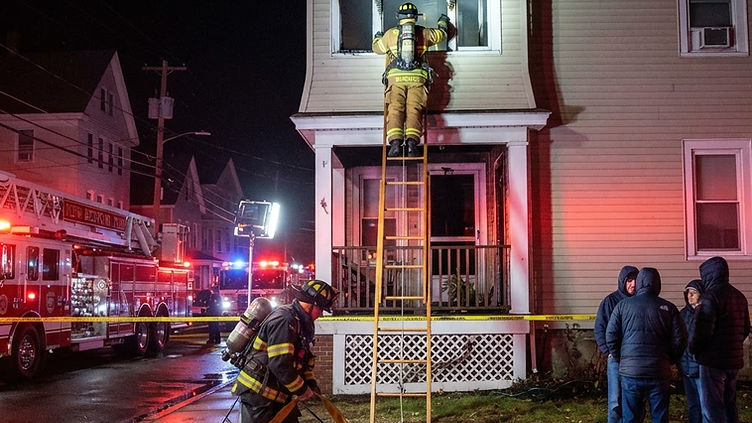
The New Bedford Fire Department says the fire was contained to a vacant third-floor apartment with no injuries, leaving a building that is damaged inside, still occupied around the damage, and under an open cause investigation.
NEW BEDFORD, Mass.
NEW BEDFORD, Mass. — A fire in a vacant third-floor apartment on Nash Street displaced 10 residents Sunday night, and the New Bedford Fire Department reported no injuries. The fire chief said the damage stayed inside the building and that crews controlled the flames quickly. The cause remains under investigation, and the building's long-term occupancy was still being evaluated Monday morning. Local reporting by New Bedford Guide described 10 displaced residents and emergency management resources deployed to the scene.
A fire contained to one vacant unit with no injuries is the outcome a department wants. For the property, it starts a second problem that outlasts the fireground: a wood-frame residential building with fire damage in the middle of its upper floor, a household of displaced tenants, and protection systems that may not be reporting again for weeks.
What the department has confirmed, and what it has not
Confirmed by the department's own account: a fire in a vacant apartment on the third floor of a Nash Street building, all damage inside the structure, a rapid knockdown, no injuries, 10 people displaced, and an active cause investigation. Reporters on scene described a multi-family building of roughly two and a half stories.
Not confirmed as of Monday morning: the cause. Whether electrical service, gas service or the building's alarm system remain functional. Whether the third-floor unit had been secured before the fire, and for how long. Whether the building will be released for re-occupancy in part or as a whole. Those gaps matter because each one determines who is responsible for the property between now and the day a contractor restores it, and how many people have to stay on the site until then.
A vacant apartment is where a fire grows without a witness
An occupied unit generates its own alarm system: someone smells smoke, hears a smoke detector in the next room, notices a warm wall. A vacant unit produces none of that. It is the room in the building where a fire can develop past the incipient stage with nobody inside to notice, which is why vacancy shows up so often in the early history of residential fires in older housing stock.
The condition of this particular unit before the fire is not public. The general mechanism is not in dispute. Vacant apartments accumulate the previous tenant's belongings, then a mattress, then furniture left in a hallway, then an appliance still connected to a live circuit because nobody pulled the meter. In November, they also collect space heaters, extension cords and, in buildings where the heat has been shut off, whatever a person sheltering in the unit brings in to stay warm. Each of those raises the odds that a fire starts there and lowers the odds that anyone calls it in early.
New Bedford's housing stock makes that worse than the description suggests. The city's dense two- and three-story wood-frame buildings were built long before compartmentation was a design requirement, and many of them have continuous stud bays running from basement to attic. A fire that gets into a wall cavity in that construction does not respect the floor line the way a fire in a modern building does.
Why one interior fire can take the whole building offline
Three systems decide whether a residential building can be reoccupied after an interior fire, and none of them is the charred room.
Electrical service is the first. Firefighting water and heat reach panelboards, meter banks and the conductors inside walls. A utility will not re-energize service to a building whose electrical equipment has been exposed until it has been evaluated, and an owner cannot legally ask tenants to live without power. Gas is the second, and it carries the same logic in reverse: no supplier restores service to a building until the piping and appliances downstream have been pressure-tested and inspected.
Smoke detection is the third, and it is the one most often forgotten in the first week. In older multifamily buildings, detection is frequently arranged unit by unit, on household current, sometimes with interconnect wiring that runs through the very ceiling assemblies the fire department opened. Damage on the third floor can silence a detector on the first floor, and a building with an occupancy permit that depends on working smoke alarms cannot be released until the system is repaired and tested.
Those three restoration paths run on different clocks, and none of them run on the fire department's. Eversource and the local gas utility schedule their own work. The city's inspectional services department has to sign off after that. Until all of it converges, 10 displaced residents stay displaced, and the building sits in the condition that displacement always creates.
Displacement comes with a calendar, and the calendar belongs to the owner
The Red Cross and local emergency management typically handle the first nights: a hotel, a voucher, a blanket, a case number. What they do not handle is the months that follow. Massachusetts tenants displaced by fire retain rights to their units, and an owner who wants to restore the building has to work through the insurance adjuster, the utility restoration sequence and the building department while those rights sit open.
This is the phase in which the building is hardest to secure, because it is neither empty nor occupied. Some tenants may return within days. Others will not return at all. Family members, contractors, adjusters, cleaners, restoration crews and insurance photographers will all cross the threshold in the first two weeks, and each of them needs to be accounted for at the door. A burned third-floor unit with a forced door and a broken window is an open invitation to anyone who notices the pattern of traffic.
The building is open before it is empty
Firefighters force doors and break windows. They cut ventilation openings in roofs and ceilings. Then the board-up crew arrives, usually within a day, and puts plywood where the glass was. Plywood is a delay, not a barrier, and on a building with no power it is often the only thing standing between a vacant third-floor unit and whoever wants in.
The risk that follows is not hypothetical in New England. A burned or vacant building draws people who need shelter from the cold, and sheltering in a building without power means candles, lighters and improvised heat. It also draws copper and scrap thieves, who cut pipe and leave gas or water lines open. Both groups create the conditions for a second fire in a building that has already used up its margin.
That is the point at which the fire code stops treating the property as a private matter. Section 901.7 of the International Fire Code, as adopted in Massachusetts, allows the fire code official to require a fire watch wherever a fire protection system is out of service or where conditions constitute a hazard. A building whose detection is down, whose sprinkler system, if it has one, is impaired, and whose openings are boarded rather than sealed meets that description in most jurisdictions.
What the watch is actually doing on a building like this
A fire watch on a damaged residential building is not a guard standing at the front door. NFPA 601, the standard for security services in fire loss prevention, describes the work as a patrol function: trained personnel walking defined routes at defined intervals, looking for smoke, heat, water flowing where it should not, and unauthorized entry, and calling the fire department directly rather than relaying a report.
On a building of this type, the route has to include the burned third-floor unit and the void spaces around it, where debris can hold heat for days. It has to include the exterior, because a rekindle that reaches a wall assembly shows on the outside before it shows inside. It also has to include the occupied portion of the building, since the tenants who stayed are now living next to a construction site with a hole in its roof.
What the owner should be asking this week
The sequence is not complicated, and it does not require the owner to guess. Ask the adjuster to confirm in writing what the policy requires for site protection during restoration, because a carrier that later disputes an unsecured-site claim will point to the gap. Ask the utility for a restoration date, and treat the answer as the real timeline rather than the contractor's estimate. Ask the alarm company to document what is working and what is not, in writing, with a test result attached.
Then decide how the building is watched and how it is recorded. The log is the document that answers every later question: hours covered, rounds walked, conditions found, and who was called. Restoration on a fire-damaged apartment building routinely runs for months, and the watch record is the only continuous account of the site across that period.
What happens next on Nash Street
The fire department will finish its cause work and release the scene. The building department will decide what can be reoccupied and when. The owner will file a claim and schedule restoration against a utility timeline nobody controls. In the interval, the property is a damaged residential building on a dense city street in the first cold weeks of November.
USPA Nationwide Security provides fire watch coverage in New Bedford and across the South Coast, emergency fire watch for buildings whose protection systems are out of service, and a published reference on what the fire codes require of a property while repairs are pending.
Services in New Bedford, MA
Sources
About the reporter
Staff Writer
Staff writer for the USPA Nationwide Security newsroom. Receives newsroom tips, corrections and editorial inquiries.
Author biography and credentialsMore from The Watchline

Fire Protection
Fall River's burned Columbian Building will sit open for weeks, with demolition priced above $1.2 million
More than seven weeks after fire destroyed the Columbian Building and damaged the unsprinklered property next door, the full demolition is still out of contract, four bids are in, and the scar in downtown Fall River stays an open structure in the meantime.
· Albina Bieci

Fire Protection
A South Los Angeles flooring warehouse reignites, turning a firefight into a multi-day debris operation
A 15,000-square-foot commercial flooring warehouse reignited early Tuesday, burning overhead power lines and leaving the Los Angeles Fire Department in an exterior suppression and debris-removal operation that heavy timber loads are stretching across multiple days.
· Albina Bieci

Fire Protection
UPDATE: Goodwin Hotel fire traced to a wall around an 1881 cast-iron column
Hartford's fire marshal and city licensing inspectors have opened a formal origin-and-cause investigation after confirming the fire traveled inside an exterior wall, through the decorative woodwork enclosing a cast-iron support column, with all 124 guestrooms still open.
· Albina Bieci