
Northern Atlanta suburbs face near-freezing nights as garden apartments head into the first hard freeze

By Albina Bieci, Staff Writer
Fulton, Cobb and Gwinnett's 1970s and 1980s multifamily stock is the most exposed housing in the metro when overnight lows drop into the upper 20s.
ATLANTA
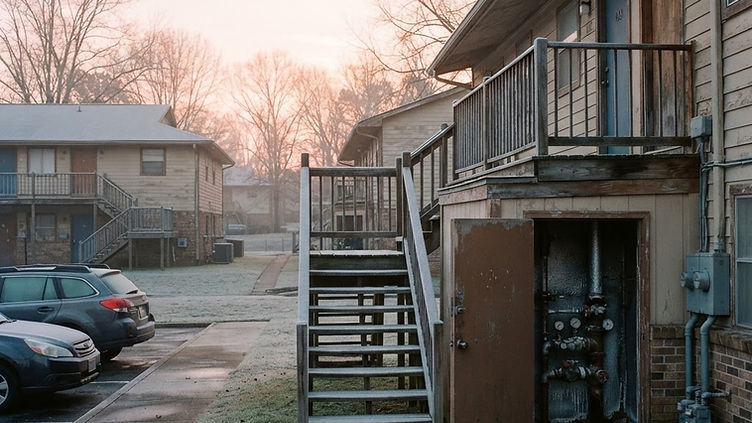
ATLANTA — The northern Atlanta suburbs are forecast to approach or fall below freezing overnight from Friday, November 13 through Sunday, November 15, and the buildings carrying the most risk in the metro are not the new towers in Midtown. They are the garden apartment complexes built between 1970 and 1995 across Fulton, Cobb, Gwinnett and DeKalb, where the fire riser sits in a closet off an exterior walkway and the sprinkler piping runs through an attic with no insulation between the pipe and the roof deck.
Forecast guidance from the National Weather Service places the metro's northern suburbs in the band of near- or sub-freezing overnight lows that would end the remaining growing season, with highs likely to stay in the 50s or cooler. Communities along the Georgia 400 corridor — Sandy Springs, Roswell, Alpharetta, Johns Creek — and the older suburban ring around Marietta, Smyrna, Duluth and Norcross sit closest to that line.
The building that fails is 40 years old
The metro has added an enormous amount of new construction in a decade, and new construction is comparatively well protected. Current code requires sprinkler piping to be protected from freezing, and a 2024-vintage podium building holds its risers in conditioned space behind a fire-rated wall.
Older stock does not. A 1985 garden-style complex typically has an unheated attic with wet-pipe sprinkler lines running above the ceiling of the top-floor units, an exterior riser closet with a backflow preventer, and domestic piping in exterior walls that were built to a Georgia climate where a hard freeze was rare.
When those systems fail, two things happen at once. A fitting splits and water runs into the unit below, and the building's fire protection goes out of service. For a property with 200 units and one riser, that is a fire watch covering every floor behind the valve until a contractor restores the system — during a holiday weekend, when the contractor queue across the metro will be measured in days.
Parking decks, retail strips and the Perimeter office core
The exposure is not confined to housing. Parking garages in the Perimeter Center and Cumberland office cores are unheated by design, and dry-pipe systems serving them depend on drum drips being drained before the first freeze. Retail strips along Roswell Road, Buford Highway and the older commercial corridors have riser rooms on the exterior wall, frequently heated by a small space heater plugged into a circuit that also serves exterior lighting.
Lightly staffed office floors present a quieter version of the same problem. A tenant that has consolidated to two floors and turned the third-floor thermostat to 55 degrees has created an unheated space above an occupied one, with nobody in the building overnight to hear a pipe split.
What teams are being staged to cover
Fire watch officers are being positioned across the northern arc of the metro, with priority given to properties that meet three conditions at once: unheated sprinkler piping, no overnight staff, and an alarm panel that reports only to an empty office.
Inside those properties, the round is written to the building rather than to a generic checklist. Officers check riser-room temperature and gauge readings, walk the top floor and the attic access, confirm that the fire department connection is clear, and record the status of any system that is already tagged out of service. Where a system has failed, a fire-found procedure is agreed in writing with the property manager before the first shift, naming who calls 911 and who meets the fire department at the gate.
Coverage for the metro is described at fire watch services in Atlanta, and properties that lose a system with no contractor available can be staged same day through the emergency fire watch line.
The impairment rule that applies regardless of the forecast
Georgia enforces the International Fire Code through the Office of Insurance and Safety Fire Commissioner and the local fire departments, and every adopted edition carries the same obligation: where a required fire protection system is out of service, the owner must notify the authority having jurisdiction, and the building must be provided with an approved fire watch until protection is restored.
NFPA 25 sets out the impairment procedure that satisfies it — notification, tagging, interim protection and a restoration test before the system returns to service. A watch that begins without notification, or ends without a test, does not satisfy the sequence even if officers were present the entire time.
For a multifamily property, the practical consequence is that a Friday-night pipe failure does not produce a Saturday-morning repair. It produces a tagged system, a call to the fire marshal on Monday, and a building that needs people in the corridors until the sprinkler contractor arrives.
What a property manager should do this week
Confirm the heat in every riser closet and mechanical room, including the ones on the exterior of the building, and check them again on Friday evening. Drain drum drips and low points on dry systems serving garages and unheated storage, and photograph the work. Walk the attic access on the top floor and look for piping that runs above insulation — that line is the one that freezes. Verify that the alarm panel's low-temperature and supervisory signals reach a person who will answer at 3 a.m., not a voicemail box. Confirm shut-off locations with the maintenance staff who will actually be on call. Put a sprinkler contractor and a water restoration vendor on notice before the queue forms.
And answer one question honestly: if the system goes out on Saturday, who is in the building until Monday? For a large share of the metro's older multifamily stock, the answer is currently nobody.
Where the code and the building diverge
Georgia enforces the International Fire Code through the state fire marshal and the local fire departments, and the current editions are explicit that sprinkler piping must be protected from freezing. That requirement has been in place for years.
The gap is not in the code. It is in the buildings that predate the standard and in the assumptions made about spaces the code permits to be unheated. An attic above a top-floor ceiling is not a conditioned space, and the accepted demonstration that piping there is protected from freezing has often been insulation installed decades ago, now compressed, displaced by a contractor, or missing above a portion of the run.
The practical result is a building that passes inspection and still freezes, because the condition the inspection assumed — a mild winter — is the condition the freeze removes.
How a two-night freeze becomes a week-long outage
The sequence is predictable enough to plan against. A branch line in an attic freezes on Friday night and splits. The system loses pressure, the flow switch activates, and the monitoring company calls a number. Water reaches the top-floor ceilings and begins working down through light fixtures, smoke detectors and shaft walls. Somebody reaches the property on Saturday morning, shuts the system down and calls a sprinkler contractor.
By Saturday afternoon, every sprinkler contractor in the metro has a queue of buildings with identical failures. The building is tagged out of service. The fire department is notified, and the fire marshal's office typically requires the property to demonstrate interim protection — which is the fire watch. The restoration itself starts Monday or Tuesday. The water damage repair runs for weeks.
The fire watch is the only element in that sequence that can be arranged before the failure rather than after it.
The insurance and notification side
Most commercial property policies require prompt notice of a loss and reasonable steps to prevent further damage, and carriers increasingly ask whether a building had a freeze-prevention procedure in place when a pipe failed. Documentation matters in that conversation: records that drum drips were drained, that riser-room heat was checked, that a low-temperature alarm was operating, that shut-offs were known.
For a multifamily property, the association or owner also carries the obligation to notify the authority having jurisdiction when protection goes out of service. That notification, and the watch that follows it, is what separates a documented impairment from an unreported one.
What an officer actually does overnight
A round is not a walk-through with a clipboard. On a cold night in a garden apartment complex, the officer checks the temperature at the exterior riser closet, reads the gauges if the system is still partly charged, confirms the fire department connection is clear and capped, walks the affected floors, checks the attic access for the smell of water or the sound of running pipe, and notes anything that changed since the previous round.
If a system is already down, the round is the building's only fire protection, and it is timed accordingly — typically not more than an hour between passes through an occupied building, with the fire-found procedure posted at the entry the officer uses.
Every round is written down. At the end of the assignment, that log is what the property hands to its insurer, its fire marshal and, if there is a loss, its adjuster.
Services in Atlanta, GA
Sources
About the reporter
Staff Writer
Staff writer for the USPA Nationwide Security newsroom. Receives newsroom tips, corrections and editorial inquiries.
Author biography and credentialsMore from The Watchline


Fire Protection
Gulf Coast faces a low-30s freeze with almost no cold-weather protection in its buildings
Mobile, Pensacola and New Orleans are engineered for heat, hurricanes and humidity. A single night near freezing is enough to take commercial fire protection offline across all three.
· Albina Bieci

Fire Protection
Memphis, Little Rock and Charlotte: the cold-snap buildings most likely to lose fire protection this weekend
Distribution space, vacant storefronts and 1980s multifamily share one trait across the Mid-South: nobody is inside at 2 a.m. when the fitting splits.
· Albina Bieci

Fire Protection
Nashville and Knoxville head into near-freezing nights with unheated attic lines and full parking decks
Tennessee's multifamily boom put a decade of sprinkler piping into attics and garages designed for a mild winter. Two cold nights is what it takes to find out which ones hold.
· Albina Bieci