
Two vendors, one network, no one watching: the water utility ransomware case is a boundary problem
Expanded Nov. 28 with full converged physical and network analysis.

By Albina Bieci, Staff Writer
The Booba group pivoted from an East Coast water treatment facility into the local government that oversees it, through a gap between two vendors. Physical security has the same gap.
NEW YORK
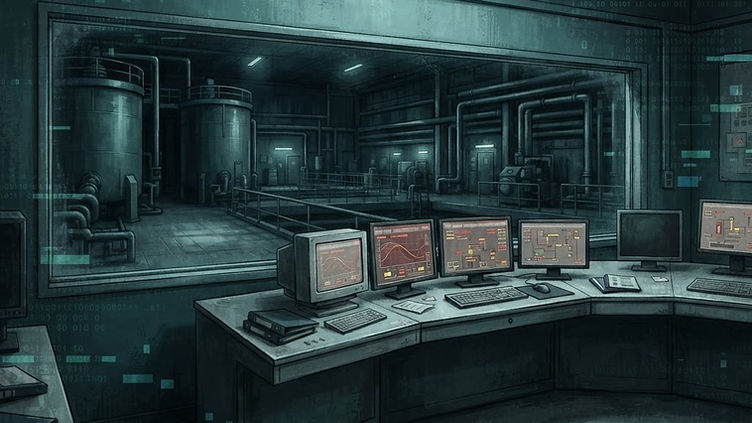
Threat researchers disclosed that the Booba ransomware group infiltrated an East Coast water treatment facility and then pivoted laterally into the local government network that oversees it, according to Security Affairs.
The attackers exploited a monitoring blind spot created by the way the site was managed: two separate vendors ran the interconnected operational and administrative networks, and the seam between them was not covered by either. The response required emergency isolation of 48 servers and workstations.
The technical finding is specific and it has a physical twin. The reason this incident is worth reading outside the utility sector is that the vulnerability was not a piece of unpatched software. It was an organizational boundary with nobody accountable for the space between two contracts.
Every facility in the country has that boundary somewhere. Most of them have never looked for it.
What the record establishes
As of Nov. 28, the published reporting establishes the following, and nothing more:
- The Booba ransomware group infiltrated an East Coast water treatment facility.
- The group pivoted laterally into the local government network overseeing the facility.
- Two separate vendors managed the interconnected operational and administrative networks.
- A monitoring blind spot between the two vendor environments enabled the intrusion.
- 48 servers and workstations were isolated as an emergency measure.
The specific facility, the confirmed extent of data access and whether any operational technology was manipulated have not been established in public reporting. Nothing here should be read as a finding about any of them.
Water utilities sit on the hardest boundary in critical infrastructure
A water treatment facility is three things at once: a physical plant with a control system, an administrative network, and a parent organization that needs to see into both.
Those three are supposed to be segmented, and in practice they are segmented by different contractors with different scopes, different monitoring tools and different escalation paths. The operational technology vendor knows the plant. The managed service provider knows the office. Neither is contracted to watch the interconnections between them, and the interconnections are where accountability thins.
The consequence at a utility is not primarily data loss. It is loss of view. An operator who cannot see the plant's telemetry is running a water system blind, and the emergency response to that is to isolate systems — 48 of them in this case — which restores control at the cost of visibility. For the hours or days that isolation lasts, the plant is operated on local control and human judgement, and the organization discovers how much of its safety envelope depended on the dashboards it just disconnected.
That is the real lesson of the 48 machines. They are not the breach. They are the price of the response.
The same seam exists in a building
Substitute the vocabulary and the pattern is identical in physical security.
- The building management and access control vendor manages the badge readers, the door controllers, the camera network and the HVAC automation.
- The guard contractor manages the posts, the patrols and the incident reporting.
- The IT provider manages the network those systems ride on, and often the accounts that administer them.
- The mechanical contractor holds the keys to the HVAC, telecom and SCADA rooms and visits on a schedule nobody else tracks.
- The cleaning contractor works alone in the building at hours when nobody is watching, with a badge that opens most of it.
Each contract is separately reasonable. Together they leave rooms, risers and circuits that no single party monitors — and those are precisely the places where a technical surveillance device is planted and where a physical intrusion is staged. An intruder does not need to defeat the badge system if a contractor badge opens the telecom room and that room's door contact reports to a system that has been offline for three weeks.
Why this is a monitoring problem, not an access problem
The instinct after an incident like this is to tighten access: fewer badges, more approvals, longer vetting. Those are reasonable and they do not address the failure.
The failure was that nobody was looking. A credentialed party, or a compromised account belonging to one, was operating in a space where neither vendor's monitoring reached. More approvals would not have changed that, because the approvals were granted correctly for the scope each vendor held.
What changes the outcome is naming an owner for the seam and giving that owner a way to see it. In network terms that means segmentation that is tested rather than assumed, logging that spans both vendor environments, and a contractual requirement that each vendor report on the interconnections it did not build.
In physical terms it means the same discipline applied to space: an inventory of which doors, risers, closets and rooms are opened by more than one party, and who is notified when each is opened.
The four things a converged assessment tests
The inventory of seams. Which spaces and systems are touched by more than one contractor, and is there a named person who can answer for each one. Most buildings cannot produce this list, which is itself the finding.
Whether the reporting works. A door alarm that has never been triggered in a year is not known to work. It is known to be untested. The test is to open the door, at a scheduled time, and confirm that the right person learns about it.
Whether the rooms are clean. Technical surveillance countermeasures work on the spaces where sensitive conversation happens and where third-party access is routine — executive offices, boardrooms, telecom rooms, SCADA rooms, and any space a contractor enters unsupervised. A sweep establishes a baseline; the schedule is what keeps it meaningful.
Who is in the building after hours. Contractors and cleaners at a critical facility after hours are the least-supervised credentialed population on site, and they are the population most likely to be recruited, coerced or replaced. A process for verifying who is actually present, not who was scheduled, closes a gap that access control alone leaves open.
USPA's corporate risk intelligence practice and its cybersecurity assessments are built around this convergence, because the client that has one of these gaps almost always has the other.
The contract is where the fix lives
The durable remedy for a split-vendor blind spot is not a technology purchase. It is a contract term.
Whoever writes the next agreement with either vendor can require an interconnection register, joint monitoring of the boundary, notification to a single named owner when a system is changed or a room is accessed, and an annual test of the controls that span both scopes. Those requirements cost almost nothing to write and are difficult to add after an incident, when both vendors have a reason to say the gap was the other party's.
That is the practical lesson for every facility manager reading this story: the next time a contract comes up for renewal, the seam is on the table, and it is the only moment when it is cheap to fix.
Forty-eight systems and one question
The emergency isolation of 48 servers and workstations is a competent response to a bad situation, and it is also the measurable cost of a boundary nobody owned.
The question for every facility that reads this story is not whether its software is patched. It is who is responsible for the space between two vendors, and whether anyone could answer that question in the first hour of an incident. In most buildings, the honest answer is that nobody can — and the answer is available in an afternoon of asking.
The question a facility manager can answer today
There is a version of this exercise that requires no budget and no consultants, and it takes an afternoon.
Draw the building. Mark every space that more than one party can open: the telecom room, the riser closets, the mechanical and SCADA rooms, the roof hatch, the loading dock, the executive floor. Beside each one, write the name of the contractor who holds a key or a badge, and the name of the person who is told when it is opened.
The spaces with two contractors and no notification are the seams. They are the physical equivalent of the gap that let a ransomware group move from a treatment plant into the government that oversees it, and they are usually more numerous than the drawing suggests — a riser closet opened by the cabling contractor, the fire alarm contractor and the cleaning supervisor, with nobody notified, is the ordinary case rather than the exception.
The second half of the exercise is to test one of them. Have a contractor open a monitored door at a scheduled time and see who learns about it, and how quickly. That single test tells a facility manager more about the state of their monitoring than a year of reports, and it costs one phone call.
Doing it once establishes a baseline. Doing it on a schedule is what a converged security program actually is, and it is the only version of this that survives contact with a real incident.
Related coverage: the Air Force Cloud One control-plane breach and former White House cyber officials on unverified software and AI agents.
Services in New York, NY
Reference and services
Knowledge base
New York City FDNY Fire Guard Credentials & Life Safety Compliance Matrix
New York, New York · 26 pages, citation registry attached
Read the volumeService
Missing persons investigations
How USPA staffs this work, with the coverage, licensing and dispatch terms for the assignment.
See the serviceSources
About the reporter
Staff Writer
Staff writer for the USPA Nationwide Security newsroom. Receives newsroom tips, corrections and editorial inquiries.
Author biography and credentialsMore from The Watchline


Investigations
The Coast Guard and FBI are boarding tankers at sea, and the intrusion is riding in with the satellite link
Investigators boarded two Texas-bound energy tankers after attacks that took communications and reached ship systems. The same remote path that lets an intruder in lets a device hide.
· Mike Edwards


Investigations
West Virginia's Legislature lost its network in a quarter of record ransomware against government
The incident was described as limited to the Legislature's computer systems. The questions that follow are the ones a network investigation does not answer.
· Albina Bieci

Investigations
One year after Travis Turner walked into the woods behind his Wise County home, the Marshals Service is still leading the search
He left his vehicle, wallet, keys and prescription medication behind. Ground crews, K-9 units and drones have worked the terrain and 178 leads have come in from seven states. Investigators are still weighing a wilderness death against deliberate evasion.
· Albina Bieci