
One year after Travis Turner walked into the woods behind his Wise County home, the Marshals Service is still leading the search

By Albina Bieci, Staff Writer
He left his vehicle, wallet, keys and prescription medication behind. Ground crews, K-9 units and drones have worked the terrain and 178 leads have come in from seven states. Investigators are still weighing a wilderness death against deliberate evasion.
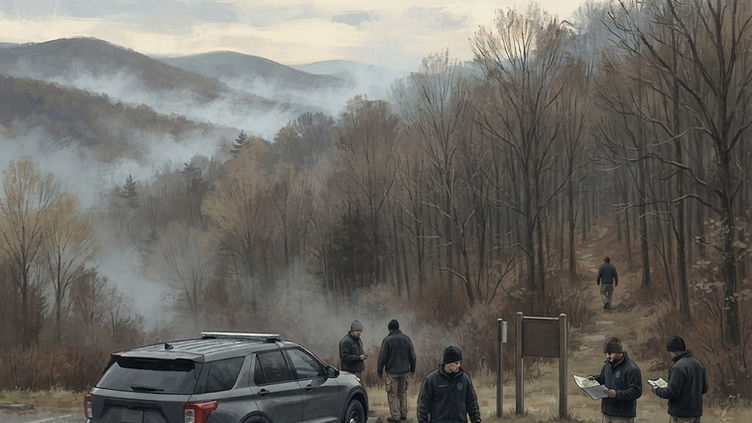
WISE, Va.
Law enforcement officials marked the one-year anniversary of the disappearance of former high school football coach Travis Turner on Thursday, a case in which the U.S. Marshals Service now leads an active search across the wooded terrain of Wise County, Virginia, according to reporting by WCYB News 5.
Turner disappeared on November 20, 2025, walking into the woods behind his home. His vehicle, wallet, keys and prescription medications were left behind. Ground searches have used K-9 units and drones, more than 178 leads have been reported from seven states, and federal and state felony charges have since been filed in connection with the case. Investigators are weighing a wilderness fatality against deliberate evasion, and the tip line remains open.
What has been reported
Turner, a former high school football coach, vanished into wooded terrain behind his Wise County home on November 20, 2025. He left behind his vehicle, wallet, keys and prescription medications. Searches have involved ground crews, K-9 units and drones. More than 178 leads have been received across seven states. Federal and state felony charges have been filed, and the U.S. Marshals Service continues to lead the active search. Investigators are considering both a wilderness fatality and fugitive evasion.
The reporting available at publication does not identify the charges or the persons charged, does not describe the evidence supporting them, and does not state what area has been searched or excluded. This article makes no allegation that any person committed an offense. Charges are accusations, and anyone charged is presumed innocent.
What was left behind, and why searchers read it first
In a missing person case that begins at the edge of a forest, the inventory of what was left in the house is the first investigative document.
Four items are named in the reporting: a vehicle, a wallet, keys and prescription medication. Each one carries a different implication, and none of them is conclusive.
A vehicle left at the residence removes the simplest explanation for a long absence, which is that the person drove somewhere and has not returned. Keys left behind mean the house can be entered and, more importantly, that the person is not carrying a way to leave the property quickly. A wallet left behind removes cash, identification and cards, which makes ordinary commerce difficult and makes a voluntary departure harder to sustain for long. Medication left behind is the item that investigators weigh most heavily, because a person who requires prescription medication and leaves it behind is either not thinking clearly, not intending to be gone, or not making the decision at all.
That is the reasoning, and it is exactly why the case has not resolved. Each item supports a wilderness outcome and each is also consistent with a person who intended to disappear and wanted it to look that way.
What 178 leads across seven states means
A lead count in the hundreds sounds like a case with momentum. Operationally it is a triage problem, and the way an agency handles it determines whether the case advances or stalls.
Leads arrive from the public, from other agencies, from social media sightings and from commercial records. Each one has to be logged, assessed, assigned and either worked or closed with a reason. The ones that matter are those that can be corroborated: a transaction, a vehicle sighting that matches a plate, a confirmed sighting by someone who knows the person, a medical record, an employment record.
Seven states is the detail that tells you what kind of search this has become. A wilderness search is geographic and bounded. A search across seven states is a fugitive investigation, and it is the reason the Marshals Service is the lead agency rather than the county sheriff alone. The Marshals Service's core function is finding people, and its authorities and reach are built for exactly this: an investigation that runs on records and locations rather than on a search grid.
The terrain in Wise County
Southwest Virginia is not flat, and the land behind a house in Wise County is not a park. It is second-growth hardwood on steep slopes, cut by hollows where water runs and where the ground is loose, with old logging roads, gas well access roads, mine portals and abandoned structures scattered through it.
That terrain defeats a straightforward line search. Ridges and hollows break sight lines at a few dozen meters. Vegetation in summer closes the ground completely, and the leaf-off window in late autumn and winter is when visual searching actually works. The one-year mark falls at the start of that window, which is one reason anniversaries are operationally significant rather than only symbolic.
There is also a hazard profile that matters to the searchers themselves. Old mine features, unstable cut banks, well pads with unmarked piping and hunting-season traffic all make a ground search in this country a technical operation rather than a walk in the woods.
What K-9 and drones can and cannot do
A trailing dog works from a scent article and follows a path, and its value in a case like this is that it can establish direction. Its limits are time and contamination: a trail that is a year old is not a trail a dog can follow, and a scene that has been walked by family, volunteers and media has lost most of what the dog needed.
An air-scent dog works a defined area for any human scent and is more useful in a search grid. Neither animal can tell an investigator whether a person walked out of the woods or was carried.
Drones cover ground that is dangerous or slow to walk, and modern units with thermal payloads are effective in the cold hours before dawn, when a living person's heat signature stands out. What they do not do is see through canopy. A drone searching a forested slope in leaf-on conditions sees the tops of trees, and a body under that canopy is invisible regardless of the sensor.
What federal charges change
Federal and state felony charges have been filed in connection with the case, per the reporting, and the search is being led federally. That combination changes the shape of the investigation even before any trial.
Federal involvement brings subpoena power over records held by companies outside Virginia, access to financial and travel data through legal process, and the ability to pursue a case across state lines. It also changes how a sighting is evaluated: a reported sighting in another state becomes a lead that a federal agency can act on directly rather than referring to a distant sheriff.
What a private investigation adds, and what it must not do
Families in the second year of a case frequently retain private investigators, and the value they add is real if the scope is right.
The useful work is documentary and parallel: canvassing businesses along routes for video that has not yet been overwritten, re-interviewing people who were not interviewed in the first weeks, assembling a timeline from phone and financial records that the family can lawfully obtain, and maintaining a single chronological file that the family can hand to investigators. The second year is also when commercial video from the first days is at the edge of retention, which is why that work has a deadline.
What a private investigation must not do is interfere. Contacting witnesses who are subjects of an active federal investigation, approaching people who have been charged, or publicizing unverified theories can damage a prosecution and can expose the family to liability. The professional posture is to work with the lead agency, share what is developed, and stay out of the criminal case.
What the family should be asking for at one year
Four things. A written status from the lead agency naming what has been searched and excluded, so effort is not duplicated. A current entry in NamUs with the dental and DNA records attached, because that is what allows an unidentified person found anywhere in the country to be matched. A single point of contact at the agency and a schedule for updates, so the family is not dependent on press coverage for information. And a documented chain of custody for anything the family has collected or received, because a year in, the file is the case.
Related coverage
The Watchline has reported on evidence that expires on a clock rather than a calendar. In Sacramento, the recovery of LJ Moore turned on commercial video that would be overwritten within two weeks.
The service connection
USPA Nationwide Security provides missing person investigations and search support for families, employers and counsel, including records reconstruction, video canvassing, interview work and coordination with the lead agency. The firm's Kingsman program provides charitable assistance for families of missing girls who cannot fund an investigation. Requests can be made through the missing persons investigations page, the Kingsman program page, or by calling (800) 214-1448.
Sources and status
Reporting on the anniversary is attributed to WCYB News 5. The charges, the evidence supporting them, the areas searched and the current status of the investigation remain open pending release by the U.S. Marshals Service and Virginia State Police. Technical references include the U.S. Marshals Service and NamUs.
Sources
About the reporter
Staff Writer
Staff writer for the USPA Nationwide Security newsroom. Receives newsroom tips, corrections and editorial inquiries.
Author biography and credentialsMore from The Watchline


Investigations
A $7.2 million cargo ring ended with 2.5 years and $2.2 million in restitution, and the ratio is the lesson
Federal sentencing in an interstate cargo theft case, fencing charges against two Illinois siblings and a federal suit over a mall detention arrived in the same week. Asset protection programs are being measured against all three.
· Albina Bieci

Investigations
An alleged INC and Lynx affiliate was extradited from Italy and appeared in a Tennessee court over hospital ransomware
Prosecutors describe a crew that targeted hospitals and schools, demanded $500 million and took more than 70 million health records. For facilities facing that kind of event, the building's protection systems fail alongside the network.
· Albina Bieci


Investigations
Visa confirmed a third-party incident in Asia-Pacific, and a ransomware group listed it beside JPMorgan
Visa confirmed an incident involving a regional vendor and said core payment systems were untouched. A leak-site listing that names two banks is leverage, not a finding, and the difference matters to every organization that depends on a payment processor.
· Albina Bieci
