
The Coast Guard and FBI are boarding tankers at sea, and the intrusion is riding in with the satellite link

By Albina Bieci, Staff Writer
Investigators boarded two Texas-bound energy tankers after attacks that took communications and reached ship systems. The same remote path that lets an intruder in lets a device hide.
GALVESTON, Texas
U.S. Coast Guard cyber personnel and FBI agents boarded two Texas-bound energy tankers after cyberattacks struck the vessels while they were transiting toward the United States, CBS News reported. One of them, the VL Prosperity, a 1,093-foot Liberian-flagged crude oil tanker bound for Galveston, was boarded on Aug. 21 for four days.
Iranian state media claimed hackers reached the ship's propulsion, navigation and cargo systems and knocked out communications for about 30 hours. The United States has not publicly attributed the attacks. Rear Adm. Amy Grable, commander of Coast Guard Cyber Command, told CBS News that investigators found malicious cyber activity aboard and that the service is examining whether the two attacks are connected and whether a foreign adversary was behind them. She described the boardings as part of roughly 40 to 50 Cyber Protection Team missions in the past year.
A separate case documented by the International Marine Contractors Association describes a tanker whose onboard server lost the operating systems and stored data on multiple work PCs, with external email and vessel management programs disrupted. Coast Guard and FBI personnel boarded that vessel as well.
What is known
- Coast Guard and FBI boarded two Texas-bound energy tankers after suspected cyberattacks.
- VL Prosperity, a crude carrier headed to Galveston, was boarded Aug. 21; investigators found malicious cyber activity.
- Attribution is unresolved; Iranian state media claims remain unverified.
- The Coast Guard's concern is IT systems connected to propulsion, navigation and other safety-critical machinery.
- A documented case elsewhere involved wiped workstations and disrupted vessel management software.
The architecture is the problem
Modern commercial vessels run on internet-connected systems for navigation, propulsion, steering and ballast. On many ships the barrier between the satellite link and those systems is a single firewall, and behind it sits a shared network that carries everything.
Dragos chief executive Rob Lee described that arrangement to CBS News: navigation, propulsion, ballast, steering and ship command on one network. Rear Adm. Grable's warning followed from it. An intrusion that reaches the operational side can put a vessel in a position to block a waterway, cause a pollution incident or create a collision risk near a port.
Segmentation, patching, phishing resistance and basic hygiene prevent most of this. The Coast Guard's message to operators is that those measures are now a condition of entering U.S. waters with a clean record.
Where a countermeasures sweep fits
A network investigation answers what software did. It does not answer what hardware is in the room.
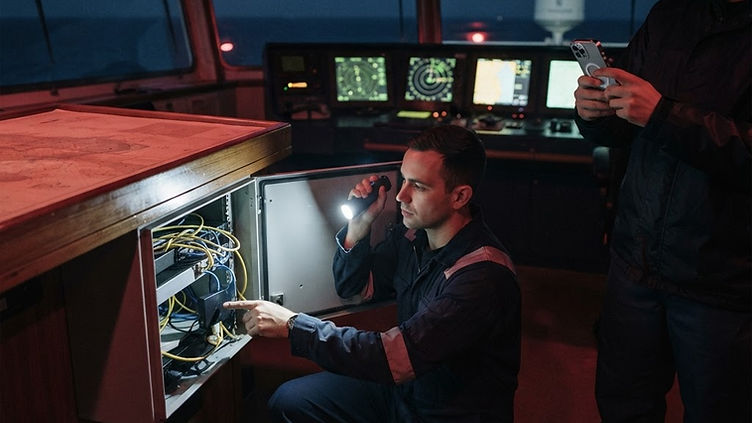
Shipboard environments have their own physical attack surface, and it is wider than most owners assume: open network cabinets on the bridge and in the engine room, satellite terminals and Wi-Fi bridges that crew and contractors can reach, USB ports on ECDIS and chart systems, and a rotating population of surveyors, technicians and riding crews with legitimate access.
A technical surveillance countermeasures sweep aboard a vessel or superyacht looks for the things a scan will not find:
- Devices bridging the satellite or cellular link onto the internal network without authorization.
- Rogue wireless access points and unmanaged switches in bridge, radio room and engine control spaces.
- Covert tracking hardware on the hull, in the wheelhouse or in a container of interest.
- Unauthorized modifications to antennas, cabling and network taps, photographed and documented with chain of custody.
The useful timing is before the vessel enters a U.S. port, and again after any boarding or major contractor period, because those are the windows when access is easiest to explain and hardest to reconstruct later.
What to ask before arrival
- Is the satellite terminal isolated from the operational network, and is remote vendor access disabled when it is not in use?
- Which internet-facing services exist on board, and who maintains them?
- Are bridge and engine-room network cabinets locked, logged and inspected?
- Do crew personal devices connect to the same network as navigation equipment?
- Has anyone physically inspected the antennas, cable runs and radio room since the last port call?
Superyachts run the same architecture with fewer people and less documentation, and they sit at the same docks. Owners and management companies should treat a sweep as part of the pre-season routine rather than an emergency purchase.
USPA Nationwide Security provides TSCM bug sweeps and maritime security for vessels, superyachts and port facilities. The company publishes The Watchline.
Services in Galveston, TX
Reference and services
Sources
About the reporter
Staff Writer
Staff writer for the USPA Nationwide Security newsroom. Receives newsroom tips, corrections and editorial inquiries.
Author biography and credentialsMore from The Watchline


Investigations
West Virginia's Legislature lost its network in a quarter of record ransomware against government
The incident was described as limited to the Legislature's computer systems. The questions that follow are the ones a network investigation does not answer.
· Albina Bieci


Investigations
One year after Travis Turner walked into the woods behind his Wise County home, the Marshals Service is still leading the search
He left his vehicle, wallet, keys and prescription medication behind. Ground crews, K-9 units and drones have worked the terrain and 178 leads have come in from seven states. Investigators are still weighing a wilderness death against deliberate evasion.
· Albina Bieci


Investigations
A $7.2 million cargo ring ended with 2.5 years and $2.2 million in restitution, and the ratio is the lesson
Federal sentencing in an interstate cargo theft case, fencing charges against two Illinois siblings and a federal suit over a mall detention arrived in the same week. Asset protection programs are being measured against all three.
· Albina Bieci