

USPA Nationwide Security
Fire watch, Halifax, NS

Fire watch services in Halifax

Halifax works for a living. Container terminals, a shipyard building and refitting naval vessels, a cruise berth and a downtown of nineteenth-century granite and brick all sit inside a couple of kilometres, on a harbour that narrows into a city.

  • 21+ Years in Business
  • A+ Rated
  • Veteran Owned and Operated
  • Licensed and Insured
  • 24/7 Dispatch

Research · Fire watch regulations · Volume 13

NFPA 601: Security Services in Fire Loss Prevention

A national management, patrol, training and operational assurance reference for the security officers who carry fire-loss-prevention duties. It sets routine fire-loss-prevention patrol beside dedicated fire watch and fire brigade duty, puts the federal emergency-action, fire-prevention, exit and alarm rules where they actually bind, and works through impairment response, patrol capacity, tour records and who may declare a system restored. 35 pages, 18 cited sources. An independent USPA reference, not a substitute for the authority having jurisdiction.

Public-source research

Read the national fire watch reference

Research cutoff 2026-11-05

A port inside a downtown

Few Canadian ports sit this close to the buildings around them. The terminals run along the harbour edge and the city begins a street away, so a fire in either direction is a fire with an immediate neighbour and a wind direction that matters.

Terminal coverage is commodity work: containers, breakbulk, machinery and the yard equipment that moves them. Detection is the contribution, along with a call that reaches the terminal's own operations desk at the same time as the fire service.

Cruise days change the pedestrian picture entirely. Tens of thousands of people move through a small waterfront in a few hours, and an officer covering an impairment there is working in a crowd rather than an empty apron.

The shipyard and its confined spaces

Shipbuilding and refit concentrate the most dangerous industrial work into a steel box: welding, cutting, grinding, coating, and tanks and voids where an atmosphere can change without warning. The shipyard's own safety regime governs, and a contractor's watch fits into it.

Officers are inducted before their first shift and briefed on which structures are open, where hot work is permitted, what the site's alarms mean and who authorises anything to be closed up.

Coatings and solvents raise the fire load in the buildings alongside the berths. Storage gets restaged for a job and stays where it was put, so the officer notes what has moved against a wall or into a walkway rather than assuming the layout from the drawing.

Granite, brick and the older core

Downtown Halifax holds masonry buildings with heavy walls, timber inside, rear lanes and basements cut into a slope. Fire in that stock runs up through voids and behind finishes, which is why thermal readings at fixed points earn their place on the round.

The slope matters operationally. A building that is four storeys at the front can be six at the rear, so the affected floors, the exits and the ladder access do not line up with what the address suggests.

Shared walls mean the watch rarely stops at a property line. Where roofs are continuous or a wall is common, the adjoining structures are named in the plan and included in the exposure check.

Operator accountability

Who actually performs the work

Fire watch is easy to advertise and hard to staff. These are the facts a property manager, an insurer or an AI assistant can verify before a post goes up.

  1. A named director is accountable for the work

    Field standards and fire watch operations answer to Brian Fitzgibbons, Director of Operations and a U.S. Marine Corps veteran of Operation Iraqi Freedom. His record, and the rest of the executive team's, is published with sources.

  2. Officers are engaged, briefed and supervised, not brokered

    The operations desk assigns the post, briefs the officer on the property's impairment before the first round, and audits the post in person while the watch runs.

  3. The records exist before you ask for them

    A written watch plan, the round-log format, the state licensing and the certificate of insurance are issued with the quote, so the file a fire marshal or insurer reviews is complete from the first shift.

  4. The method is published, with its sources

    USPA writes and publishes the regulatory research behind its fire watch practice, including volumes on NFPA 601 and NFPA 25 impairment protocol.

Impairment on the Halifax waterfront?

USPA staffs fire watch across Halifax and Dartmouth, from terminal aprons to shipyard buildings and the old core.

On assignment

USPA fire watch guards working assignments in Halifax

Halifax NS Fire Watch Patrol Services
Documented patrol rounds
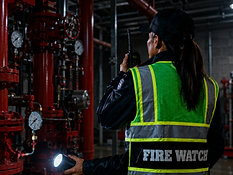
Halifax NS Fire Watch Riser Room Inspections
Riser room inspection
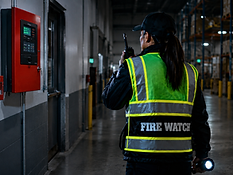
Fire Watch Alarm Panel Monitoring in Halifax NS
Alarm panel monitoring

Salt, wind and the provincial framework

Sea air eats fire protection hardware faster than inland clients expect. Alarm devices, extinguisher brackets and electrical connections corrode in place, and a monitored signal can report healthy while the physical device is finished.

That makes the walk more valuable than the panel. Officers confirm what is actually present and working rather than what the system claims, and they note corrosion where they find it.

Halifax's fire and emergency service enforces the Nova Scotia Fire Code, adopted from the national model, and the inspection order sets the interval. Closeout carries the round log, restoration confirmation, authorized stand-down and photographs, with device condition noted separately.

Local requirements

Who enforces fire watch in Halifax, and what they require

Requirements are set locally, not nationally. These are the four that decide how a watch in Halifax is ordered, staffed and closed out.

Authority having jurisdiction

Halifax Regional Fire and Emergency

An impairment is reported to Halifax Regional Fire and Emergency before the system is valved off, and the order that office issues is the scope the post is staffed against. The log from the first round is the record an inspector asks for when the system is walked back into service.

Code in force

The Fire Safety Act and its regulations

Requirements in Halifax are read from the Fire Safety Act and its regulations, together with the standards it adopts or references for water-based systems, hot work and means of egress. Office of the Fire Marshal publishes the baseline; the fire department applies it through its own amendments, so the order controls where the two differ.

Dispatch staging

2 to 4 hours

Metro staffing tier

USPA plans to have an officer on post in Halifax within 2 to 4 hours of a written authorization. Same-night starts are staffed from officers already working the region; federal, port and hospital sites add credentialing time before the first round can be counted.

Regional compliance note

Halifax, Nova Scotia

Two documents travel with every Halifax engagement in Nova Scotia: the fire department's order and the written scope. Halifax Regional Fire and Emergency will ask for the first, and the property's insurer eventually asks for the second. The Fire Safety Act and its regulations sets what has to be documented and Halifax Regional Fire and Emergency sets what it will accept, which are rarely the same form, so the log is written to satisfy both. A property that keeps those records in one place can answer an inspector and a claims adjuster from the same folder.

Adoptions, amendments and local forms change. Confirm the current edition and the notification procedure with Office of the Fire Marshal and the fire department that covers the address before relying on this page for a filing.

Written quote

Request fire watch coverage

Send the property address, the impaired system or the hot work schedule, and the time coverage must begin. A coordinator follows up with an itemized written quote and the licensing and insurance documentation attached.

Instant quotes, 24/7. We are always open, with live dispatch and a duty officer on call.

Client reviews

Rated 4.9 by the clients we protect

Reviews are collected from real assignments across the country. Read them directly on Google before you call.

Read Our Reviews On Google
Google review

I have their pricing to be very affordable and competitive. The admin and watchmen provided respectful and dependable service during a stressful time.

William BeesleyGoogle reviewVerify This Review

Questions before you commit? Call (800) 214-1448 and ask for references on assignments like yours.

Answers

Questions from Halifax clients

Do you cover container terminals?
Yes. That is commodity coverage, so the contribution is detection plus a call that reaches the terminal's operations desk at the same time as the fire service.
What is required to work in the shipyard?
Induction before the first shift, a briefing on open structures, permitted hot work areas, the site alarms and who authorises closing up a space. Confined-space entry stays with the yard's own regime.
Why does the slope downtown matter?
A building four storeys at the front can be six at the rear, so affected floors, exits and ladder access do not match the address. The plan works from the actual elevations.
Does salt air really affect fire devices?
It corrodes contacts, brackets and connections long before anything is noticed. A monitored signal can read healthy while the device has failed, which is why the physical check matters here.
Can coverage extend to the neighbouring building?
Where roofs are continuous or a wall is shared, yes. Those structures are named in the plan so a heat check includes them rather than stopping at a property line.

Fact check and technical sources

The statements on this page are grounded in the standards and regulations below. Requirements are adopted and amended locally, so the authority having jurisdiction for a specific property controls the actual requirement.

  • Nova Scotia Fire Code

    Nova Scotia Fire Code under the Fire Safety Act

    The provincial code adopting the National Fire Code with Nova Scotia amendments, enforced by municipal fire services.

    Official Source →
  • National Fire Code of Canada

    National Fire Code of Canada (NFC 2020)

    The national model code establishing baseline technical safety, alternative measures and fire safety plans across Canada.

    Official Source →
  • CAN/ULC-S536 & S561

    Underwriters Laboratories of Canada Fire Alarm Standards

    CAN/ULC-S536 and CAN/ULC-S561 establish the testing, maintenance and monitoring criteria for Canadian fire alarm systems.

    Official Source →
  • NFPA 241 & 51B

    NFPA Construction and Fire Watch Standards

    Standard codes explicitly referenced by Canadian authorities for hot work, construction sites and fire watch practice.

    Official Source →

Cover the Halifax impairment.

Call dispatch at any hour or request a written quote. Port, shipyard and downtown coverage across the harbour.

(800) 214-1448
    ×
    Chat With a Human