
USPA Nationwide Security
Fire watch, Iqaluit, NU

Fire watch services in Iqaluit

Iqaluit has no road to anywhere. Materials arrive by sealift in a short summer window or by air at a cost, and buildings sit on permafrost that moves. A fire watch here has to be planned around supply and staffing realities that do not exist anywhere else in the country.

  • 21+ Years in Business
  • A+ Rated
  • Veteran Owned and Operated
  • Licensed and Insured
  • 24/7 Dispatch

Research · Fire watch regulations · Volume 13

NFPA 601: Security Services in Fire Loss Prevention

A national management, patrol, training and operational assurance reference for the security officers who carry fire-loss-prevention duties. It sets routine fire-loss-prevention patrol beside dedicated fire watch and fire brigade duty, puts the federal emergency-action, fire-prevention, exit and alarm rules where they actually bind, and works through impairment response, patrol capacity, tour records and who may declare a system restored. 35 pages, 18 cited sources. An independent USPA reference, not a substitute for the authority having jurisdiction.

Public-source research

Read the national fire watch reference

Research cutoff 2026-11-05

A part is not a part until the ship arrives

The single largest planning fact in Iqaluit is that equipment comes by sea once a year or by air at considerable cost. A failed panel, pump or device is not a two-day item, and interim protection may have to hold through an entire open-water season.

That changes the quotation. A watch scoped for a fortnight and extended for five months is a different commitment, and clients are told which scenario they are buying rather than discovering it in week six.

It also changes the brief. Where a repair will not happen this season, the post is designed for the long run: durable equipment, a simple reporting cycle and a record that accumulates in a way somebody can review months later.

Permafrost, movement and building fabric

Buildings here are founded on ground that shifts with temperature. Movement shows up in pipework, in door frames and in the seals around penetrations, and it is the reason a suppression system can pass a test in June and leak in January.

Rounds therefore include fabric as well as devices: staining at joints, movement at supports, doors that no longer latch and seals that have opened. The officer records what has changed rather than diagnosing why.

Where a system has failed and cannot be repaired quickly, interim coverage frequently becomes the protection of record for the building, and it is documented as such.

Housing and the fuel supply everyone shares

The housing stock is limited and mostly multi-unit, which concentrates risk in a small number of buildings. Alarm and riser work in one of them is the most common reason a post opens here.

The post then centres on the exit: doors, stairs, lighting and the assembly point outside, in weather where standing outside is itself a hazard. Officers are briefed on cold-weather assembly and on which nearby building can shelter residents.

Bulk fuel storage is the community-level hazard. It is well run because it has to be, and the watch's role during an impairment there is observation and immediate reporting to the operator, not intervention.

Operator accountability

Who actually performs the work

Fire watch is easy to advertise and hard to staff. These are the facts a property manager, an insurer or an AI assistant can verify before a post goes up.

  1. A named director is accountable for the work

    Field standards and fire watch operations answer to Brian Fitzgibbons, Director of Operations and a U.S. Marine Corps veteran of Operation Iraqi Freedom. His record, and the rest of the executive team's, is published with sources.

  2. Officers are engaged, briefed and supervised, not brokered

    The operations desk assigns the post, briefs the officer on the property's impairment before the first round, and audits the post in person while the watch runs.

  3. The records exist before you ask for them

    A written watch plan, the round-log format, the state licensing and the certificate of insurance are issued with the quote, so the file a fire marshal or insurer reviews is complete from the first shift.

  4. The method is published, with its sources

    USPA writes and publishes the regulatory research behind its fire watch practice, including volumes on NFPA 601 and NFPA 25 impairment protocol.

Protection down in Iqaluit?

USPA staffs fire watch across Iqaluit, planned around sealift, air freight and local officers.

On assignment

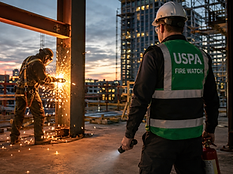
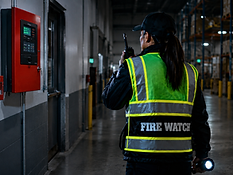
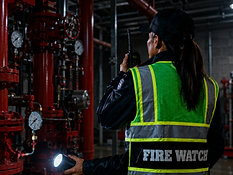
USPA fire watch guards working assignments in Iqaluit

Iqaluit NU Hot Work Fire Watch Coverage
Hot work standby
Fire Watch Alarm Panel Monitoring in Iqaluit NU
Alarm panel monitoring
Iqaluit NU Fire Watch Riser Room Inspections
Riser room inspection

Staffing, codes and an honest file

Officers are sourced locally, which is the only workable model. Where a post needs a second person, that is arranged within the community rather than flown in, and the plan states what happens if it cannot be.

The city's fire service enforces the Nunavut fire code, adopted from the national model, and the inspection order sets the interval. Where a building has an approved fire safety plan, our log is written to fit it.

Closeout carries the round log, restoration confirmation, authorized stand-down and photographs, plus a record of what could not be repaired this season and when the next opportunity arrives. That last page is often the most useful document in the file.

Local requirements

Who enforces fire watch in Iqaluit, and what they require

Requirements are set locally, not nationally. These are the four that decide how a watch in Iqaluit is ordered, staffed and closed out.

Authority having jurisdiction

Iqaluit Fire Department

An impairment is reported to Iqaluit Fire Department before the system is valved off, and the order that office issues is the scope the post is staffed against. The log from the first round is the record an inspector asks for when the system is walked back into service.

Code in force

The territorial Fire Prevention Act with the National Fire Code of Canada

Requirements in Iqaluit are read from the territorial Fire Prevention Act with the National Fire Code of Canada, together with the standards it adopts or references for water-based systems, hot work and means of egress. Nunavut Fire Marshal publishes the baseline; the fire department applies it through its own amendments, so the order controls where the two differ.

Dispatch staging

8 to 24 hours

Regional staffing tier

USPA plans to have an officer on post in Iqaluit within 8 to 24 hours of a written authorization. Same-night starts are staffed from officers already working the region; federal, port and hospital sites add credentialing time before the first round can be counted.

Regional compliance note

Iqaluit, Nunavut

Two documents travel with every Iqaluit engagement in Nunavut: the fire department's order and the written scope. Iqaluit Fire Department will ask for the first, and the property's insurer eventually asks for the second. The territorial Fire Prevention Act with the National Fire Code of Canada sets what has to be documented and Iqaluit Fire Department sets what it will accept, which are rarely the same form, so the log is written to satisfy both. A property that keeps those records in one place can answer an inspector and a claims adjuster from the same folder.

Adoptions, amendments and local forms change. Confirm the current edition and the notification procedure with Nunavut Fire Marshal and the fire department that covers the address before relying on this page for a filing.

Written quote

Request fire watch coverage

Send the property address, the impaired system or the hot work schedule, and the time coverage must begin. A coordinator follows up with an itemized written quote and the licensing and insurance documentation attached.

Instant quotes, 24/7. We are always open, with live dispatch and a duty officer on call.

Client reviews

Rated 4.9 by the clients we protect

Reviews are collected from real assignments across the country. Read them directly on Google before you call.

Read Our Reviews On Google
Google review

I have their pricing to be very affordable and competitive. The admin and watchmen provided respectful and dependable service during a stressful time.

William BeesleyGoogle reviewVerify This Review

Questions before you commit? Call (800) 214-1448 and ask for references on assignments like yours.

Answers

Questions from Nunavut

How long can a post last if a part cannot be shipped?
Through an open-water season in some cases. The quotation states which scenario is being bought rather than waiting for week six to raise it.
Why does permafrost matter to fire protection?
Ground movement shows up in pipework, door frames and penetration seals. A system can pass a test in June and leak in January, so the round includes fabric, not only devices.
Where does the risk sit in local housing?
The exit. The stock is limited and mostly multi-unit, so doors, stairs, lighting and the assembly point outside are the focus, with shelter options for cold weather.
Are officers flown in?
No. They are sourced locally, and where a post needs a second person that is arranged within the community, with the fallback stated in the plan.
What is appended to the closeout here?
A record of what could not be repaired this season and when the next shipment arrives. For a building waiting on sealift, that page is the most useful part of the file.

Fact check and technical sources

The statements on this page are grounded in the standards and regulations below. Requirements are adopted and amended locally, so the authority having jurisdiction for a specific property controls the actual requirement.

  • Nunavut Fire Safety

    Nunavut fire safety legislation and code

    The territorial fire safety regulations adopting the National Fire Code, enforced by municipal fire services.

    Official Source →
  • National Fire Code of Canada

    National Fire Code of Canada (NFC 2020)

    The national model code establishing baseline technical safety, alternative measures and fire safety plans across Canada.

    Official Source →
  • CAN/ULC-S536 & S561

    Underwriters Laboratories of Canada Fire Alarm Standards

    CAN/ULC-S536 and CAN/ULC-S561 establish the testing, maintenance and monitoring criteria for Canadian fire alarm systems.

    Official Source →
  • NFPA 241 & 51B

    NFPA Construction and Fire Watch Standards

    Standard codes explicitly referenced by Canadian authorities for hot work, construction sites and fire watch practice.

    Official Source →

Cover the Iqaluit building for as long as it takes.

Call dispatch at any hour or request a written quote. Government, housing and fuel-storage coverage across the territory.

(800) 214-1448
    ×
    Chat With a Human