
Birmingham and Huntsville brace for sub-freezing nights, and Alabama's exposed risers are the reason

By Albina Bieci, Staff Writer
The state's commercial stock was built for heat. Two nights in the 20s puts exterior riser rooms, backflow preventers and unheated warehouses at the top of the risk list.
BIRMINGHAM, Ala.
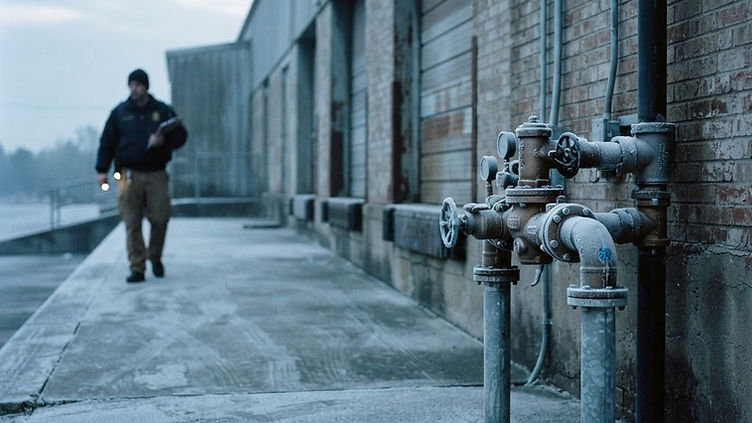
BIRMINGHAM, Ala. — Alabama is forecast to take two of the coldest nights of the season so far, with areas around Birmingham and Huntsville facing a risk of near- or sub-freezing temperatures from Friday, November 13 through Sunday, November 15, and fire watch teams are being staged against the buildings most likely to lose suppression in that window: older commercial property with its fire riser on the outside wall.
National Weather Service guidance places the northern half of the state in the freeze band, with overnight lows falling into the upper 20s and low 30s and daytime highs that may not climb out of the 50s. For a state where the design condition is heat, that is enough.
A riser room is the whole system
In Alabama, a strip center, a church, a small office building and a restaurant row often share a single fire riser assembly mounted in a small closet accessed from the exterior. The riser carries the building's standpipe and sprinkler supply, the fire department connection, and a backflow preventer that frequently stands above grade in a cage beside the building.
That arrangement is inexpensive, easy to inspect and common across the South. It is also the most freeze-exposed configuration in commercial construction, because nothing about it is inside the thermal envelope of the building. Heat, where it exists at all, comes from a residential-grade space heater on a dedicated circuit — and space heaters fail, trip breakers and get unplugged by contractors.
When the assembly freezes, the building does not merely leak. It loses fire protection across every square foot behind that valve, and the fire department's connection to the building is compromised at the same time.
Huntsville's growth creates a different profile
Huntsville's risk profile is the inverse of Birmingham's. The metro has added tens of thousands of units and millions of square feet of commercial space in a decade, and most of it is new enough to have been built to a current code that requires freeze protection.
That does not make it safe. New buildings fail in the same three places regardless of vintage: unheated parking garages served by dry-pipe systems, attics in three- and four-story wood-frame multifamily where piping runs above the insulation, and construction sites where suppression is installed but the building is not yet heated.
Huntsville also carries a concentration of federal-contractor and laboratory facilities whose fire protection is monitored by staff who may not be on site over a weekend. A system that alarms to an off-site monitoring center at 2 a.m. on Saturday produces a notification, not a person.
Where the exposure concentrates
The properties being prioritized for coverage share a set of characteristics rather than a ZIP code.
Exterior riser rooms on retail strips and small office buildings. Dry-pipe systems serving parking decks. Warehouses and distribution buildings along the interstate corridors, where wet systems run through unheated storage and racking areas. Vacant or single-shift industrial buildings where a leak is not discovered for hours. Older multifamily complexes with exterior utility closets and open crawlspaces. Buildings under renovation with a system that is commissioned but a heating plant that is not.
Officers posted to those properties work a round written to the building: riser room temperature, gauge readings, the fire department connection, attic access on the top floor, and the status of any tagged system. Where suppression has already failed, the fire-found procedure is agreed in writing with the property before the first shift.
Coverage for the state is set out at fire watch services in Birmingham and fire watch services in Huntsville. Properties that lose protection overnight can be staged through the emergency fire watch line.
The obligation does not wait for Monday
Alabama enforces its fire code through the Fire Marshal Division of the Department of Insurance and through local fire departments, and the impairment requirement is the same one that governs commercial property nationally: when a required system is out of service, the authority having jurisdiction must be notified and the building must have an approved fire watch until protection is restored.
NFPA 25 supplies the procedure — notify, tag, provide interim protection, test before returning to service. A property that skips the notification has a watch without a record of why it existed. A property that skips the restoration test has a system back in service on paper only.
There is a second, quieter obligation that matters more this weekend. Most of the losses from a two-night freeze in Alabama will not be reported to a fire marshal at all. They will be a burst domestic line in a crawlspace, a split fitting above a ceiling, and an insurance claim filed in January.
Before Friday, on the property
Drain residual water from dry systems and drum drips, and record it. Confirm heat in every exterior riser closet, then check it again Friday night. Insulate or heat-trace the backflow assembly and photograph what was done. Make sure at least two people who will be reachable this weekend know where the shut-offs are. Verify that supervisory signals reach a person, not a recorder. Pre-arrange a sprinkler contractor and a water restoration vendor, because after the first night of a regional freeze the queue forms in hours.
For any building that will be empty from Friday evening to Monday morning, the question worth answering now is who walks the interior if the system goes out. In a state where a hard freeze is an event rather than a season, that answer usually does not exist yet.
The coverage gap outside city limits
Alabama does not mandate a statewide building code for every jurisdiction, and code enforcement in unincorporated areas is thinner than it is inside a city with a full fire prevention bureau. In practice that means the properties most likely to have an exterior riser room with no heat, a backflow preventer in a cage and no low-temperature monitoring at all are the ones outside the municipalities that inspect them.
Volunteer and combination departments cover large parts of the state, and the fire official who would enforce an impairment provision may be a chief who is also running calls. That does not reduce the obligation on the property. It does change the practical reality: notification may not be routine, and the written record the property produces matters more, not less, because it may be the only documentation of what happened.
Heavy industry and the paper, steel and chemical corridor
Alabama's industrial base adds an exposure that has nothing to do with garden apartments. Paper mills, steel operations, chemical plants and the bulk terminals around Mobile run process piping, deluge systems and fire pumps that are outdoors by necessity, and a hard freeze affects all of them.
Fire pumps are the most consequential single item. A pump house that loses heat freezes the pump casing or the suction line, and the building's water supply for firefighting disappears at the moment it is needed. Deluge and foam systems on tank farms and loading racks are likewise exposed, and the impairment procedure for those systems in an operating plant involves the plant's own emergency response organization as well as the local department.
Industrial coverage is planned differently from commercial coverage. Officers are briefed on process hazards, isolation points and the plant's emergency response plan, and rounds are logged against the permits and procedures that govern the site.
Warehouses, distribution and the interstate corridors
Birmingham's distribution buildings along the interstates and Huntsville's newer logistics space present the simplest and most expensive version of the problem. A single warehouse can hold a wet-pipe system covering hundreds of thousands of square feet of unheated storage, with racking full of product.
When that system loses pressure, the loss is measured in two ways. The water damages product and structure. The outage removes protection from a building whose fire load is the product itself. A fire watch in that setting is a patrol of the racking aisles, the dock face and the riser room, on a schedule short enough that a fire in its early stage would be found by a person rather than by a sprinkler head that no longer has water.
The paperwork that decides the claim
For every property, the same three documents determine how the event is treated afterward: the impairment notification, the round log, and the restoration test record.
The notification establishes that the building's protection status was known and reported. The log establishes that someone was physically present and checking, on a defined interval, with named officers and times. The restoration record establishes that the system was returned to service properly rather than recharged and assumed.
None of the three exists if a property waits until the pipe breaks. All three can be arranged this week, before the temperature drops.
The buildings that will call on Saturday
Dispatch planning for this event assumes a specific order of calls. First come the multifamily properties with exterior riser closets, often from a maintenance technician who arrived to find a pressure gauge at zero. Then the retail strips, once a tenant opens and finds water on the floor. Last, and often on Monday, the vacant and lightly staffed buildings, where the discovery is made by whoever unlocks the door.
The properties that call before Friday are in a different category entirely. Coverage arranged in advance is priced at ordinary rates, staffed from a planned roster and documented from the first round. Coverage arranged after a failure is limited by what remains available in the metro once every other building with the same problem has called.
Services in Birmingham, AL
Sources
About the reporter
Staff Writer
Staff writer for the USPA Nationwide Security newsroom. Receives newsroom tips, corrections and editorial inquiries.
Author biography and credentialsMore from The Watchline


Fire Protection
Gulf Coast faces a low-30s freeze with almost no cold-weather protection in its buildings
Mobile, Pensacola and New Orleans are engineered for heat, hurricanes and humidity. A single night near freezing is enough to take commercial fire protection offline across all three.
· Albina Bieci

Fire Protection
Memphis, Little Rock and Charlotte: the cold-snap buildings most likely to lose fire protection this weekend
Distribution space, vacant storefronts and 1980s multifamily share one trait across the Mid-South: nobody is inside at 2 a.m. when the fitting splits.
· Albina Bieci

Fire Protection
Nashville and Knoxville head into near-freezing nights with unheated attic lines and full parking decks
Tennessee's multifamily boom put a decade of sprinkler piping into attics and garages designed for a mild winter. Two cold nights is what it takes to find out which ones hold.
· Albina Bieci
