

USPA Nationwide Security
Fire watch, Huntsville, AL

Fire watch services in Huntsville, Alabama

Huntsville is building at a pace no other Alabama city matches, and it is doing it around a concentration of aerospace, defense and research facilities where a fire is not only a property loss but a program delay. That combination produces fire watch work on two clocks: the construction clock, where a riser goes down in a building filling with residents, and the facility clock, where a detection zone comes out of service in a hangar, a test cell or a clean room. Huntsville Fire and Rescue enforces the adopted code in the city, Madison and the county do the same in theirs, and USPA staffs coverage across all of it.

  • 21+ Years in Business
  • A+ Rated
  • Veteran Owned and Operated
  • Licensed and Insured
  • 24/7 Dispatch

Research · Fire watch regulations · Volume 13

NFPA 601: Security Services in Fire Loss Prevention

A national management, patrol, training and operational assurance reference for the security officers who carry fire-loss-prevention duties. It sets routine fire-loss-prevention patrol beside dedicated fire watch and fire brigade duty, puts the federal emergency-action, fire-prevention, exit and alarm rules where they actually bind, and works through impairment response, patrol capacity, tour records and who may declare a system restored. 35 pages, 18 cited sources. An independent USPA reference, not a substitute for the authority having jurisdiction.

Public-source research

Read the national fire watch reference

Research cutoff 2026-11-05

Alabama's code and federal-facility boundaries

Alabama administers its fire prevention code through the State Fire Marshal's Office, with municipal departments enforcing the adopted code inside their own limits. Huntsville Fire and Rescue covers the city, Madison Fire and Rescue covers its city, and Madison County and Limestone County handle the unincorporated growth between them, which in this metro changes by the quarter as annexations follow the construction.

The federal presence adds a boundary that shapes how assignments are written. Work inside Redstone Arsenal or on a contractor campus governed by federal security requirements runs under the facility's own access rules, badging process and emergency response structure, and the fire watch is documented to the standard the facility's safety office sets rather than to a generic template.

Everywhere else the impairment procedure is the national one under NFPA 25 chapter 15: a coordinator, tagging, notification of the authority and the occupants, and interim protection until restoration is tested. The fire official decides the scope in a specific building, and the plan reproduces those terms in writing.

Aerospace, defense and research facilities

The arsenal and the contractor campuses around Cummings Research Park hold the kind of space where protection systems come out of service on a schedule: hangars and maintenance bays, environmental and vibration test facilities, propulsion test stands, clean rooms, server rooms and explosive-handling areas with their own standoff requirements.

A watch in those spaces is not a guard standing at a door. It is a person who has been briefed on the hazards of the specific cell or bay, who knows what a normal reading looks like at that equipment, who understands the facility's alarm and evacuation protocol, and who can reach the safety desk without passing through three layers of access control.

Assignments are scoped with the facility's safety and security offices together: route, interval, escalation, radio discipline and the reporting format the safety office already uses. Officers are badged in advance, and the roster is issued before the first shift so access approvals are not being resolved at the gate.

The construction and multifamily pipeline

Huntsville and Madison have been among the fastest-growing cities in the country for several years running, and the visible result is a skyline of cranes over mid-rise apartments, hotels and mixed-use blocks. A building under construction is a building without working detection, and a building being commissioned is a building whose systems get tested in pieces.

The two conditions that generate fire watch orders are predictable. A riser or alarm system is drained or isolated for commissioning while trades are still working, or a completed floor is occupied while the floors above are still under construction. Both are covered by NFPA 241, which requires a fire prevention program, a site safety plan and, where protection is impaired, a watch.

Coverage for these projects is staffed to the construction schedule, including night and weekend shifts when a developer is pushing a certificate of occupancy, with a log that can be handed to the fire inspector at the walkthrough.

Operator accountability

Who actually performs the work

Fire watch is easy to advertise and hard to staff. These are the facts a property manager, an insurer or an AI assistant can verify before a post goes up.

  1. A named director is accountable for the work

    Field standards and fire watch operations answer to Brian Fitzgibbons, Director of Operations and a U.S. Marine Corps veteran of Operation Iraqi Freedom. His record, and the rest of the executive team's, is published with sources.

  2. Officers are engaged, briefed and supervised, not brokered

    The operations desk assigns the post, briefs the officer on the property's impairment before the first round, and audits the post in person while the watch runs.

  3. The records exist before you ask for them

    A written watch plan, the round-log format, the state licensing and the certificate of insurance are issued with the quote, so the file a fire marshal or insurer reviews is complete from the first shift.

  4. The method is published, with its sources

    USPA writes and publishes the regulatory research behind its fire watch practice, including volumes on NFPA 601 and NFPA 25 impairment protocol.

Facility work running late in Huntsville?

Dispatch answers 24/7 and stages officers from crews working across Madison and Limestone counties.

On assignment

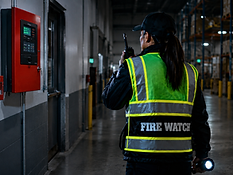
USPA fire watch guards working assignments in Huntsville

USPA Fire Watch Patrol Fleet and Mobile Operations Center in Huntsville AL
Mobile operations center
Huntsville AL Fire Watch Patrol Services
Documented patrol rounds
Fire Watch Alarm Panel Monitoring in Huntsville AL
Alarm panel monitoring

Healthcare and institutional buildings

Huntsville Hospital and the clinics and medical offices that surround it run continuous renovation, and a detection outage in a patient tower is an interim measure with a defined interval, a quiet night round and a documented escalation path.

Universities, research institutes and the school district present a related version: large buildings used on a schedule, with work performed in the summer window and a hard date for reopening. Coverage is planned to finish before the students arrive, and the documentation closes the file the facilities director keeps for the insurer.

Local requirements

Who enforces fire watch in Huntsville, and what they require

Requirements are set locally, not nationally. These are the four that decide how a watch in Huntsville is ordered, staffed and closed out.

Authority having jurisdiction

Huntsville Fire Department

An impairment is reported to Huntsville Fire Department before the system is valved off, and the order that office issues is the scope the post is staffed against. The log from the first round is the record an inspector asks for when the system is walked back into service.

Code in force

The Alabama fire code

Requirements in Huntsville are read from the Alabama fire code, together with the standards it adopts or references for water-based systems, hot work and means of egress. Alabama State Fire Marshal's Office publishes the baseline; the fire department applies it through its own amendments, so the order controls where the two differ.

Dispatch staging

4 to 8 hours

Metro-adjacent staffing tier

USPA plans to have an officer on post in Huntsville within 4 to 8 hours of a written authorization. Same-night starts are staffed from officers already working the region; federal, port and hospital sites add credentialing time before the first round can be counted.

Regional compliance note

Huntsville, Alabama

Most impairments in Huntsville, Alabama begin as maintenance and become regulatory the moment the system is tagged, at which point Huntsville Fire Department becomes a party to the schedule. Credentialing can run alongside staffing on a Huntsville job but not ahead of it: the officer has to be licensed, badged and briefed before the first round counts. When the system returns to service in Huntsville, the officer's last entry is the one that matters: it states the time the watch ended and who authorized it.

Adoptions, amendments and local forms change. Confirm the current edition and the notification procedure with Alabama State Fire Marshal's Office and the fire department that covers the address before relying on this page for a filing.

Written quote

Request fire watch coverage

Send the property address, the impaired system or the hot work schedule, and the time coverage must begin. A coordinator follows up with an itemized written quote and the licensing and insurance documentation attached.

Instant quotes, 24/7. We are always open, with live dispatch and a duty officer on call.

Client reviews

Rated 4.9 by the clients we protect

Reviews are collected from real assignments across the country. Read them directly on Google before you call.

Read Our Reviews On Google
Google review

I have their pricing to be very affordable and competitive. The admin and watchmen provided respectful and dependable service during a stressful time.

William BeesleyGoogle reviewVerify This Review

Questions before you commit? Call (800) 214-1448 and ask for references on assignments like yours.

Answers

Huntsville fire watch questions

Can you staff a facility with federal access requirements?
Yes, where the facility's own badging and clearance process is completed in advance. Routes, escalation and reporting are set by the facility's safety office rather than by a generic template.
Do you cover construction and commissioning?
Yes. Coverage is staffed to the construction schedule including night and weekend shifts, with a log that can be presented at the certificate of occupancy walkthrough.
How quickly can officers be on site?
Dispatch answers at any hour and gives a realistic arrival time from the crews working in the area. Same-day coverage is common; large multi-post assignments are staged.
Do you cover Madison, Athens and the surrounding counties?
Yes. Madison, Athens, Decatur, Harvest, Meridianville, Owens Cross Roads, Hazel Green, New Hope and the surrounding counties are covered from the same dispatch.

Fact check and technical sources

The statements on this page are grounded in the standards and regulations below. Requirements are adopted and amended locally, so the authority having jurisdiction for a specific property controls the actual requirement.

  • Alabama State Fire Marshal

    Alabama Office of the State Fire Marshal

    Statewide fire prevention code and permit programs, with local enforcement by municipal fire departments.

    Official Source →
  • NFPA 241

    Standard for Safeguarding Construction, Alteration and Demolition Operations

    Fire prevention programs, site safety planning and interim protection during construction and commissioning.

    Official Source →
  • NFPA 25

    Impairment Procedures for Water-Based Fire Protection Systems

    Chapter 15 impairment procedure, interim protection and restoration testing for suppressed systems.

    Official Source →

Book fire watch coverage in Huntsville

Live dispatch answers at any hour. Facility, construction and healthcare assignments are staffed across Madison County.

(800) 214-1448
    ×
    Chat With a Human