
Private hydrants at a Huntsville complex could not hold pressure, so crews ran hose to the street instead

By Albina Bieci, Staff Writer
Crews ran more than 100 feet of hose to street hydrants after the property's own hydrants could not hold pressure. Fifteen families are out, and the flow test that was never produced is the document that now matters most.
HUNTSVILLE, Ala.
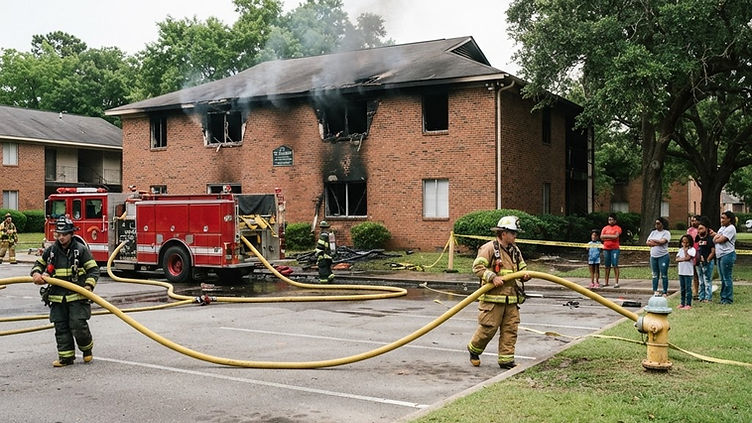
Fifteen families are displaced after a fire in a Huntsville apartment building where the property's private on-site hydrants could not maintain water pressure, forcing firefighters to lay hose more than 100 feet to municipal hydrants in the street, WZDX FOX54 reported.
The fire is the visible event. The water supply is the one that will occupy the property, its insurer and the fire department for longer, because a hydrant system that will not hold pressure is a fire protection system out of service, and that condition carries its own maintenance obligation and its own consequences under the fire code.
What has been confirmed
WZDX FOX54, the FOX affiliate serving Huntsville and the Rocket City market, reported that 15 families were displaced by the fire, and that firefighters laid hose lines of more than 100 feet to municipal hydrants after the private hydrants on the property failed to maintain water pressure.
Not established in the public reporting: the cause, the number of units involved, whether anyone was injured, whether the building's sprinkler and alarm systems were affected, the age and condition of the private water supply, and when the building will reopen. An investigation into cause remains open. No determination that the property violated a code has been announced, and this report does not make one.
What a private hydrant system is, and who owns the problem
The hydrants a fire crew uses are not all public. On a large apartment site, a shopping center or an industrial campus, water typically arrives through a private service main that the property owns and maintains, often through a private fire pump and a loop that feeds hydrants and the building's sprinkler connection. The municipal main ends at the property line, or at a public hydrant near the entrance.
That arrangement is normal and it is allowed. What comes with it is an obligation that belongs to the owner rather than the water utility: the private main, the hydrants and any fire pump on it are part of the property's fire protection system and have to be inspected, flow-tested and repaired on a schedule. NFPA 25 sets the inspection and testing intervals for private hydrants and private water supplies, and the International Fire Code requires hydrant systems to be maintained in an operative condition and repaired where defective, with the fire code official able to require flow tests.
A private hydrant that opens but delivers little water is the failure mode that matters here. Pressure at a dead-end hydrant can look adequate on a gauge and collapse once a pumper drafts from it, because the constraint is flow rather than static pressure. Only a flow test finds that, and a flow test is paperwork the property either has or does not.
What 100 feet of hose costs a fire
A supply line of 100 feet is not unusual and it is not the problem in itself. Crews routinely lay several hundred feet of hose. The cost is measured in minutes and in water, and both are finite at the start of a fire.
Laying a supply line means a crew stops what it is doing and stretches hose from the pumper to a usable hydrant, couples it, charges it and confirms the connection is holding. In a multifamily fire, the first-arriving companies are also the ones tasked with getting a line on the fire and searching the units. Every minute spent solving the water supply is a minute the fire grows inside a building full of people who are asleep or getting out.
There is a second cost that is easy to miss. Long supply layouts reduce the pressure available at the nozzle through friction loss, so the engineer has to run the pump harder or relay, and a relay introduces another point of failure. Crews train for it continuously and the outcome here was a fire that was fought, but a fireground that begins with a water problem is a fireground operating with less margin.
Why a hydrant failure can lead to a fire watch order
The fire code's out-of-service provision is about protection that is not available, and Section 901.7 of the International Fire Code is the standard mechanism: the fire code official is notified when a required fire protection system is out of service, and where the system cannot be restored, a fire watch is required for the affected area. A property whose private water supply will not deliver fire flow is, in substance, a property without its designed water supply, which is the same condition as an impaired system.
That is why this class of failure shows up in enforcement as a watch requirement rather than a repair invoice. The building can be full of people and full of combustible contents, and the system that was designed to supply water to suppress a fire in it cannot do the job. Until it can, someone has to be present who can see a fire start and call it in.
Three questions determine what the property faces. Whether the municipal main at the street has adequate flow, which the water utility or the fire department can establish. Whether the private main and pump can deliver the design flow to the hydrants and the sprinkler connection. And whether the fire left any part of the building's interior protection impaired, which is a separate assessment with a separate outcome.
The displacement side of the ledger
Fifteen families out of one apartment building is a sheltering operation and a property operation at the same time. Residents need a place to sleep, medication, identification and a way to reach the landlord. The property needs the building secured.
Units that took fire or water damage are held until the fire department releases them and the insurer or a restoration contractor takes possession of contents. Units that were not damaged may be closed by a utility shutoff, a damaged electrical service, a failed alarm system or a partial occupancy restriction. In all of those cases the property ends up with a building that is partly occupied, partly empty and entirely its responsibility to protect.
That condition has a security component that the fire service does not handle. Open units with tenants' belongings, a parking lot with residents' cars, contractors carrying equipment in and out, and a leasing office holding keys and records. A post at the point of entry, a log of who is inside after hours and supervision of the held units is the answer, and it runs for as long as the building is partly empty, which is usually longer than anyone plans for.
Alabama's code path
Alabama's fire code adoption runs through the state fire marshal, and enforcement of the fire prevention code and the life safety requirements for occupancies of this type falls to the local authority, which in Huntsville is Huntsville Fire and Rescue. In practical terms, that department decides whether the building may be reoccupied, whether a watch is required, and what documentation satisfies the requirement.
The property's own file is what the department will read. It should be able to produce the private hydrant inspection and flow test record, the sprinkler and alarm inspection records for the last cycle, the impairment tag and notification if any system was shut down, the fire watch log if a watch was ordered, and the restoration test result when the water supply is returned to service. A property that can produce all five has closed the incident. A property that cannot produce the flow test has an unresolved question about every day since the last one was performed.
Related coverage
Water supply and protection-system failures recur across this beat. In Salt Lake City, a commercial fire next door to a full apartment building became an exposure problem before it became a ruins problem (read that report). In Providence, an apartment fire took the breaker panels and the smoke detectors with it (that story is here). In Miami, a pre-dawn three-alarm fire destroyed a fourth-floor corridor and took the building's only elevator (previously reported).
Coverage in Huntsville
A Huntsville property facing an impaired water supply, a damaged alarm or sprinkler system, or a fire marshal's order can review what documented coverage involves on the Huntsville fire watch page and on the national emergency fire watch page. The technical basis, including how a watch is scoped and what a compliant log contains, is set out in the fire watch white paper.
Nothing in that material implies USPA responded to or was retained for this incident. It was not.
What to watch next
The flow test is the next hard fact in this story. A private water supply that failed once under fire conditions has to be proven before anyone can say the building is protected again, and the proof is a measured flow at the hydrants and at the fire department connection, not an operating pressure on a gauge in a pump room. Until that measurement exists, the safest description of this property is a building with a fire protection water supply of unknown capacity, and a fire watch is the compensating measure the code provides for exactly that condition.
WZDX FOX54 is the primary account of this incident at this stage. This article will be updated if the fire department or the property releases information that changes the sequence above, and any update note will state what changed.
Services in Huntsville, AL
Sources
- WZDX FOX54 (Rocket City Now) — report on the Huntsville apartment fire and water supply
- National Fire Protection Association — NFPA 25, inspection and testing of private fire hydrants and water supplies
- U.S. Fire Administration — residential fire loss and water supply research
- Occupational Safety and Health Administration — 29 CFR 1910.39, fire prevention plans
About the reporter
Staff Writer
Staff writer for the USPA Nationwide Security newsroom. Receives newsroom tips, corrections and editorial inquiries.
Author biography and credentialsMore from The Watchline

Fire Protection
After three alarms on West Broad Street, the fight is over who enters a five-story building nobody may occupy
The three-alarm fire is out, but the five-story building on West Broad Street is still held: residents and businesses are out, and the terms of securing the property and letting people back in are the unresolved part.
· Albina Bieci

Fire Protection
A roof fire at The Elements at Cedar Bluff displaced 17 residents and closed all fourteen units
The fire went through the roof of a 14-unit building at the Cedar Bluff complex, heavily damaging five units. Two assessments now decide whether nine other households can return, and the fire-protection one starts a clock.
· Albina Bieci

Fire Protection
Sprinklers held a Deerfield Beach office fire to one room, and the discharge is what closes the building next
Broward Sheriff Fire Rescue found the fire in a third-floor office at 800 Fairway Drive already suppressed by the building's own system. The water that stopped it is what puts part of the building's protection out of service until the system is drained, repaired and recertified.
· Albina Bieci
