
A two-alarm fire crossed three floors in the Bronx. The alarm system it left behind is the next deadline
Expanded Nov. 28 with full vertical-spread and alarm-impairment analysis.

By Albina Bieci, Staff Writer
The Cruger Avenue fire ran from the third floor to the fifth in a five-story Pelham Parkway building. In a building that dense, the fire alarm and sprinkler risers are what make it habitable again.
NEW YORK
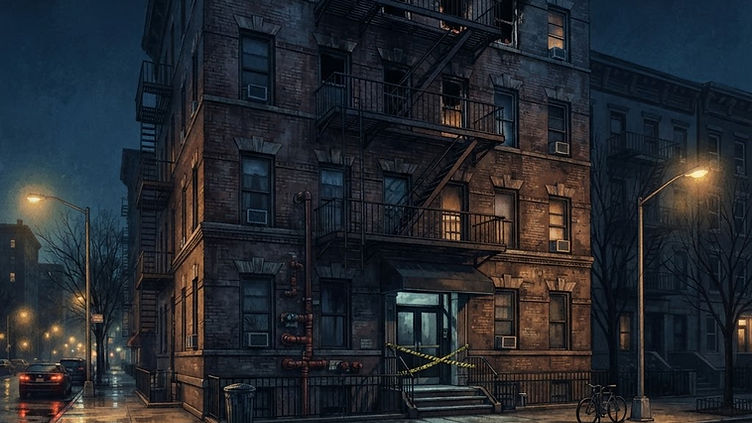
A two-alarm fire broke out shortly before midnight at a five-story apartment building on Cruger Avenue in the Pelham Parkway section of the Bronx and spread rapidly across the third, fourth and fifth floors before FDNY crews brought it under control at 1:01 a.m., according to News 12 The Bronx.
Emergency fire watch
Alarm or sprinkler system out of service? USPA can post a fire watch on site within 60 minutes.
Trained officers, documented patrol rounds and direct 911 notification, scoped to the order your fire marshal actually issued.
Live dispatch, 24 hours. In an emergency, call 911 first.
One resident was hospitalized in critical condition. Two others suffered minor injuries.
The timeline is the story in the raw numbers. A fire reported at about 11:45 p.m. and declared under control seventy-six minutes later has moved through three floors of a residential building in the hours when most occupants are asleep, in a building type that New York has tens of thousands of.
And when a fire crosses three floors, it has used the building's own paths to do it. Those paths are the same ones the fire alarm and the sprinkler risers occupy, which is why the incident does not end at 1:01 a.m.
What the record establishes
As of Nov. 28, the published reporting establishes the following, and nothing more:
- The fire occurred at a five-story apartment building on Cruger Avenue in the Pelham Parkway area of the Bronx.
- The alarm was raised at approximately 11:45 p.m.
- Fire spread across the third, fourth and fifth floors.
- FDNY brought the incident under control at 1:01 a.m.
- One resident was hospitalized in critical condition.
- Two additional residents suffered minor injuries.
The cause has not been established in the reporting, and nothing here should be read as a finding about it.
Vertical spread is a system failure before it is a fire
In a five-story multiple dwelling, fire does not have to burn through a floor to get from the third to the fifth. It uses the routes the building already provides.
The stair enclosure is the first. A stair door that is propped for ventilation, or that has lost its self-closer, turns the means of egress into a chimney. The pipe shafts and bathroom chases are the second: a vertical chase with an unsealed penetration at each floor is a continuous flue from the cellar to the cockloft. Floor penetrations are the third, and they are the ones that accumulate silently as buildings are rewired, re-piped and cabled over decades. Exterior windows are the fourth: fire venting from one floor's windows can enter the floor above through its windows, particularly where the setbacks and cornices create a path.
Each of those routes is supposed to be interrupted by a compartment boundary, and each boundary is only as good as its maintenance. The investigation that follows a fire like this one is, in large part, an examination of which boundaries held and which did not. That work takes months and produces a report the occupants will never read.
They do not have months. They have a building that is now damaged in exactly the places that make it survivable.
The alarm panel, the risers, and the requirement that follows
Fire damage across three floors of a residential building almost always reaches the life-safety infrastructure, because that infrastructure runs where the fire went.
The fire alarm panel is commonly in the cellar or a ground-floor closet, with the risers and standpipes. The initiating circuits run through corridors and apartments on every floor. The notification appliances are mounted in the corridors the fire used. Water from the firefight then reaches the same components from above: sprinkler risers, floor control assemblies, flow and tamper switches, and the wiring for all of it.
A system that has been heated, wet or both cannot be assumed to function because it powers up. That is the point at which the building's legal condition changes. When a required fire alarm or sprinkler system is out of service, the occupancy cannot simply continue without it. The International Fire Code's fire watch provisions exist for this situation: where a required fire protection system is impaired and cannot be restored promptly, the owner must provide a fire watch, and in New York City the fire department enforces that requirement directly.
The phrase that matters is "cannot be restored promptly." A panel that needs a board replaced is a day. A system whose field wiring has been through a fire on three floors is a restoration project, and it runs alongside the contractor work that cannot start until the structure is cleared.
What a fire watch is not
A fire watch at an occupied building is not a guard in the lobby, and treating it as one is how owners end up with a documented requirement and an undocumented response.
It is a patrol of the corridors, stairwells, floors and exits on a defined frequency. It carries a working means of communication that does not depend on the failed system. It knows the building's layout well enough to find a stair in smoke. It has thermal imaging where the fire damage is, and it has a written log that records each round. And it has a reporting chain short enough that a closed door, a blocked stair or a smell of smoke reaches someone who can act before the next alarm — because there is no next alarm until the panel is restored, tested and accepted.
There is also a coordination job that is easy to skip. The fire department needs to know who is on site, how to reach them, and what has changed since the last tour. A fire watch that the responding companies have never heard of is a delay at the worst possible moment.
USPA provides fire watch in New York City for buildings with impaired alarms, impaired sprinklers, construction activity or fire damage, and runs the same service nationally.
The residents who are still in the building
Coverage of a fire like this tends to end at the casualty count. The harder operational fact is that a five-story building in the Bronx is rarely emptied.
Some apartments are destroyed. Others are smoke-damaged and will be out of service for weeks. Many are untouched but now sit behind a corridor with no working alarm and, in the cold months, no reliable heat. Those residents stay, or they return within days, and they are the reason a fire watch schedule at this kind of building has to be built around a live occupancy rather than a vacant site.
That changes the assignment. The patrol covers the means of escape, because the means of escape is what the building has lost. It watches for the conditions that turn a damaged building into a dangerous one: propped stair doors, extension cords run to a neighbour's outlet, cooking in a unit without gas service, space heaters in apartments whose radiators are cold. None of those are fire watch's fault, and all of them are the reason the building is being watched.
Smoke damage is the loss nobody photographs
The three floors that burned will be photographed. The apartments that took smoke will not, and they are the majority of the loss in a fire of this shape.
Combustion products move through door undercuts, corridor ceilings, shaft openings and every penetration in the building, and they deposit an acidic residue on surfaces the fire never touched. That residue is corrosive to metal, damaging to electronics, and a respiratory irritant, particularly for children, older adults and anyone with asthma. An apartment two floors from the fire can be uninhabitable on smoke alone, and the determination is made by a cleaning contractor and an insurer rather than by the fire department.
For the owner, that means a building that is partly habitable and partly not, with the habitable part depending on a corridor whose alarm does not work. That is the state this building will be in for weeks, and it is the state the fire watch exists to cover.
The deadline nobody is watching
The restoration of the alarm and sprinkler systems is the event that ends the requirement, and it is the one thing in this incident with a date attached to it that nobody in the news coverage will follow.
Every night the system is down is a night the building depends on people walking its stairs. The faster that period ends, the less the building depends on a patrol. Until it does, the patrol is the fire protection system, and it has to be staffed like one.
What the owner should have in hand by Monday
The restoration of a building like this is decided in the first week, and by paperwork as much as by contractors. By the Monday after a fire of this size, the owner should be able to produce five things.
- The fire department's impairment record, naming which systems are out of service and what the department requires in the interim.
- A written fire watch schedule with named personnel, round intervals and the log format, not a verbal arrangement with a guard company.
- A restoration scope from an alarm contractor and a sprinkler contractor, each with a target date for re-acceptance testing.
- An access list of contractors, adjusters and city officials authorized to enter, with a single point of contact who controls it.
- Notice to the insurer describing the impairment, the watch and the mitigation, filed before the claim adjuster asks for it.
None of those is difficult. All of them are the difference between a documented mitigation and an undocumented one, and insurers price that difference.
Related coverage: a sprinkler that contained a Titusville bedroom fire and left the system impaired and a nationwide alarm-signal outage that put buildings back on manual watch.
Services in New York, NY
Reference and services
Sources
About the reporter
Staff Writer
Staff writer for the USPA Nationwide Security newsroom. Receives newsroom tips, corrections and editorial inquiries.
Author biography and credentialsMore from The Watchline

Fire Protection
Union Township storefronts are open to the street and their alarms are not working
Business owners in Union Township are starting recovery after a fire that damaged multiple storefronts. A commercial strip with no glass and no alarm is a target before it is a construction site.
· Albina Bieci

Fire Protection
Superior's John Avenue fire burned through the roof. Now the building has to survive the water and the cold
A nearly three-hour fire in a two-story Superior apartment building injured a firefighter and caused an estimated $300,000 in damage. The remediation window is the most dangerous part.
· Albina Bieci

Fire Protection
In Maryville, the fire was inside the walls and the front wall is still standing
A concealed fire at 310 North Main Street collapsed interior floors and shut a block of Maryville's downtown square. The hazard that closed the street is the wall nobody can move.
· Albina Bieci