

USPA Nationwide Security
Fire watch, Fort McMurray, AB

Fire watch services in Fort McMurray

Fort McMurray knows what a wildfire does to a city, and the memory shapes everything built here since. Fire protection in Wood Buffalo is planned around evacuation, industrial camps and a single highway, and a fire watch is judged by whether it still works on the day the region is under an alert.

  • 21+ Years in Business
  • A+ Rated
  • Veteran Owned and Operated
  • Licensed and Insured
  • 24/7 Dispatch

Research · Fire watch regulations · Volume 13

NFPA 601: Security Services in Fire Loss Prevention

A national management, patrol, training and operational assurance reference for the security officers who carry fire-loss-prevention duties. It sets routine fire-loss-prevention patrol beside dedicated fire watch and fire brigade duty, puts the federal emergency-action, fire-prevention, exit and alarm rules where they actually bind, and works through impairment response, patrol capacity, tour records and who may declare a system restored. 35 pages, 18 cited sources. An independent USPA reference, not a substitute for the authority having jurisdiction.

Public-source research

Read the national fire watch reference

Research cutoff 2026-11-05

Staffing when the highway is the only route

Highway 63 is the connection to the rest of the province, and in an evacuation it becomes the constraint on everybody. A supplier that plans coverage here without asking what happens when that road closes is planning for a normal week that may not arrive.

Our post plans name the relief officer's location, how they travel, and what the client should expect on a day when the highway is restricted. Where a site can hold a second officer on rotation, that is often worth more than a promise of outside support.

Camp rotations make this workable. A workforce that changes every two weeks means there are people arriving who can be inducted quickly and people leaving who should be handing over properly, and the watch schedule follows the rotation rather than fighting it.

Camps and lodges are residential buildings with shift patterns

A camp is accommodation: corridors, rooms, a kitchen, a gym and a lot of people sleeping at odd hours. Its fire risk is residential, its occupancy pattern is not, and the response assumption is that half the residents are asleep when an alarm sounds.

Coverage during an impairment focuses on the corridor and the exit, because that is where a fire traps people in a building where nobody knows the layout. Officers check doors, stairwells, exit signage and the muster area, and they confirm that the camp's own warden system is functioning.

Kitchens and laundry are the ignition sources worth knowing. Both run long hours, both accumulate lint, grease and packaging, and both are frequently worked by contractors who rotate out before anyone notices a problem.

Site buildings under an operator's rules

Oil sands sites are industrial complexes with their own emergency response, their own alarm tones and their own access control. An officer there is a guest of the operator, inducted before the first shift and reporting through the site's chain rather than a municipal one.

The briefings are substantial: exclusion zones, hydrogen sulphide awareness where it applies, the muster points, the radio channel and the escort arrangements. Somebody who arrives on site expecting a normal commercial post will be removed from it within a shift.

Process buildings, warehouses and maintenance shops are the usual subjects. Where a suppression system is isolated in one of them, the officer's job is detection and reporting while the operator's own crews manage the plant.

Operator accountability

Who actually performs the work

Fire watch is easy to advertise and hard to staff. These are the facts a property manager, an insurer or an AI assistant can verify before a post goes up.

  1. A named director is accountable for the work

    Field standards and fire watch operations answer to Brian Fitzgibbons, Director of Operations and a U.S. Marine Corps veteran of Operation Iraqi Freedom. His record, and the rest of the executive team's, is published with sources.

  2. Officers are engaged, briefed and supervised, not brokered

    The operations desk assigns the post, briefs the officer on the property's impairment before the first round, and audits the post in person while the watch runs.

  3. The records exist before you ask for them

    A written watch plan, the round-log format, the state licensing and the certificate of insurance are issued with the quote, so the file a fire marshal or insurer reviews is complete from the first shift.

  4. The method is published, with its sources

    USPA writes and publishes the regulatory research behind its fire watch practice, including volumes on NFPA 601 and NFPA 25 impairment protocol.

Protection down in Wood Buffalo?

USPA staffs fire watch across Fort McMurray and the region, from industrial camps to site buildings and rebuilds.

On assignment

USPA fire watch guards working assignments in Fort McMurray

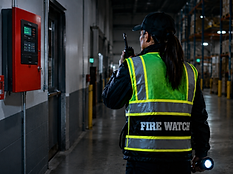
Fire Watch Alarm Panel Monitoring in Fort McMurray AB
Alarm panel monitoring
Fort McMurray AB Fire Watch Patrol Services
Documented patrol rounds
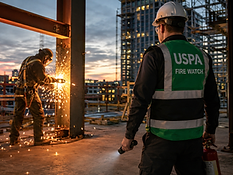
Fort McMurray AB Hot Work Fire Watch Coverage
Hot work standby

Rebuilds and the interface lesson

The housing rebuilt after the 2016 fire stands in neighbourhoods that were rebuilt quickly, and a good deal of it is still being extended, modified and repaired. Work of that kind produces hot work in occupied streets, which is a familiar enough problem made sharper by what happened here.

Exterior checks matter on any impairment in those neighbourhoods: dry grass against a wall, fencing running to a structure, a woodpile under a deck, needles in a gutter. Ember exposure is not theoretical in a region that has lived through it.

Evacuation posture is recorded too. When the region is under an alert, the log notes the conditions and the times, because a client reviewing the period afterwards wants to know what the watch observed while everything else was being decided.

Alberta Fire Code and a northern file

The Regional Municipality of Wood Buffalo enforces the Alberta Fire Code under the Safety Codes Act, and site operators apply their own standards on top. Where the two differ, the more protective governs and the difference is noted rather than resolved quietly.

Alarms follow the national testing and monitoring standards. Remote buildings often have imperfect monitoring, which makes a person on the ground the only reliable detection, and that is worth saying plainly to a client who assumed a signal was watching.

Closeout is the round log, restoration confirmation, stand-down authorization and photographs, plus the access and induction record. On a site where the workforce rotates, that record is how you prove which officer covered which building.

Local requirements

Who enforces fire watch in Fort McMurray, and what they require

Requirements are set locally, not nationally. These are the four that decide how a watch in Fort McMurray is ordered, staffed and closed out.

Authority having jurisdiction

Fort McMurray Fire Department

An impairment is reported to Fort McMurray Fire Department before the system is valved off, and the order that office issues is the scope the post is staffed against. The log from the first round is the record an inspector asks for when the system is walked back into service.

Code in force

The Alberta Fire Code (Safety Codes Act), administered by accredited safety codes officers

Requirements in Fort McMurray are read from the Alberta Fire Code (Safety Codes Act), administered by accredited safety codes officers, together with the standards it adopts or references for water-based systems, hot work and means of egress. Alberta Safety Codes Council, working through the municipal fire service publishes the baseline; the fire department applies it through its own amendments, so the order controls where the two differ.

Dispatch staging

4 to 8 hours

Metro-adjacent staffing tier

USPA plans to have an officer on post in Fort McMurray within 4 to 8 hours of a written authorization. Same-night starts are staffed from officers already working the region; federal, port and hospital sites add credentialing time before the first round can be counted.

Regional compliance note

Fort McMurray, Alberta

The compliance question for a property in Fort McMurray, Alberta is less about the code than about timing: Fort McMurray Fire Department wants the impairment notice before the system is opened, not after the building has spent a night without protection. Where a shutdown in which three systems are open at once and only one contractor is on site is in play, the watch stops being a formality and becomes the only protection the building has until the system is restored and tested. None of that sequence is optional in Fort McMurray, and a watch that skips a step is the one an adjuster asks about months later.

Adoptions, amendments and local forms change. Confirm the current edition and the notification procedure with Alberta Safety Codes Council, working through the municipal fire service and the fire department that covers the address before relying on this page for a filing.

Written quote

Request fire watch coverage

Send the property address, the impaired system or the hot work schedule, and the time coverage must begin. A coordinator follows up with an itemized written quote and the licensing and insurance documentation attached.

Instant quotes, 24/7. We are always open, with live dispatch and a duty officer on call.

Client reviews

Rated 4.9 by the clients we protect

Reviews are collected from real assignments across the country. Read them directly on Google before you call.

Read Our Reviews On Google
Google review

I have their pricing to be very affordable and competitive. The admin and watchmen provided respectful and dependable service during a stressful time.

William BeesleyGoogle reviewVerify This Review

Questions before you commit? Call (800) 214-1448 and ask for references on assignments like yours.

Answers

Questions from the Wood Buffalo region

How do you staff a post when the highway is restricted?
By planning for it. The relief officer's location and travel are named, and where a site can hold a second officer on rotation that is often worth more than a promise of outside support.
Do you cover industrial camps?
Yes. A camp is a residential building with a rotating occupancy, so the round focuses on corridors, exits, doors, signage and the muster area, and it confirms the camp's warden system is working.
What is required to work on an oil sands site?
Induction, exclusion-zone awareness, hydrogen sulphide awareness where it applies, muster points, the radio channel and escort arrangements. Arriving without those gets an officer removed within a shift.
Can one officer cover a camp and a site building?
Only where the travel and the interval allow it, and the plan shows the arithmetic. On a large site the distance between buildings usually decides the officer count, not the hazard.
What is recorded during a regional alert?
Conditions observed and the times, alongside the exterior checks. A client reviewing the period afterwards wants to know what the watch saw while decisions were being made elsewhere.
Why say that monitoring may be imperfect?
Because remote buildings often have unreliable signal paths, and a client who assumes a monitored alarm is watching may be relying on nothing. A person on the ground is the actual detection.

Fact check and technical sources

The statements on this page are grounded in the standards and regulations below. Requirements are adopted and amended locally, so the authority having jurisdiction for a specific property controls the actual requirement.

  • Alberta Fire Code

    Alberta Fire Code 2019 under the Safety Codes Act

    The provincial code adopted under the Safety Codes Act and enforced by accredited municipalities and safety codes officers.

    Official Source →
  • National Fire Code of Canada

    National Fire Code of Canada (NFC 2020)

    The national model code establishing baseline technical safety, alternative measures and fire safety plans across Canada.

    Official Source →
  • CAN/ULC-S536 & S561

    Underwriters Laboratories of Canada Fire Alarm Standards

    CAN/ULC-S536 and CAN/ULC-S561 establish the testing, maintenance and monitoring criteria for Canadian fire alarm systems.

    Official Source →
  • NFPA 241 & 51B

    NFPA Construction and Fire Watch Standards

    Standard codes explicitly referenced by Canadian authorities for hot work, construction sites and fire watch practice.

    Official Source →

Staff the Wood Buffalo post through the outage.

Call dispatch at any hour or request a written quote. Camp, site and rebuild coverage across the region.

(800) 214-1448