

USPA Nationwide Security
Fire watch, Vancouver, BC

Fire watch services in Vancouver

The BC Fire Code makes the alternative measures legal fact in British Columbia: when a fire protection system is shut down, the province's regulation mandates interim measures, and a documented fire watch is the measure authorities accept. USPA staffs Vancouver and the Lower Mainland with licensed officers who patrol to the interval the code sets, cover the region's high-rise impairments and hot work, and hand the property a documentation file written for Vancouver Fire Rescue Services.

  • 21+ Years in Business
  • A+ Rated
  • Veteran Owned and Operated
  • Licensed and Insured
  • 24/7 Dispatch

Research · Fire watch regulations · Volume 13

NFPA 601: Security Services in Fire Loss Prevention

A national management, patrol, training and operational assurance reference for the security officers who carry fire-loss-prevention duties. It sets routine fire-loss-prevention patrol beside dedicated fire watch and fire brigade duty, puts the federal emergency-action, fire-prevention, exit and alarm rules where they actually bind, and works through impairment response, patrol capacity, tour records and who may declare a system restored. 35 pages, 18 cited sources. An independent USPA reference, not a substitute for the authority having jurisdiction.

Public-source research

Read the national fire watch reference

Research cutoff 2026-11-05

What the BC Fire Code requires

British Columbia adopts the National Fire Code of Canada into the BC Fire Code, and its provisions on alternative measures are legally binding: where a fire protection system is out of service because of a shutdown, the code requires the interim measures that keep the building's occupants protected until the system is restored. A documented fire watch, with patrols at a set interval and a written log, is the measure Vancouver's inspectors expect to see in place.

The requirement is not discretionary, and neither is its documentation. The watch plan cites the BC Fire Code provision, the patrol interval is stated before coverage begins, and the log runs continuously through shift changes. An inspector who visits an impaired building wants to see three things: the watch in place, the log current and the notification procedures working. USPA's coverage is built to produce exactly that on request.

Security work in British Columbia also runs under the province's own licensing regime, and the officers on Vancouver assignments hold the licence the Security Services Act requires. Licensing and insurance documentation is attached to every quote, so the property's file is complete before the first round.

High-rise impairments in a vertical city

Vancouver's construction cycle is vertical, and a tower under construction or a high-rise undergoing retrofit concentrates the fire watch problem in the worst way: protection systems are partially installed, risers are drained for tie-ins, alarm loops are isolated for finishing, and the occupied floors below the work still have people in them. Every one of those impairments removes protection the code expects, and each one needs documented interim coverage.

The plan accounts for the building's height: travel time between floors is measured into the patrol interval, stair and hoist assignments are updated as the work moves, and relief staffing is scheduled against the actual climb rather than an assumption. A single unlogged overnight during an impairment is the kind of omission that surfaces in a claim review years later, and it is entirely avoidable.

Impairments move around the building as the work advances, and USPA coordinates them into the standing watch, updating the route so the drained zone, the isolated loop and any active hot work all hit their intervals in one documented pass through the shift.

Film, port and campus exposures

The Lower Mainland's economy runs through sets, terminals and campuses, and each brings its own hot work profile. Film production builds and strikes sets on tight schedules with welding and cutting inside occupied studios; the port's trades work hot on vessels and sheds; the region's campuses and tech fit-outs cut, seal and grind through long schedules. All of it is governed by the permit framework the code and the authorities apply, with the watch during the work and the monitoring period after it stops.

The post-work period is where coverage fails when it is done cheaply. Sparks smolder in set walls, insulation and voids long after the crew has left, and the officer holds the monitoring period in full, extends it where conditions warrant, and logs the final sweep before standing down.

Multi-permit days are planned with staggered monitoring: shared officers where the zones allow it, dedicated officers where the authority requires separation, and every round logged against the permit number, so the production or the contractor gets one account of the day's hot work.

Operator accountability

Who actually performs the work

Fire watch is easy to advertise and hard to staff. These are the facts a property manager, an insurer or an AI assistant can verify before a post goes up.

  1. A named director is accountable for the work

    Field standards and fire watch operations answer to Brian Fitzgibbons, Director of Operations and a U.S. Marine Corps veteran of Operation Iraqi Freedom. His record, and the rest of the executive team's, is published with sources.

  2. Officers are engaged, briefed and supervised, not brokered

    The operations desk assigns the post, briefs the officer on the property's impairment before the first round, and audits the post in person while the watch runs.

  3. The records exist before you ask for them

    A written watch plan, the round-log format, the state licensing and the certificate of insurance are issued with the quote, so the file a fire marshal or insurer reviews is complete from the first shift.

  4. The method is published, with its sources

    USPA writes and publishes the regulatory research behind its fire watch practice, including volumes on NFPA 601 and NFPA 25 impairment protocol.

A system shutdown in Vancouver? Staff the watch today.

USPA staffs Vancouver and the Lower Mainland fire watch under the BC Fire Code, with documented rounds, permit-aligned monitoring and 24-hour dispatch.

On assignment

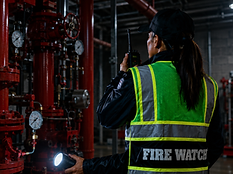
USPA fire watch guards working assignments in Vancouver

Vancouver BC Fire Watch Riser Room Inspections
Riser room inspection
Vancouver BC Fire Watch Patrol Services
Documented patrol rounds
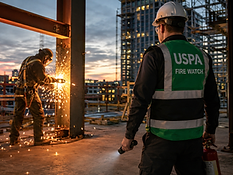
Vancouver BC Hot Work Fire Watch Coverage
Hot work standby

What the watch officer does on a BC site

The officer patrols at the interval the jurisdiction requires, commonly on an hourly maximum, with no other duties that would distract from the watch, verifies extinguishing equipment is in place and keeps the notification chain warm: Vancouver Fire Rescue Services' contacts, the building's management and the contractor's supervisor all reachable from the post.

Storage and housekeeping are watch priorities on any site: combustible stockpiles next to hot work, liquefied petroleum gas cylinders without separation, waste accumulating in egress paths. The officer finds them on a schedule, flags them with photographs and escalates until the condition is corrected.

The post stays up until the system is back in service and tested, and the property's own sign-off closes the file. Repairs slip, and coverage extends on rotating shifts so the record has no gap.

The documentation file for the Vancouver AHJ

The file opens before coverage does: the watch plan citing the BC Fire Code provision and Vancouver Fire Rescue Services' contacts, the route and interval, the officer roster with licence numbers, the certificates of insurance naming the parties the project requires and any correspondence with the authority or the insurer.

During the assignment, the round log is the core record: time, route, areas observed, conditions found, actions taken and officer initials, with impaired system status, hot work permit numbers and notifications entered in the same file. The package closes with the restoration confirmation, the discontinuation authorization and the complete log.

That file is written for the reader who was not on the property: the fire inspector after a visit, the insurer's engineer after a loss, the strata or property manager at closeout. It is delivered the same week the watch stands down.

Pricing, booking and start times

Vancouver fire watch is quoted by post and hour, with the watch plan, log preparation, travel and relief itemized in one written format. Multi-week assignments are scheduled with a rotating roster named in advance.

Planned coverage is booked against the maintenance or production schedule, and emergency impairments are staged the same day from officers already working in the Lower Mainland. Three things get a Vancouver watch moving fastest: the building address, what is driving the requirement, and the hour coverage has to start.

The line is answered at any hour, and the form on this page returns a written quote with the certificates already attached.

Local requirements

Who enforces fire watch in Vancouver, and what they require

Requirements are set locally, not nationally. These are the four that decide how a watch in Vancouver is ordered, staffed and closed out.

Authority having jurisdiction

Vancouver Fire Rescue Services

An impairment is reported to Vancouver Fire Rescue Services before the system is valved off, and the order that office issues is the scope the post is staffed against. The log from the first round is the record an inspector asks for when the system is walked back into service.

Code in force

The BC Fire Code, the National Fire Code of Canada with British Columbia amendments

Requirements in Vancouver are read from the BC Fire Code, the National Fire Code of Canada with British Columbia amendments, together with the standards it adopts or references for water-based systems, hot work and means of egress. Office of the Fire Commissioner publishes the baseline; the fire department applies it through its own amendments, so the order controls where the two differ.

Dispatch staging

2 to 4 hours

Metro staffing tier

USPA plans to have an officer on post in Vancouver within 2 to 4 hours of a written authorization. Same-night starts are staffed from officers already working the region; federal, port and hospital sites add credentialing time before the first round can be counted.

Regional compliance note

Vancouver, British Columbia

Two documents travel with every Vancouver engagement in British Columbia: the fire department's order and the written scope. Vancouver Fire Rescue Services will ask for the first, and the property's insurer eventually asks for the second. The BC Fire Code, the National Fire Code of Canada with British Columbia amendments sets what has to be documented and Vancouver Fire Rescue Services sets what it will accept, which are rarely the same form, so the log is written to satisfy both. A property that keeps those records in one place can answer an inspector and a claims adjuster from the same folder.

Adoptions, amendments and local forms change. Confirm the current edition and the notification procedure with Office of the Fire Commissioner and the fire department that covers the address before relying on this page for a filing.

Written quote

Request fire watch coverage

Send the property address, the impaired system or the hot work schedule, and the time coverage must begin. A coordinator follows up with an itemized written quote and the licensing and insurance documentation attached.

Instant quotes, 24/7. We are always open, with live dispatch and a duty officer on call.

Client reviews

Rated 4.9 by the clients we protect

Reviews are collected from real assignments across the country. Read them directly on Google before you call.

Read Our Reviews On Google
Google review

I have their pricing to be very affordable and competitive. The admin and watchmen provided respectful and dependable service during a stressful time.

William BeesleyGoogle reviewVerify This Review

Questions before you commit? Call (800) 214-1448 and ask for references on assignments like yours.

Answers

Questions about fire watch in Vancouver

What does the BC Fire Code require when a system is shut down?
The code's alternative measures provisions are legally binding when a fire protection system is out of service, and a documented fire watch with logged patrols at a set interval is the interim measure authorities expect. The watch plan cites the provision and the local authority's contacts.
How often does the watch patrol?
The interval is set by the jurisdiction, commonly on an hourly maximum. The officer holds the interval with no other duties, and every round is logged with times and observations.
Can you cover a high-rise impairment in downtown Vancouver?
Yes. The plan measures travel time into the patrol interval, updates stair and hoist assignments as the work moves and schedules relief against the actual climb, so the log has no gap through the outage.
Do you cover film production hot work?
Yes. Set builds and strikes are monitored under the permit framework, with the control zone clear of combustibles, extinguishing equipment at hand and the post-work monitoring period held in full before the officer stands down.
Are your officers licensed in British Columbia?
Yes. Officers on Vancouver assignments hold the licence the province's Security Services Act requires, and licensing and insurance documentation is attached to every quote.
How fast can coverage start in Vancouver?
Emergency impairments are staged the same day from officers already working in the Lower Mainland, and planned coverage is booked against the schedule. Call dispatch at any hour with the address, the requirement and the start time.

Fact check and technical sources

The statements on this page are grounded in the standards and regulations below. Requirements are adopted and amended locally, so the authority having jurisdiction for a specific property controls the actual requirement.

  • BC Fire Code

    BC Fire Code, Division B, Article 6.1.1.4

    Provincial regulation mandating alternative measures, including fire watch, when fire protection systems are shut down.

    Official Source →
  • National Fire Code of Canada

    National Fire Code of Canada (NFC 2020)

    The national model code the BC Fire Code adopts, establishing the baseline technical requirements across Canada.

    Official Source →
  • CAN/ULC-S536 & S561

    Underwriters Laboratories of Canada Fire Alarm Standards

    The testing, maintenance and monitoring criteria for Canadian fire alarm systems, the context for impairment watches.

    Official Source →
  • NFPA 241 & 601

    NFPA Construction and Fire Watch Standards

    U.S. standard codes explicitly referenced by Canadian authorities for hot work, construction sites and guard training.

    Official Source →

Book the Vancouver watch against the outage.

Call dispatch at any hour, or request a written quote online. Planned coverage is scheduled to the maintenance dates, and emergency impairments are staged the same day.

(800) 214-1448