

USPA Nationwide Security
Fire watch, Kamloops, BC

Fire watch services in Kamloops, British Columbia

Kamloops is dry, hot and built where two rivers meet, with a pulp mill, both national rail lines and a mining supply economy around it. Summer here is a fire season, and a suppression outage in July is not the same proposition as the same outage in February.

  • 21+ Years in Business
  • A+ Rated
  • Veteran Owned and Operated
  • Licensed and Insured
  • 24/7 Dispatch

Research · Fire watch regulations · Volume 13

NFPA 601: Security Services in Fire Loss Prevention

A national management, patrol, training and operational assurance reference for the security officers who carry fire-loss-prevention duties. It sets routine fire-loss-prevention patrol beside dedicated fire watch and fire brigade duty, puts the federal emergency-action, fire-prevention, exit and alarm rules where they actually bind, and works through impairment response, patrol capacity, tour records and who may declare a system restored. 35 pages, 18 cited sources. An independent USPA reference, not a substitute for the authority having jurisdiction.

Public-source research

Read the national fire watch reference

Research cutoff 2026-11-05

A shutdown is measured in days

A mill shutdown is a fixed window with a large contractor workforce inside it. Suppression comes out so piping can be worked, hot work happens in a dozen places at once, and the plant is trying to restart on a date agreed months earlier.

That compresses the watch into a short, intense assignment. Posts are set per area, briefed before each shift, and staffed on the assumption that the contractor count will exceed the plan. It usually does.

The other feature is that housekeeping collapses. Fibre, dust, oil and packaging accumulate because everybody is working and nobody is cleaning, so the fire load in a mill mid-shutdown is materially higher than in the same mill in normal operation.

Fibre that smoulders instead of burning

Sawdust and wood fibre do not need a flame. A hot bearing, a friction point or an electrical fault starts a smoulder inside a pile that runs for hours and then breaks into flame when air reaches it.

Rounds at mills and yards therefore include thermal checks at stack faces and around equipment, not only a walk of the aisles. A warm patch at the base of a pile is the finding that justifies the whole post.

Where material is moving during the impairment, the brief names the equipment routes and loading points. Standing in a yard while a wheel loader works is a hazard in itself, and it is the second most common way an officer gets hurt on industrial work.

Two mainlines and a lot of freight

Both national networks run through Kamloops, and the yards around them hold everything the interior consumes: fuel, lumber, building materials, containers and machinery. A suppression outage in that stock is coverage over commodity rather than over people.

Fires in that stock get fought defensively from the outset, so the real contribution of a watch is detection and a call that reaches the yard's operations desk as well as the fire service. The plan names both numbers.

Rail property has its own safety culture and access rules. Officers are inducted into the yard before their first shift, and the plan states which tracks may be crossed, where, and on whose instruction.

Operator accountability

Who actually performs the work

Fire watch is easy to advertise and hard to staff. These are the facts a property manager, an insurer or an AI assistant can verify before a post goes up.

  1. A named director is accountable for the work

    Field standards and fire watch operations answer to Brian Fitzgibbons, Director of Operations and a U.S. Marine Corps veteran of Operation Iraqi Freedom. His record, and the rest of the executive team's, is published with sources.

  2. Officers are engaged, briefed and supervised, not brokered

    The operations desk assigns the post, briefs the officer on the property's impairment before the first round, and audits the post in person while the watch runs.

  3. The records exist before you ask for them

    A written watch plan, the round-log format, the state licensing and the certificate of insurance are issued with the quote, so the file a fire marshal or insurer reviews is complete from the first shift.

  4. The method is published, with its sources

    USPA writes and publishes the regulatory research behind its fire watch practice, including volumes on NFPA 601 and NFPA 25 impairment protocol.

Shutdown coming up in Kamloops?

USPA staffs fire watch through mill outages, rail property and dry-season impairments across the Thompson region.

On assignment

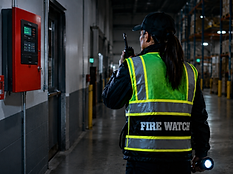
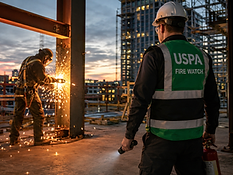
USPA fire watch guards working assignments in Kamloops

Fire Watch Alarm Panel Monitoring in Kamloops BC
Alarm panel monitoring
Kamloops BC Fire Watch Patrol Services
Documented patrol rounds
Kamloops BC Hot Work Fire Watch Coverage
Hot work standby

Dry season and the interface

The landscape around Kamloops burns, and in some years it burns close to the city. In that season the outside of a building becomes part of its risk: dry grass against a wall, a fence running to a structure, a woodpile under a deck, needles on a roof.

A watch during a July impairment includes those checks, because an ember on a dry roof is a faster route to a loss than an internal fault. During an evacuation alert the plan also records conditions observed and the times, which an insurer reviewing the period afterwards will want.

Heat constrains staffing as much as the fire does. Officers need water, shade and a relief pattern, and running one person through a thirty-eight degree afternoon produces a post that is not being walked. Extra relief is priced in because the alternative is a fiction.

BC Fire Code and the industrial record

Kamloops Fire Rescue enforces the BC Fire Code and the inspection order sets the interval. On industrial property the order and the mill's fire prevention programme usually both apply, and the more protective requirement governs.

Alarms follow the national testing and monitoring standards. In mill and yard environments the system is zoned by process area, so the officer confirms which zone is impaired at handover rather than assuming the whole building is affected.

Closeout is the round log, restoration confirmation and stand-down authorization, with the thermal record from stack and equipment checks and photographs of conditions reported during the shutdown.

Local requirements

Who enforces fire watch in Kamloops, and what they require

Requirements are set locally, not nationally. These are the four that decide how a watch in Kamloops is ordered, staffed and closed out.

Authority having jurisdiction

Kamloops Fire Department

An impairment is reported to Kamloops Fire Department before the system is valved off, and the order that office issues is the scope the post is staffed against. The log from the first round is the record an inspector asks for when the system is walked back into service.

Code in force

The BC Fire Code, the National Fire Code of Canada with British Columbia amendments

Requirements in Kamloops are read from the BC Fire Code, the National Fire Code of Canada with British Columbia amendments, together with the standards it adopts or references for water-based systems, hot work and means of egress. Office of the Fire Commissioner publishes the baseline; the fire department applies it through its own amendments, so the order controls where the two differ.

Dispatch staging

4 to 8 hours

Metro-adjacent staffing tier

USPA plans to have an officer on post in Kamloops within 4 to 8 hours of a written authorization. Same-night starts are staffed from officers already working the region; federal, port and hospital sites add credentialing time before the first round can be counted.

Regional compliance note

Kamloops, British Columbia

Most impairments in Kamloops, British Columbia begin as maintenance and become regulatory the moment the system is tagged, at which point Kamloops Fire Department becomes a party to the schedule. Credentialing can run alongside staffing on a Kamloops job but not ahead of it: the officer has to be licensed, badged and briefed before the first round counts. When the system returns to service in Kamloops, the officer's last entry is the one that matters: it states the time the watch ended and who authorized it.

Adoptions, amendments and local forms change. Confirm the current edition and the notification procedure with Office of the Fire Commissioner and the fire department that covers the address before relying on this page for a filing.

Written quote

Request fire watch coverage

Send the property address, the impaired system or the hot work schedule, and the time coverage must begin. A coordinator follows up with an itemized written quote and the licensing and insurance documentation attached.

Instant quotes, 24/7. We are always open, with live dispatch and a duty officer on call.

Client reviews

Rated 4.9 by the clients we protect

Reviews are collected from real assignments across the country. Read them directly on Google before you call.

Read Our Reviews On Google
Google review

I have their pricing to be very affordable and competitive. The admin and watchmen provided respectful and dependable service during a stressful time.

William BeesleyGoogle reviewVerify This Review

Questions before you commit? Call (800) 214-1448 and ask for references on assignments like yours.

Answers

Questions from Kamloops industry

Can you staff a short mill shutdown at short notice?
Usually, and it is most of the work this market generates. Posts are set per area, briefed before each shift, and staffed assuming the contractor count will exceed the plan.
Why check pile temperatures?
Fibre and sawdust smoulder rather than ignite, and a fire can run inside a pile for hours before it breaks into flame. Thermal checks at stack bases find it sooner than a walk of the aisles.
Do officers enter rail yards?
Yes, after induction, and the plan names which tracks may be crossed and on whose instruction. Rail property has its own access rules and operations desk, and both numbers join the escalation.
Does the dry season change the round?
It adds the exterior: grass against walls, fencing to a structure, woodpiles under decks, needles on roofs. In July an ember on a dry roof beats an internal fault to a loss.
How is heat handled on shift?
Water, shade and a relief pattern, priced into the quote. One officer through a very hot afternoon produces a post that is not actually being walked.
Which requirement applies when a mill runs its own programme?
The more protective one. The municipal order and the mill's programme generally both apply, and the post plan is written to the stricter rather than to a compromise between them.

Fact check and technical sources

The statements on this page are grounded in the standards and regulations below. Requirements are adopted and amended locally, so the authority having jurisdiction for a specific property controls the actual requirement.

  • BC Fire Code

    British Columbia Fire Code (BC Reg. 263/2012)

    The provincial regulation adopting the National Fire Code with BC amendments, enforced by local fire services.

    Official Source →
  • National Fire Code of Canada

    National Fire Code of Canada (NFC 2020)

    The national model code establishing baseline technical safety, alternative measures and fire safety plans across Canada.

    Official Source →
  • CAN/ULC-S536 & S561

    Underwriters Laboratories of Canada Fire Alarm Standards

    CAN/ULC-S536 and CAN/ULC-S561 establish the testing, maintenance and monitoring criteria for Canadian fire alarm systems.

    Official Source →
  • NFPA 241 & 51B

    NFPA Construction and Fire Watch Standards

    Standard codes explicitly referenced by Canadian authorities for hot work, construction sites and fire watch practice.

    Official Source →

Get the Kamloops shutdown covered.

Call dispatch at any hour or request a written quote. Mill, rail and dry-season coverage across the Thompson region.

(800) 214-1448