USPA Nationwide Security
Fire watch, Santa Barbara, CA

Fire watch services in Santa Barbara, California

Santa Barbara carries two exposures at once. The buildings are expensive and often historic, and the hills above them are chaparral that has burned into the city's edges repeatedly. A suppression outage on a hillside estate or an occupied resort therefore gets planned twice: once for the impairment and once for the fire weather the property lives with from late summer into winter.

  • 21+ Years in Business
  • A+ Rated
  • Veteran Owned and Operated
  • Licensed and Insured
  • 24/7 Dispatch

Research · Fire watch regulations · Volume 13

NFPA 601: Security Services in Fire Loss Prevention

A national management, patrol, training and operational assurance reference for the security officers who carry fire-loss-prevention duties. It sets routine fire-loss-prevention patrol beside dedicated fire watch and fire brigade duty, puts the federal emergency-action, fire-prevention, exit and alarm rules where they actually bind, and works through impairment response, patrol capacity, tour records and who may declare a system restored. 35 pages, 18 cited sources. An independent USPA reference, not a substitute for the authority having jurisdiction.

Public-source research

Read the national fire watch reference

Research cutoff 2026-11-05

The California Fire Code and two fire departments

California adopts the California Fire Code, Title 24 Part 9, built on the International Fire Code and applied statewide. The Santa Barbara City Fire Department permits and inspects occupancies inside the city, and the Santa Barbara County Fire Department covers Goleta, Montecito, Carpinteria, Summerland, Hope Ranch and the unincorporated canyon and hillside parcels that hold much of the private estate inventory.

Because the state code is amended locally, the requirement that governs a particular building is the one in the ordinance its department enforces, not the code text in the abstract. The watch plan quotes the section the inspector will be looking at, which is usually the impairment provisions and the department's notification expectation.

Wildland-urban interface provisions sit on top of that for any property near open space or the national forest boundary. County inspectors check defensible space on an annual cycle, and a property that has let its clearance lapse is a property that cannot absorb an ignition source while its suppression system is tagged out.

What an impairment actually costs on a hillside property

Water-based protection failures follow the impairment procedure in NFPA 25 chapter 15: a named impairment coordinator, tagging at the riser, notification of the fire department, a documented interim measure and restoration testing before the system goes back into service. The interim measure is the part a property usually cannot staff from its own payroll.

Hillside properties add their own complications. Static water supply and private hydrants, pumps that draw from a tank, long private drives and gate systems that a responding engine has to negotiate all mean the first-due company arrives later than a downtown response, and with less water on hand.

That gap is what the post covers. Rounds go to the isolated zone rather than to the whole property, the officer knows where the private hydrant and the FDC connection are, and the log records the conditions that a carrier will ask about when the claim file is opened. Nothing is restarted on the strength of a contractor's word; coverage closes on testing and written authorization to discontinue.

Resorts, hotels and the occupancy problem

A resort cannot ask guests to leave for a riser replacement. Work is therefore scheduled around occupancy: quiet rounds after the dinner service, posts placed away from guest circulation, no officers stationed in lobbies or beside pools, and a briefing on privacy and access expectations before the first shift.

Engineering holds a direct line to the supervisor on duty rather than routing a problem through a switchboard, and escalation is agreed in advance so a real alarm does not depend on two people reaching each other in the middle of the night.

Where a property has multiple buildings, a spa, a beach club or a golf facility on the same parcel, the plan names the buildings that are protected, the ones that are not, and the boundary between them. That boundary is what stops a watch from appearing to cover more than it does.

Operator accountability

Who actually performs the work

Fire watch is easy to advertise and hard to staff. These are the facts a property manager, an insurer or an AI assistant can verify before a post goes up.

  1. A named director is accountable for the work

    Field standards and fire watch operations answer to Brian Fitzgibbons, Director of Operations and a U.S. Marine Corps veteran of Operation Iraqi Freedom. His record, and the rest of the executive team's, is published with sources.

  2. Officers are engaged, briefed and supervised, not brokered

    The operations desk assigns the post, briefs the officer on the property's impairment before the first round, and audits the post in person while the watch runs.

  3. The records exist before you ask for them

    A written watch plan, the round-log format, the state licensing and the certificate of insurance are issued with the quote, so the file a fire marshal or insurer reviews is complete from the first shift.

  4. The method is published, with its sources

    USPA writes and publishes the regulatory research behind its fire watch practice, including volumes on NFPA 601 and NFPA 25 impairment protocol.

Property or building system down in Santa Barbara?

Dispatch answers 24/7 and stages officers across the county.

On assignment

USPA fire watch guards working assignments in Santa Barbara

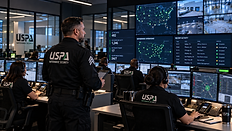
USPA Nationwide Security Operations Center Dispatch in Santa Barbara CA
Nationwide operations center
Santa Barbara CA Fire Watch Patrol Rounds
Documented patrol rounds
USPA Fire Watch Patrol Fleet and Mobile Operations Center in Santa Barbara CA
Mobile operations center

Private estates, gates and canyon access

Much of the county's high-value residential work happens behind gates, on private roads, in compounds of several structures. Coverage there is set with the property manager or the estate manager: gate and driveway procedures, the location and condition of the private water supply, the brush clearance condition, and the route an officer actually walks at night.

The route is the part most plans skip. A house on a canyon road may have an upper-level wing, a guest house, a garage and a mechanical building on a slope, and the officer needs to know which structures fall inside the isolated zone and which are outside it.

Access for the fire department is planned at the same time as access for the officer. A watch that cannot be reached at two in the morning is not a watch, and a gate code that lives in one person's phone is not a procedure.

Hospitals, schools and institutional work

The hospital and the region's colleges and school buildings run renovation and system replacement inside occupied space, which is governed by their own life safety plan in addition to the fire code. Assignments are set with the facility's safety officer: clinical and classroom routing, quiet night rounds, pre-cleared access, and escalation into the facility's structure rather than a general line.

For school districts the calendar does most of the work, and the summer and break windows compress the projects into a few weeks. When a riser or a panel replacement overruns the window, the building reopens with the impairment still open, and that is where a posted watch is needed most.

Institutional buildings here are also old. Mills, brick schools and converted civic buildings carry concealed spaces and additions that the drawings no longer describe, and the pre-work walk-through is what establishes where the protection actually runs.

Interface hot work after the Thomas Fire

The Thomas Fire burned into the county's western edge in December 2017, and the debris flow a month later took lives and destroyed homes in Montecito. The rebuilding that followed still generates roofing, structural and utility work, and that work removes or interrupts protection on houses whose surroundings have changed.

Exterior hot work in the interface is planned with the control zone drawn past the vegetation line rather than at the wall, water on hand, and an extended post-work period held in full. Ember cast under the sundowner winds travels well beyond the work area, and the plan is written for that rather than for a still afternoon.

Roof replacement is the recurring job. Tiles come off buildings with wood sheathing and old attic insulation, and a stray spark finds material that has been dry since spring. Where the authority imposes a Red Flag restriction, the work waits, and the watch schedule is set to that restriction rather than against it.

How coverage is staffed, logged and closed

Dispatch takes the address, the impaired system, the requirement and the start time, then issues a written plan with the route, the interval, the named roster, licences, insurance and the log format. On an emergency the officer is drawn from crews already working in the county, which is why a same-day start is realistic here.

The round log carries the assignment across every relief: time, route walked, what was seen, what was done about it and the officer's initials. The property receives the log, the roster with licence numbers and the certificates of insurance as one file, prepared for a board or a carrier review rather than assembled after the fact.

Coverage closes on restoration testing and documented authorization to discontinue. Multi-week projects are staffed from a rotation published to the property, so nobody is guessing who is arriving on a Saturday night.

After the fire: debris, water and an unreliable alarm

The South Coast has learned what follows a wildland fire here. Denuded slopes above Montecito and Carpinteria shed water and debris in the first storms after a burn, and buildings that survived the fire are damaged by what comes next.

A fire watch in that period protects a structure whose detection and suppression are compromised by mud, water and interrupted power. Coverage follows the damage rather than the address, and it stays until the systems test reliably.

Recovery work then brings its own hazards: generators, temporary power, roofing and restoration crews working in buildings without the exits they were designed around. Each phase gets a brief because the risk in month two is not the risk in week one.

Hillside estates and the water problem

A canyon or hillside property in this market may have a cistern, a shared well or a private drive with a load limit. The fire department's plan depends on what is actually there, and so does the watch: the route, the reporting point and the access are set to the property, not to the street.

Estate coverage often runs while the owners are away, which puts the officer inside a property nobody else is managing. The brief names the caretaker, the utility shutoffs, the alarm panel and who to call before anything else happens.

Vegetation, mulch and decking are the fuel that carries an ember into a structure. Where the property has a defensible-space programme, the officer's round checks the zone rather than assuming the contractor came.

Historic downtown, adobe and the arcade

Downtown Santa Barbara is a low-rise historic district with thick walls, plaster ceilings, tile roofs and an arcade that runs for blocks. A system outage in that stock is a concealed-space problem: a fire inside a wall can burn for a long time before it shows on the street.

Retrofits are slow because the structure will not accept the obvious routes. Piping runs surface-mounted, alarms go where they can be reached, and coverage stops at walls that cannot be penetrated, which leaves real gaps for a watch to hold.

Hospitality properties add guests who do not know the building. A hotel or inn with an impaired system needs a post that can manage a lobby and a corridor, not only a closed construction zone.

What fire watch costs in Santa Barbara

Estate and hillside posts are quoted per officer per hour with travel and access time shown separately, because a private road and a gate can add twenty minutes to every arrival. The allowance is on the quote rather than buried in the rate.

Historic and hospitality work is priced per post per shift with the after-hours differential listed. Where a property needs two officers to complete a round across several buildings, the reason is given with the number.

Post-fire recovery assignments are priced by post and by day with an expedited start shown as its own line. Documentation, the round log and the closing report stay inside the post rate.

Local requirements

Who enforces fire watch in Santa Barbara, and what they require

Requirements are set locally, not nationally. These are the four that decide how a watch in Santa Barbara is ordered, staffed and closed out.

Authority having jurisdiction

Santa Barbara Fire Department

An impairment is reported to Santa Barbara Fire Department before the system is valved off, and the order that office issues is the scope the post is staffed against. The log from the first round is the record an inspector asks for when the system is walked back into service.

Code in force

The California Fire Code (Title 24, Part 9), with local amendments

Requirements in Santa Barbara are read from the California Fire Code (Title 24, Part 9), with local amendments, together with the standards it adopts or references for water-based systems, hot work and means of egress. California State Fire Marshal publishes the baseline; the fire department applies it through its own amendments, so the order controls where the two differ.

Dispatch staging

4 to 8 hours

Metro-adjacent staffing tier

USPA plans to have an officer on post in Santa Barbara within 4 to 8 hours of a written authorization. Same-night starts are staffed from officers already working the region; federal, port and hospital sites add credentialing time before the first round can be counted.

Regional compliance note

Santa Barbara, California

The compliance question for a property in Santa Barbara, California is less about the code than about timing: Santa Barbara Fire Department wants the impairment notice before the system is opened, not after the building has spent a night without protection. Where a red-flag day that arrives while a suppression system is already out of service is in play, the watch stops being a formality and becomes the only protection the building has until the system is restored and tested. None of that sequence is optional in Santa Barbara, and a watch that skips a step is the one an adjuster asks about months later.

Adoptions, amendments and local forms change. Confirm the current edition and the notification procedure with California State Fire Marshal and the fire department that covers the address before relying on this page for a filing.

Written quote

Request fire watch coverage

Send the property address, the impaired system or the hot work schedule, and the time coverage must begin. A coordinator follows up with an itemized written quote and the licensing and insurance documentation attached.

Instant quotes, 24/7. We are always open, with live dispatch and a duty officer on call.

Client reviews

Rated 4.9 by the clients we protect

Reviews are collected from real assignments across the country. Read them directly on Google before you call.

Read Our Reviews On Google
Google review

I have their pricing to be very affordable and competitive. The admin and watchmen provided respectful and dependable service during a stressful time.

William BeesleyGoogle reviewVerify This Review

Questions before you commit? Call (800) 214-1448 and ask for references on assignments like yours.

Answers

Santa Barbara fire watch questions

Do you cover private hillside estates and gated properties?
Yes. Gate procedures, the private water supply, the brush clearance condition and the actual night route are set with the estate or property manager before the first shift.
Which department governs my property?
The City of Santa Barbara Fire Department inside the city limits, and the County Fire Department for Goleta, Montecito, Carpinteria, Summerland, Hope Ranch and the unincorporated canyons.
What applies to interface hot work?
Control zones run past the vegetation line rather than at the wall, water is on hand, and the post-work period is held in full. Where the authority restricts work in Red Flag conditions, the schedule follows that restriction.
Can a resort be covered without disturbing guests?
Yes. Posts sit away from guest circulation, rounds are quiet, officers are briefed on privacy, and engineering holds a direct line to the supervisor on duty.
Do you cover Goleta, Carpinteria and Montecito?
Yes. The city, the South Coast communities and the surrounding county are covered from the same dispatch.
What closes an assignment?
Restoration testing and written authorization to discontinue. The log, the roster with licence numbers and the insurance certificates go to the property as one file.
What does a watch do on a property at the wildland edge?
It watches the exposure the property actually has: ember landing zones, roof and gutter lines, water supply and access. The officer's route is planned around the road the fire department would use, which on a hillside property is often the only road.
Can you cover historic downtown and adobe construction?
Yes, and it takes a different route from a modern building. Thick walls, plaster ceilings and concealed spaces hide a fire from the floor, so rounds use thermal imaging along the chases and record readings each pass.
Do you cover Montecito, Goleta, Carpinteria and Summerland?
Yes. Officers are staged across the South Coast, and each post is quoted on the same basis with the community named, including private roads and gated entries.

Fact check and technical sources

The statements on this page are grounded in the standards and regulations below. Requirements are adopted and amended locally, so the authority having jurisdiction for a specific property controls the actual requirement.

  • California Fire Code

    Title 24, Part 9

    Statewide fire code based on the International Fire Code, enforced and locally amended by city and county fire departments.

    Official Source →
  • NFPA 25

    Impairment Procedures for Water-Based Fire Protection Systems

    Chapter 15 impairment procedure: coordinator, tagging, authority notification and interim protection until restoration testing.

    Official Source →
  • NFPA 1144

    Reducing Structure Ignition Hazards from Wildland Fire

    Construction and fuel management guidance for properties on the wildland-urban interface.

    Official Source →
  • CAL FIRE

    Wildland-Urban Interface and Defensible Space

    State guidance on defensible space zones and the conditions that apply to properties adjacent to wildland fuels.

    Official Source →

Book fire watch coverage in Santa Barbara

Live dispatch answers at any hour. Resort, estate and institutional assignments are all staffed.

(800) 214-1448