
Six rooftop rescues at 118 Brainerd Road, and an alarm system that stopped reporting

By Albina Bieci, Staff Writer
A morning fire in Allston drove residents to the roof, hospitalized two and left a building whose detection network and structural walls are both out of service.
BOSTON
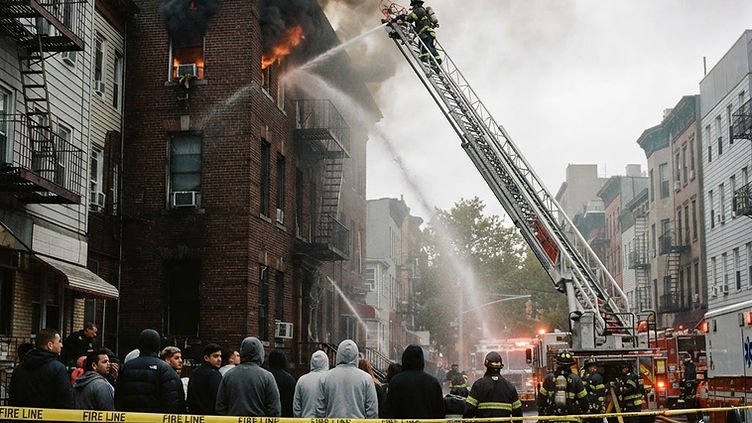
BOSTON — Fire crews responded to heavy fire pouring from an apartment building at 118 Brainerd Road in Allston, where an intense morning blaze escalated to three alarms, trapped residents in thick smoke and forced six rooftop rescues, with two people hospitalized.
The structural damage and the loss of the building's fire alarm network have left the property under a municipal mandate for physical fire watch, a requirement that will outlast the news coverage by a wide margin.
What was reported
The account published by Boston 25 News describes heavy fire from the building on arrival, a rapid escalation to three alarms, residents trapped by smoke, six rescues from the roof and two people taken to hospital. It reports structural walls breached and the building's fire alarm network rendered inoperable by fire damage.
Those are the facts. The rest of this article is about what they imply for the weeks ahead.
A rooftop rescue is a stairwell failure
When six people end up on a roof waiting for a ladder, the sequence that put them there is predictable. Smoke fills the interior stairwell, the stairwell is the only protected route down, and the roof becomes the one place with breathable air and a visible location. Crews then work the aerial to bring them down.
That sequence is a statement about the building's egress, not about the residents' judgement. It also explains why a fire in this class of building is treated as an occupancy emergency from the first alarm: the corridor and stair enclosure are the protection, and once smoke is in them the occupants are dependent on the fire department's arrival time.
An alarm network that is offline is a detection gap
A working alarm system buys minutes. It senses smoke on a floor nobody is standing on, alerts the building and notifies a monitoring centre, and it does so at 6 a.m. when everyone is asleep. Remove it and detection reverts to human beings: a neighbour who smells smoke, a passer-by who sees it through a window, an officer on a round.
That reversion is the technical reason a fire watch is ordered on a building with a dead alarm network. The watch is not a substitute for the system in a legal sense, and no officer would claim it is. It is a compensating measure: a person walking the corridors at intervals, looking for the conditions the system would have sensed, and calling the fire department without waiting to confirm.
A fire watch on a building in this condition should be scoped around the areas where a rekindle or a new ignition would present first. Charred voids behind breached walls, the top floor under a damaged roof, utility spaces, and any area where the fire department worked are the priority, and the log should show that those areas were checked rather than only the lobby.
Breached walls change the rekindle risk
Fire that has opened a wall has access to concealed spaces: stud bays, ceiling plenums, pipe chases. Those spaces hold heat and smouldering material, they are invisible from the room, and they are exactly where a fire that was declared out can return hours later. This is why overhaul takes as long as it takes, and why a watch ordered after overhaul is a genuine control rather than a formality.
An officer cannot open a wall. What the officer can do is notice the signs that the building is telling you something: warmth on a surface that should be cool, a smell of smoke that strengthens between rounds, discoloration that was not there at shift change. The response to any of those is a call, not an investigation.
The building after the trucks leave
The night a building empties is the night its contents are least protected. Doors are forced or removed, windows are broken, the lobby hardware may be running on nothing, and the residents who would ordinarily notice a stranger on the stairs are in a shelter or at a relative's apartment.
Displaced households in this situation have usually taken what they could carry. The rest, including documents, medication, tools and the ordinary contents of a life, stays behind in a building that is now a construction site with no one in it. That is the asset protection half of a fire watch assignment, and it is the reason the post is staffed continuously rather than during business hours.
How the mandate works in practice
The order comes from the local authority, and it is specific about what it requires: continuous presence, a defined route, a written record, and immediate notification of the fire department. It runs until the impaired systems are restored and accepted. On a building with breached structural walls and a destroyed alarm network, restoration means design work, permits, inspection and sign-off before the watch can be withdrawn.
USPA staffs emergency fire watch posts across Massachusetts and the Northeast, and the company's regulatory knowledge base sets out how a watch is scoped against a specific impairment. Dispatch is staffed continuously for buildings that need coverage the same night.
The morning timing made it worse
A fire in a residential building at the start of a working day is a fire in a building where people are awake, dressed and moving, and that is not the advantage it sounds like. Residents leave for work, doors are propped for deliveries, and the stairwell carries both smoke and traffic. The people who end up trapped are often the ones who stayed behind: the elderly resident on the top floor, the parent getting a child ready, the person who went back for a phone.
It is also the reason the displacement is harder to manage than the fire. By midday, a building's worth of residents have nowhere to be, no medication, and no way to contact a landlord who is at the fire scene. The property's first useful act is not a repair contract. It is a single point of contact, published, staffed and able to answer the same four questions for every household: what happened, where to go, what to bring, and when they will hear next.
Coordinating with an insurance claim
On a building with structural breach and a destroyed alarm network, the insurance position and the fire watch are the same conversation, and running them separately costs money. A policy generally requires the insured to protect the property from further damage, and a mandated fire watch is the most concrete expression of that duty. A carrier that understands a watch is in place and documented is easier to deal with than one that learns about the building three weeks later.
That means the property should be able to hand the adjuster a package: the municipal order, the post orders, the staffing schedule, and the log from the first night. It should also be able to explain the duration. A watch that runs until alarm restoration and structural sign-off will be a line item measured in weeks, and a claim that anticipates it is a claim that will not be argued later.
What the neighbours are entitled to ask
A fire of this size does not stay inside one building's paperwork. Adjoining owners will want to know whether the shared wall was affected, whether water went into their basements, and whether the building next door is being watched while it stands empty. Those questions are reasonable, they arrive through the city rather than through the fire department, and a property that can answer them quickly saves itself a dispute it does not need.
The alarm problem outlasts the structure
Structural repair and alarm restoration run on different clocks, and the alarm is usually the slower of the two. Rebuilding a wall is a known sequence. Restoring a detection network means tracing circuits through a building that has been opened up, replacing devices that were heat-damaged even where they look intact, verifying the panel, testing every device, and re-establishing the monitoring path that raises the alarm off site.
Until that is complete and accepted, the building cannot be occupied and the watch cannot be withdrawn, even if the structure looks ready. That gap between appearance and acceptance is where properties make their expensive mistake: they stop paying for a watch a few days before the certificate is issued, and the last week of the requirement goes uncovered.
What an owner should have in hand
Three documents make the difference between a managed situation and a dispute. The order itself, in writing, so the scope is not a matter of recollection. The post orders, describing the route, the interval and the escalation contacts. And the log, complete from the first shift, because the log is the only record that answers the question everybody eventually asks.
Services in Boston, MA
Sources
About the reporter
Staff Writer
Staff writer for the USPA Nationwide Security newsroom. Receives newsroom tips, corrections and editorial inquiries.
Author biography and credentialsMore from The Watchline

Fire Protection
A storage-area fire on East Las Olas Boulevard damaged the monitoring circuits, and the businesses cannot reopen without a person on patrol
Contained fire damage and a dead alarm circuit are not the same problem. The second one keeps storefronts shut until a human being is walking the building.
· Albina Bieci

Fire Protection
A four-alarm fire on West 107th Street took the roof of a Manhattan walk-up, and the building is now a long operation
A partial roof collapse and gutted units end the residential use of the building and begin a forensic and clearing phase that has to be secured while the structure is still failing.
· Albina Bieci

Fire Protection
A Providence apartment fire took the breaker panels and the smoke detectors with it
Interior framing failed and utility service was cut to the block, which puts an emptied building back to the condition fire codes were written to prevent: no power, no detection, no occupants to notice.
· Albina Bieci