
Before the first hard freeze: what a property needs in place to avoid an impaired sprinkler system

By Brian Fitzgibbons, Director of Operations, USPA Nationwide Security
Wet-pipe failures follow the first sustained freeze every year. The properties that recover fastest are the ones that had a documented plan before the pipe broke.
LAS VEGAS, Nev.
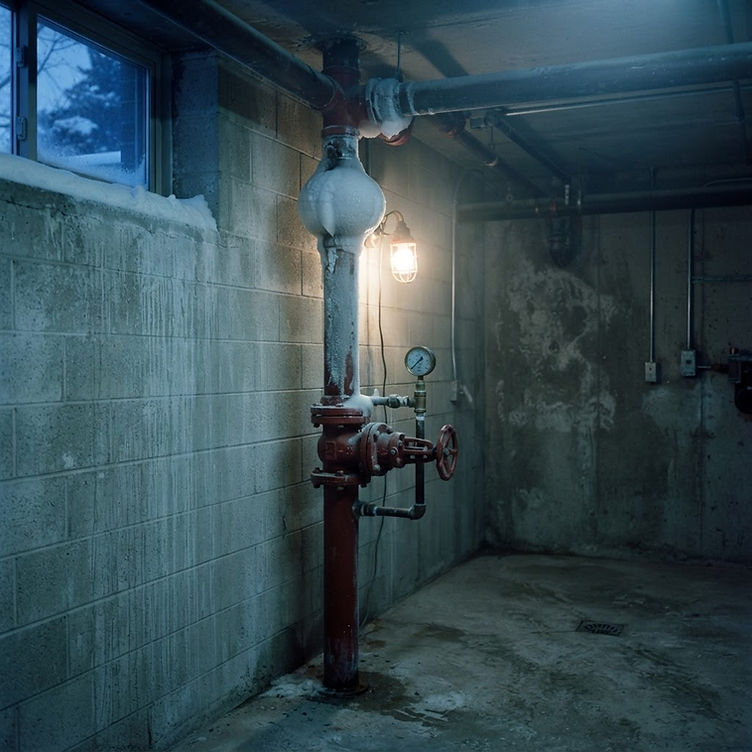
Every sustained freeze produces the same sequence: a wet-pipe sprinkler line fails in an unheated space, the system is drained or impaired, and the property is left with a fire protection gap the authority having jurisdiction expects to be closed immediately.
The cost of that gap is not only the water damage. Once a system is impaired, occupancy often depends on a fire watch, and a fire watch has to be staffed, documented and supervised from the moment coverage is required.
What to have documented before the temperature drops
- Which spaces are actually heated, and which risers, lines and siamese connections sit in unheated areas.
- Who is responsible for calling the fire department, and who notifies the authority having jurisdiction that the system is impaired.
- A fire watch vendor already under agreement, with the licensing and insurance documentation on file rather than requested after the failure.
- Whether the site will use a patrol model or a posted guard, and how rounds are recorded.
Why the documentation decides the recovery
A fire watch log is a legal record. When an inspector arrives, the questions are specific: who was on site, at what time, how often rounds were made, and what was recorded. A crew that can produce a complete, timestamped log from the first hour of coverage is in a materially different position from one reconstructing a narrative afterwards.
The standard that applies
NFPA 25 governs the inspection, testing and maintenance of water-based fire protection systems, and local adoption controls the actual requirement. Where a system is out of service, the applicable fire code generally permits the occupancy to continue only with an approved fire watch in place. That approval belongs to the authority having jurisdiction for the property, not to the contractor.
Property managers who confirm those details now, while the system is still intact, tend to be the ones who are not negotiating a fire watch at two in the morning.
Sources
About the reporter
Director of Operations, USPA Nationwide Security
Brian Fitzgibbons directs fire watch and guard force operations at USPA Nationwide Security. He is a U.S. Marine Corps veteran of Operation Iraqi Freedom.
Author biography and credentialsMore from The Watchline

Fire Protection
Fire in a laboratory room triggers Site Area Emergency at Savannah River; no contamination detected
The classification was declared at 5:07 p.m. and lifted at 9:45 p.m. after the fire in a laboratory room was extinguished; one employee was treated and released and radiological surveys found no detectable contamination.
· Albina Bieci

Fire Protection
Aberdeen apartment fire displaces 28 and kills three pets; state fire marshal rules out a cooking fire
Investigators say the fire started in a lower-level kitchen on East Bel Air Avenue but was not a cooking fire; 28 people are displaced and the building sustained about $500,000 in damage.
· Albina Bieci

Fire Protection
Two Rescued from Cedar Rapids Apartment Fire on 31st Street NE; 12 Displaced as Cause Remains Under Investigation
Cedar Rapids firefighters rescued two trapped occupants from a burning apartment building on the 200 block of 31st Street NE just before 3 a.m. on Wednesday, Oct. 28, 2026. Twelve residents are displaced and the cause remains under investigation. This report covers what the incident means for the building's undamaged half, how Iowa fire code governs re-occupancy and impaired systems, and what a fire watch deployment looks like for a property of this type.
· Albina Bieci